Reynolds L J, Pollack R I, Charnigo R J, Rashid C S, Stromberg A J, Shen S, O'Brien J M, Pearson K J
1Department of Pharmacology and Nutritional Sciences,University of Kentucky College of Medicine,Lexington,KY,USA.
2Department of Obstetrics and Gynecology,College of Medicine,University of Kentucky,Lexington,KY,USA.
J Dev Orig Health Dis. 2017 Oct;8(5):575-583. doi: 10.1017/S2040174417000290. Epub 2017 May 9.
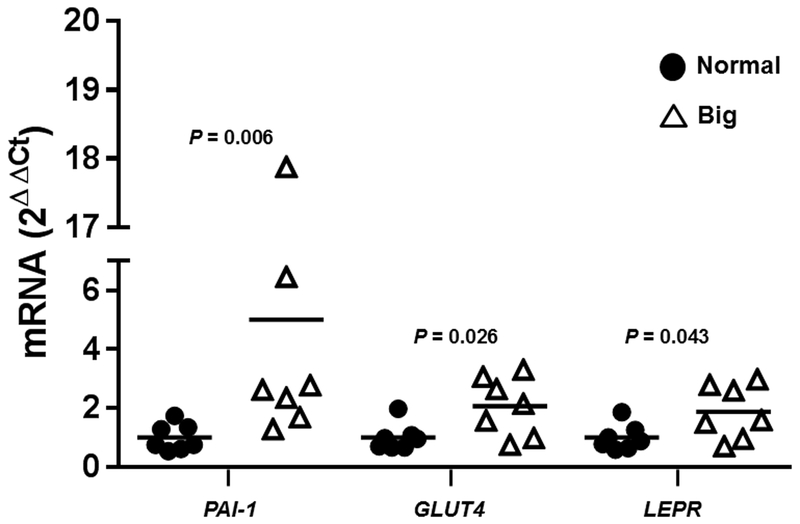
Elevated birth weight is linked to glucose intolerance and obesity health-related complications later in life. No studies have examined if infant birth weight is associated with gene expression markers of obesity and inflammation in a tissue that comes directly from the infant following birth. We evaluated the association between birth weight and gene expression on fetal programming of obesity. Foreskin samples were collected following circumcision, and gene expression analyzed comparing the 15% greatest birth weight infants (n=7) v. the remainder of the cohort (n=40). Multivariate linear regression models were fit to relate expression levels on differentially expressed genes to birth weight group with adjustment for variables selected from a list of maternal and infant characteristics. Glucose transporter type 4 (GLUT4), insulin receptor substrate 2 (IRS2), leptin receptor (LEPR), lipoprotein lipase (LPL), low-density lipoprotein receptor-related protein 1 (LRP1), matrix metalloproteinase 2 (MMP2), plasminogen activator inhibitor-1 (PAI-1) and transcription factor 7-like 2 (TCF7L2) were significantly upregulated and histone deacetylase 1 (HDAC1) and thioredoxin (TXN) downregulated in the larger birth weight neonates v.
Multivariate modeling revealed that the estimated adjusted birth weight group difference exceeded one standard deviation of the expression level for eight of the 10 genes. Between 25 and 50% of variation in expression level was explained by multivariate modeling for eight of the 10 genes. Gene expression related to glycemic control, appetite/energy balance, obesity and inflammation were altered in tissue from babies with elevated birth weight, and these genes may provide important information regarding fetal programming in macrosomic babies.
出生体重升高与葡萄糖不耐受及日后生活中与肥胖相关的健康并发症有关。尚无研究探讨婴儿出生体重是否与出生后直接取自婴儿的组织中肥胖和炎症的基因表达标志物相关。我们评估了出生体重与肥胖胎儿编程基因表达之间的关联。包皮环切术后收集包皮样本,比较出生体重最高的15%婴儿(n = 7)与队列其余部分(n = 40)的基因表达情况。采用多变量线性回归模型,将差异表达基因的表达水平与出生体重组相关联,并对从母婴特征列表中选择的变量进行调整。与对照组相比,出生体重较大的新生儿中,4型葡萄糖转运蛋白(GLUT4)、胰岛素受体底物2(IRS2)、瘦素受体(LEPR)、脂蛋白脂肪酶(LPL)、低密度脂蛋白受体相关蛋白1(LRP1)、基质金属蛋白酶2(MMP2)、纤溶酶原激活物抑制剂-1(PAI-1)和转录因子7样2(TCF7L2)显著上调,组蛋白去乙酰化酶1(HDAC1)和硫氧还蛋白(TXN)下调。
多变量建模显示,10个基因中有8个基因的估计调整后出生体重组差异超过表达水平的一个标准差。10个基因中有8个基因的表达水平变化的25%至50%可由多变量建模解释。出生体重升高的婴儿组织中与血糖控制、食欲/能量平衡、肥胖和炎症相关的基因表达发生改变,这些基因可能为巨大儿的胎儿编程提供重要信息。