Abe Hiroshi, Miki Koichi, Kobayashi Hiromasa, Ogata Toshiyasu, Iwaasa Mitsutoshi, Matsushima Toshio, Inoue Tooru
Department of Neurosurgery, Faculty of Medicine, Fukuoka University.
Department of Neurology, Faculty of Medicine, Fukuoka University.
Neurol Med Chir (Tokyo). 2017 Jun 15;57(6):284-291. doi: 10.2176/nmc.oa.2016-0319. Epub 2017 May 9.
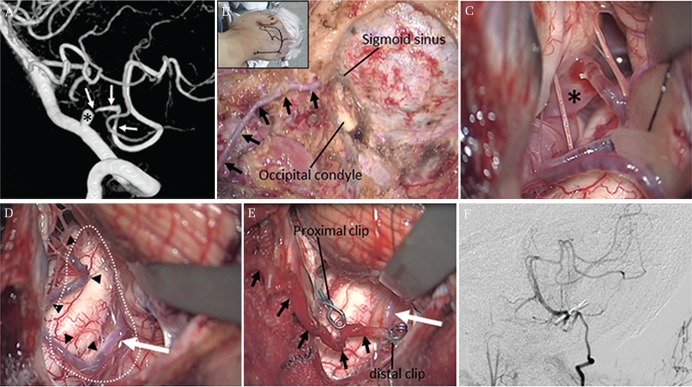
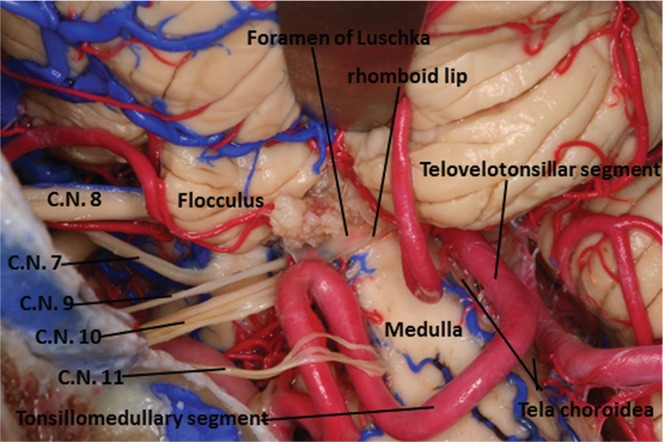
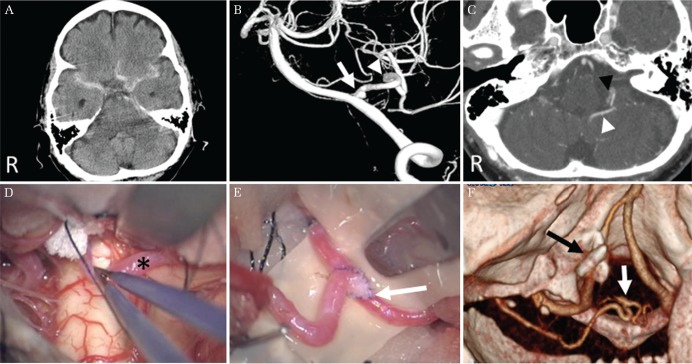
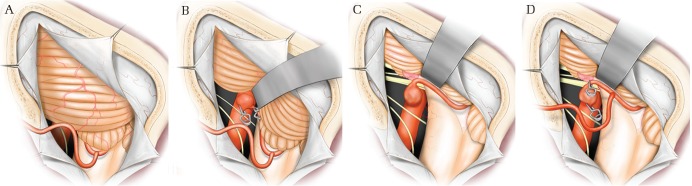
Occipital artery (OA) to the posterior inferior cerebellar artery (PICA) bypass is indispensable for the management of complex aneurysms of the PICA that cannot be reconstructed with surgical clipping or coil embolization. Although OA-PICA bypass is a comparatively standard procedure, the bypass is difficult to perform in some cases because of the location and situation of the PICA. We describe the usefulness of the unilateral trans-cerebellomedullary fissure (CMF) approach for OA-PICA bypass. Thirty patients with aneurysms in the vertebral artery (VA) or PICA were treated using OA-PICA bypasses between 2010 and 2015. Among them, the unilateral trans-CMF approach was used for OA-PICA anastomosis in 13 patients. The surgical procedures performed on and the medical records of all the patients were retrospectively reviewed. The unilateral trans-CMF approach was performed for two reasons depending on the PICA location or situation: either because the caudal loop could not be used as a recipient artery because of arterial dissection (3 patients) or because the tonsillo-medullary segment that was located in the upper part of the CMF did not have a caudal loop that was large enough (10 patients). The trans-CMF approach provided a good operative field for the OA-PICA bypass and the anastomosis were successfully performed in all patients. When the recipient artery was located in the upper part of the CMF, the unilateral trans-cerebello-medullary fissure approach provided a sufficient operative field for OA-PICA anastomosis.
枕动脉(OA)至小脑后下动脉(PICA)搭桥术对于无法通过手术夹闭或弹簧圈栓塞重建的PICA复杂动脉瘤的治疗不可或缺。尽管OA-PICA搭桥术是一种相对标准的手术,但由于PICA的位置和情况,在某些情况下该搭桥术难以实施。我们描述了单侧经小脑延髓裂(CMF)入路在OA-PICA搭桥术中的实用性。2010年至2015年间,30例椎动脉(VA)或PICA动脉瘤患者接受了OA-PICA搭桥术。其中,13例患者采用单侧经CMF入路进行OA-PICA吻合。对所有患者的手术操作和病历进行了回顾性分析。根据PICA的位置或情况,采用单侧经CMF入路有两个原因:一是由于动脉夹层,尾袢不能用作受体动脉(3例患者);二是位于CMF上部的扁桃体延髓段没有足够大的尾袢(10例患者)。经CMF入路为OA-PICA搭桥术提供了良好的手术视野,所有患者均成功完成了吻合。当受体动脉位于CMF上部时,单侧经小脑延髓裂入路为OA-PICA吻合提供了足够的手术视野。