Rafferty Ellen R S, Gagnon Heather L, Farag Marwa, Waldner Cheryl L
School of Public Health, University of Saskatchewan, Saskatoon, SK S7N 5A2 Canada.
Alberta Health Services, Calgary, AB T2N 2T9 Canada.
Cost Eff Resour Alloc. 2017 May 5;15:7. doi: 10.1186/s12962-017-0069-4. eCollection 2017.
This study aims to summarise and describe the evolution of published economic evaluations of vaccines in Canada, thereby outlining the current state of this expanding and meaningful research.
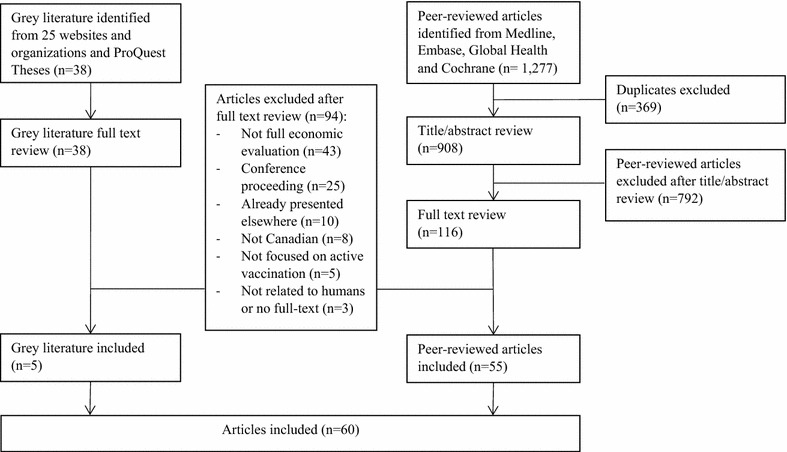
Using Arksey and O'Malley's scoping review framework we assembled relevant research from both academic and grey literature. Following abstract and full-text review we identified 60 articles to be included in the final analysis.
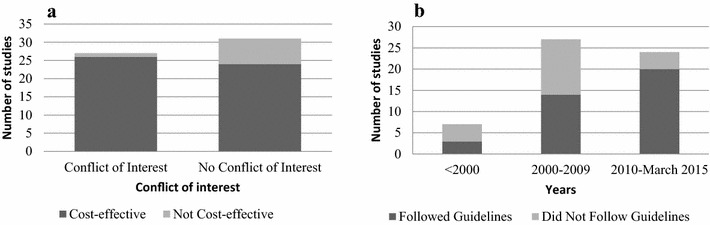
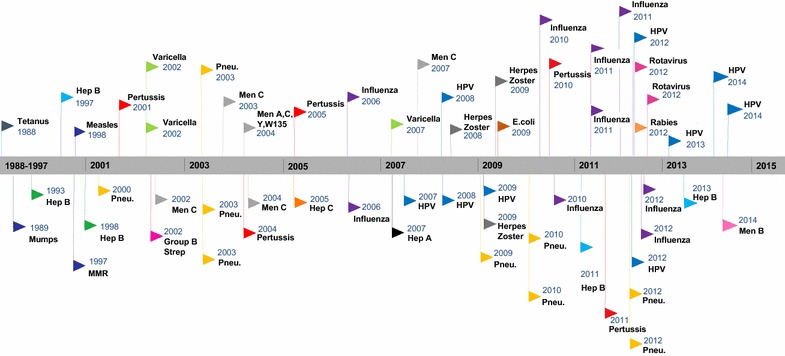
We found that since 1988 there has been a steady increase in the number of economic evaluations on vaccines in Canada. Many of these studies focus on the more recently licensed vaccines, such as influenza (16.7%), human papillomavirus (15.0%) and pneumococcal disease (15.0%). Since 2010 economic evaluations of vaccines have shown increased adherence to economic evaluation guidelines (OR = 4.6, CI 1.33, 18.7), suggesting there has been improvement in the consistency and transparency of these studies. However, there remains room for improvement, for instance, we found evidence that studies who stated a conflict of interest are more likely to assert the vaccine of interest was cost-effective (OR = 7.4; CI 1.04, 17.8). Furthermore, most reports use static models that do not consider herd immunity, and only a few evaluate vaccines post-implementation (ex-post) and traveller's vaccinations.
Researchers should examine identified research gaps and continue to improve standardization and transparency when reporting to ensure economic evaluations of vaccines best meet the needs of policy-makers, other researchers and the public.
本研究旨在总结和描述加拿大已发表的疫苗经济学评估的演变情况,从而概述这一不断扩展且有意义的研究的现状。
我们使用阿克西和奥马利的范围综述框架,从学术文献和灰色文献中收集相关研究。经过摘要和全文审查,我们确定了60篇文章纳入最终分析。
我们发现,自1988年以来,加拿大疫苗经济学评估的数量稳步增加。这些研究中有许多聚焦于最近获批的疫苗,如流感疫苗(16.7%)、人乳头瘤病毒疫苗(15.0%)和肺炎球菌疾病疫苗(15.0%)。自2010年以来,疫苗经济学评估对经济学评估指南的遵循度有所提高(比值比=4.6,可信区间1.33,18.7),这表明这些研究在一致性和透明度方面有所改善。然而,仍有改进空间,例如,我们发现有证据表明,声明存在利益冲突的研究更有可能断言所关注的疫苗具有成本效益(比值比=7.4;可信区间1.04,17.8)。此外,大多数报告使用的是不考虑群体免疫的静态模型,只有少数评估了疫苗实施后(事后)情况和旅行者疫苗接种情况。
研究人员应审视已确定的研究空白,并在报告时继续提高标准化和透明度,以确保疫苗经济学评估能最好地满足政策制定者、其他研究人员和公众的需求。