Cleven Arjen H G, Suijker Johnny, Agrogiannis Georgios, Briaire-de Bruijn Inge H, Frizzell Norma, Hoekstra Attje S, Wijers-Koster Pauline M, Cleton-Jansen Anne-Marie, Bovée Judith V M G
Department of Pathology, Leiden University Medical Center, L1-Q, P.O. Box 9600, 2300 RC Leiden, The Netherlands.
1st Department of Pathology, Laikon General Hospital, Athens University School of Medicine, Athens, Greece.
Clin Sarcoma Res. 2017 May 4;7:8. doi: 10.1186/s13569-017-0074-6. eCollection 2017.
Mutations in ( or - are found in ~50% of conventional central chondrosarcomas and in up to 87% of their assumed benign precursors enchondromas. The mutant enzyme acquires the activity to convert α-ketoglutarate into the oncometabolite d-2-hydroxyglutarate (d-2-HG), which competitively inhibits α-ketoglutarate dependent enzymes such as histone- and DNA demethylases.
We therefore evaluated the effect of or - mutations on histone modifications (H3K4me3, H3K9me3 and H3K27me3), chromatin remodeler ATRX expression, DNA modifications (5-hmC and 5-mC), and TET1 subcellular localization in a genotyped cohort (, succinate dehydrogenase () and fumarate hydratase ()) of enchondromas and central chondrosarcomas (n = 101) using immunohistochemistry.
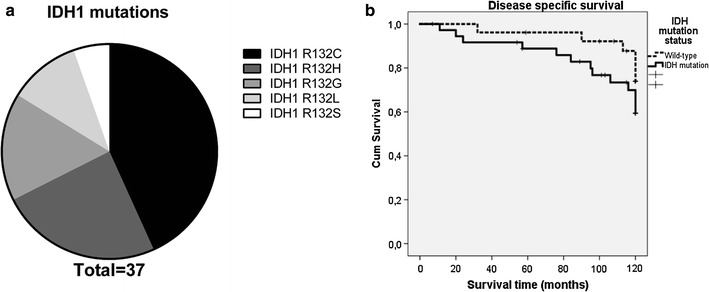
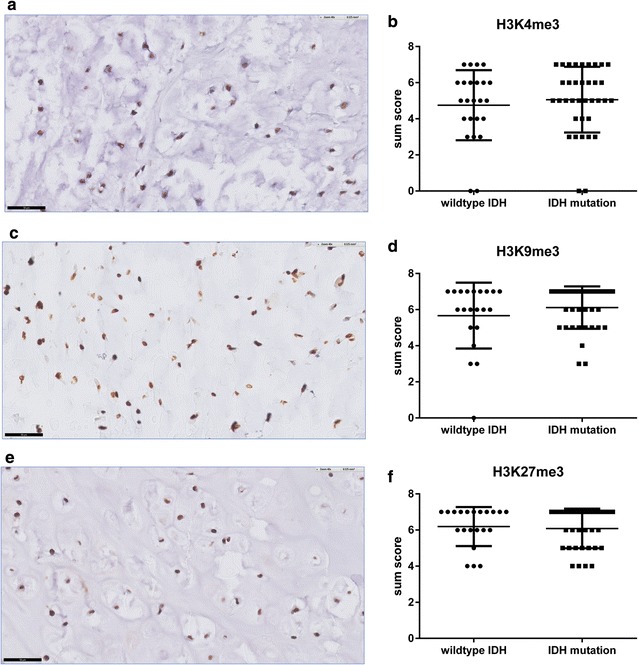
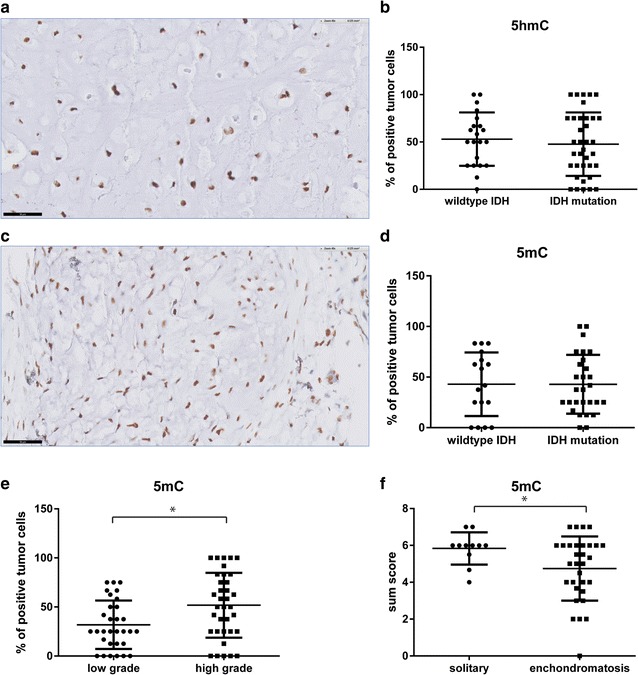
or - mutations were found in 60.8% of the central cartilaginous tumours, while mutations in and were absent. The mutation status did not correlate with outcome. Chondrosarcomas are strongly positive for the histone modifications H3K4me3, H3K9me3 and H3K27me3, which was independent of the or - mutation status. Two out of 36 chondrosarcomas (5.6%) show complete loss of ATRX. Levels of 5-hmC and 5-mC are highly variable in central cartilaginous tumours and are not associated with mutation status. In tumours with loss of 5-hmC, expression of TET1 was more prominent in the cytoplasm than the nucleus (p = 0.0001).
In summary, in central chondrosarcoma or - mutations do not affect immunohistochemical levels of 5-hmC, 5mC, trimethylation of H3K4, -K9 and K27 and outcome, as compared to wildtype.
在约50%的传统中央型软骨肉瘤以及高达87%的其假定的良性前体内生软骨瘤中发现了(或)突变。突变酶获得了将α - 酮戊二酸转化为肿瘤代谢物d - 2 - 羟基戊二酸(d - 2 - HG)的活性,d - 2 - HG竞争性抑制α - 酮戊二酸依赖性酶,如组蛋白和DNA去甲基化酶。
因此,我们使用免疫组织化学方法,在一个包含内生软骨瘤和中央型软骨肉瘤(n = 101)的基因分型队列(琥珀酸脱氢酶()和富马酸水合酶())中,评估了(或)突变对组蛋白修饰(H3K4me3、H3K9me3和H3K27me3)、染色质重塑因子ATRX表达、DNA修饰(5 - hmC和5 - mC)以及TET1亚细胞定位的影响。
在60.8%的中央软骨肿瘤中发现了(或)突变,而未发现和突变。突变状态与预后无关。软骨肉瘤对组蛋白修饰H3K4me3、H3K9me3和H3K27me3呈强阳性,这与(或)突变状态无关。36例软骨肉瘤中有2例(5.6%)显示ATRX完全缺失。中央软骨肿瘤中5 - hmC和5 - mC水平高度可变,且与突变状态无关。在5 - hmC缺失的肿瘤中,TET1在细胞质中的表达比在细胞核中更突出(p = 0.0001)。
总之,与野生型相比,在中央型软骨肉瘤中,(或)突变不影响5 - hmC、5mC、H3K4、 - K9和K27的三甲基化的免疫组化水平以及预后。