Rocha Silma L, Evans Harry C, Jorge Vanessa L, Cardoso Lucimar A O, Pereira Fernanda S T, Rocha Fabiano B, Barreto Robert W, Hart Adam G, Elliot Simon L
Department of Entomology, Universidade Federal de Viçosa, Viçosa, 36570-900 Minas Gerais, Brazil.
Department of Phytopathology, Universidade Federal de Viçosa, Viçosa, 36570-900 Minas Gerais, Brazil.
R Soc Open Sci. 2017 Apr 5;4(4):160628. doi: 10.1098/rsos.160628. eCollection 2017 Apr.
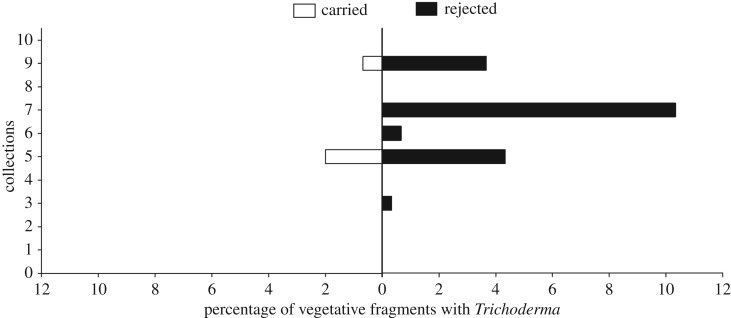
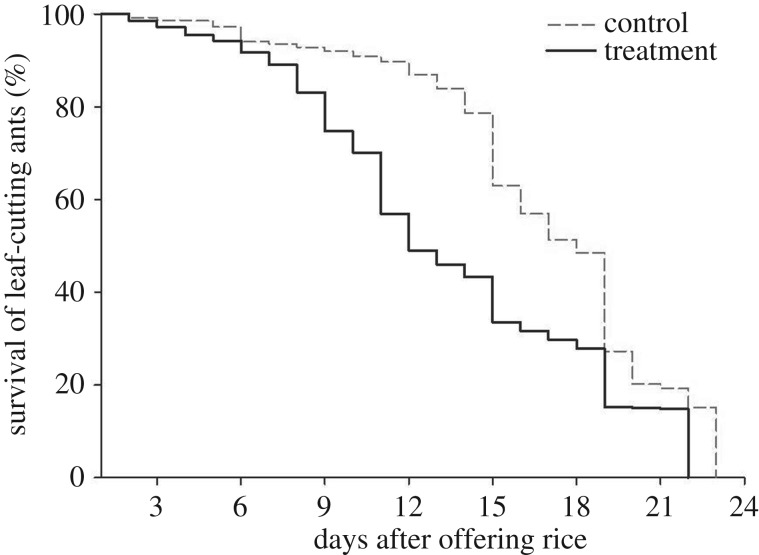
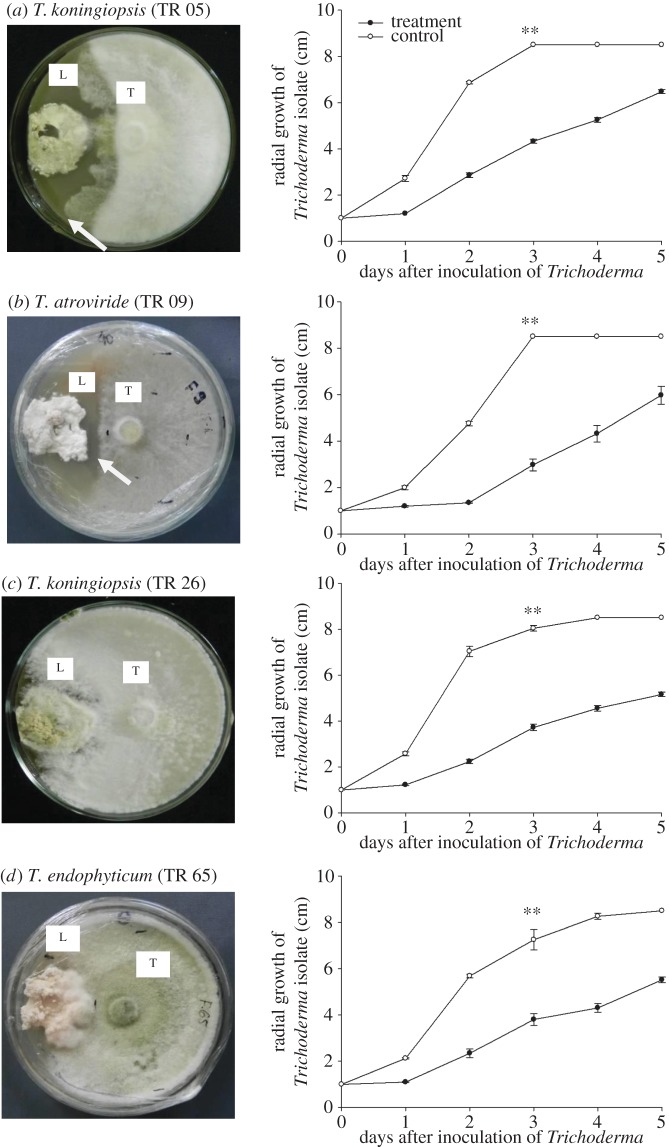
Interactions between leaf-cutting ants, their fungal symbiont () and the endophytic fungi within the vegetation they carry into their colonies are still poorly understood. If endophytes antagonistic to were found in plant material being carried by these ants, then this might indicate a potential mechanism for plants to defend themselves from leaf-cutter attack. In addition, it could offer possibilities for the management of these important Neotropical pests. Here, we show that, for , there was a significantly greater incidence of species in the vegetation removed from the nests-and deposited around the entrances-than in that being transported into the nests. In a no-choice test, infested rice was taken into the nest, with deleterious effects on both the fungal gardens and ant survival. The endophytic ability of selected strains of was also confirmed, following their inoculation and subsequent reisolation from seedlings of eucalyptus. These results indicate that endophytic fungi which pose a threat to ant fungal gardens through their antagonistic traits, such as , have the potential to act as bodyguards of their plant hosts and thus might be employed in a Trojan-horse strategy to mitigate the negative impact of leaf-cutting ants in both agriculture and silviculture in the Neotropics. We posit that the ants would detect and evict such 'malign' endophytes-artificially inoculated into vulnerable crops-during the quality-control process within the nest, and, moreover, that the foraging ants may then be deterred from further harvesting of '-enriched' plants.
切叶蚁、它们的真菌共生体( )以及它们带入蚁巢的植物体内的内生真菌之间的相互作用仍未得到充分了解。如果在这些蚂蚁搬运的植物材料中发现了对 具有拮抗作用的内生菌,那么这可能表明植物抵御切叶蚁攻击的一种潜在机制。此外,这也为管理这些重要的新热带害虫提供了可能性。在这里,我们表明,对于 来说,从蚁巢中移除并放置在入口周围的植被中 物种的发生率显著高于被运入蚁巢的植被。在一项无选择试验中,受侵染的水稻被带入蚁巢,对真菌菌圃和蚂蚁存活都产生了有害影响。从桉树幼苗接种并随后重新分离后,选定的 菌株的内生能力也得到了证实。这些结果表明,通过诸如 等拮抗特性对蚂蚁真菌菌圃构成威胁的内生真菌,有可能充当其植物宿主的保镖,因此可能被用于“特洛伊木马”策略,以减轻新热带地区农业和林业中切叶蚁的负面影响。我们认为,蚂蚁会在蚁巢内的质量控制过程中检测并驱逐人工接种到易受侵害作物中的此类“有害”内生菌,而且,觅食的蚂蚁随后可能会被阻止进一步采集“富含 ”的植物。