Fujita Misuzu, Sato Yasunori, Nagashima Kengo, Takahashi Sho, Hata Akira
Chiba University Graduate School of Medicine, Department of Public Health, Chiba City, Chiba, Japan.
Chiba University Graduate School of Medicine, Department of Global Clinical Research, Chiba City, Chiba, Japan.
PLoS One. 2017 May 9;12(5):e0177091. doi: 10.1371/journal.pone.0177091. eCollection 2017.
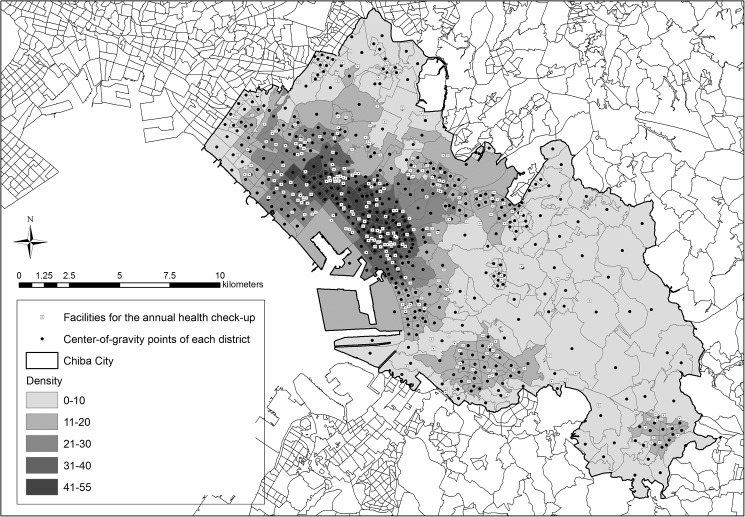
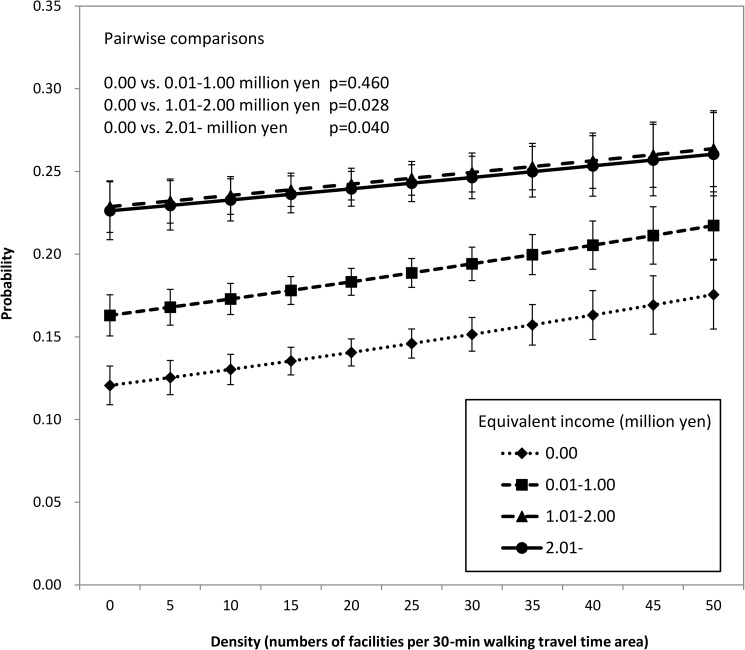
Although both geographic accessibility and socioeconomic status have been indicated as being important factors for the utilization of health care services, their combined effect has not been evaluated. The aim of this study was to reveal whether an income-dependent difference in the impact of geographic accessibility on the utilization of government-led annual health check-ups exists. Existing data collected and provided by Chiba City Hall were employed and analyzed as a retrospective cohort study. The subjects were 166,966 beneficiaries of National Health Insurance in Chiba City, Japan, aged 40 to 74 years. Of all subjects, 54,748 (32.8%) had an annual health check-up in fiscal year 2012. As an optimal index of geographic accessibility has not been established, five measures were calculated: travel time to the nearest health care facility, density of health care facilities (number facilities within a 30-min walking distance from the district of residence), and three indices based on the two-step floating catchment area method. Three-level logistic regression modeling with random intercepts for household and district of residence was performed. Of the five measures, density of health care facilities was the most compatible according to Akaike's information criterion. Both low density and low income were associated with decreased utilization of the health check-ups. Furthermore, a linear relationship was observed between the density of facilities and utilization of the health check-ups in all income groups and its slope was significantly steeper among subjects with an equivalent income of 0.00 yen than among those with equivalent income of 1.01-2.00 million yen (p = 0.028) or 2.01 million yen or more (p = 0.040). This result indicated that subjects with lower incomes were more susceptible to the effects of geographic accessibility than were those with higher incomes. Thus, better geographic accessibility could increase the health check-up utilization and also decrease the income-related disparity of utilization.
尽管地理可达性和社会经济地位都被认为是影响医疗保健服务利用的重要因素,但其综合影响尚未得到评估。本研究的目的是揭示地理可达性对政府主导的年度健康检查利用的影响是否存在收入依赖性差异。采用千叶市政府收集和提供的现有数据,作为回顾性队列研究进行分析。研究对象为日本千叶市166,966名40至74岁的国民健康保险受益人。在所有研究对象中,54,748人(32.8%)在2012财年进行了年度健康检查。由于尚未确定地理可达性的最佳指标,计算了五项指标:到最近医疗保健机构的出行时间、医疗保健机构密度(从居住地区步行30分钟范围内的机构数量),以及基于两步浮动集水区法的三项指标。采用对家庭和居住地区进行随机截距的三级逻辑回归模型。根据赤池信息准则,五项指标中医疗保健机构密度最为合适。低密度和低收入都与健康检查利用率降低有关。此外,在所有收入组中,均观察到机构密度与健康检查利用率之间存在线性关系,且收入相当于0.00日元的人群中该关系的斜率明显比收入相当于101-200万日元(p = 0.028)或201万日元及以上(p = 0.040)的人群更陡。这一结果表明,低收入人群比高收入人群更容易受到地理可达性的影响。因此,更好的地理可达性可以提高健康检查利用率,也可以减少与收入相关的利用率差异。