Department of Community Health, Faculty of Medicine, Universiti Kebangsaan Malaysia, Kuala Lumpur 56000, Malaysia.
Clinical Research Center, Sultanah Bahiyah Hospital, Alor Setar 05400, Malaysia.
Int J Environ Res Public Health. 2021 Oct 6;18(19):10486. doi: 10.3390/ijerph181910486.
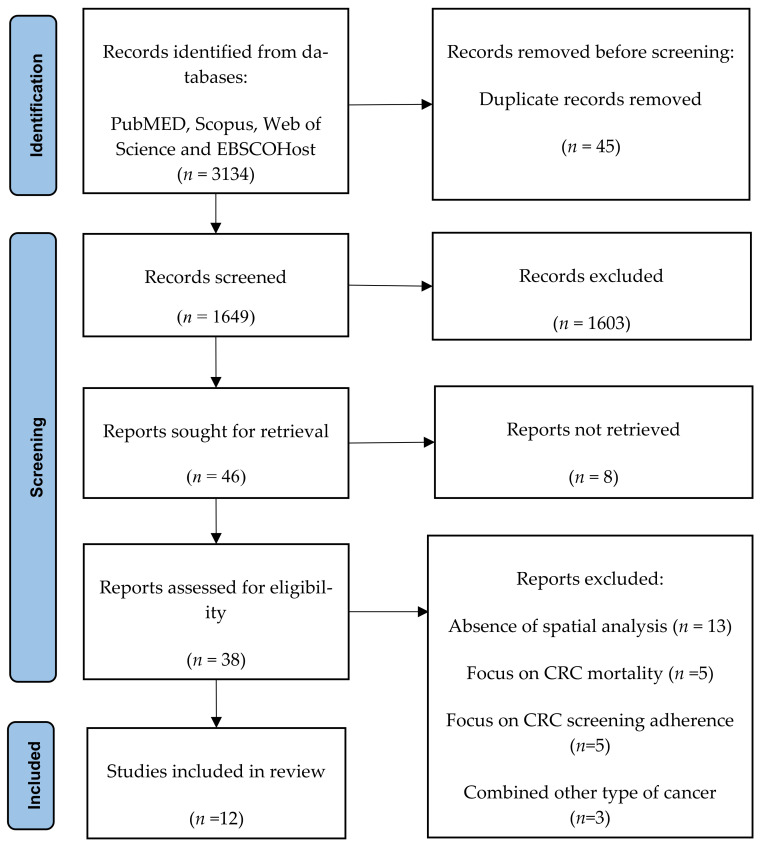
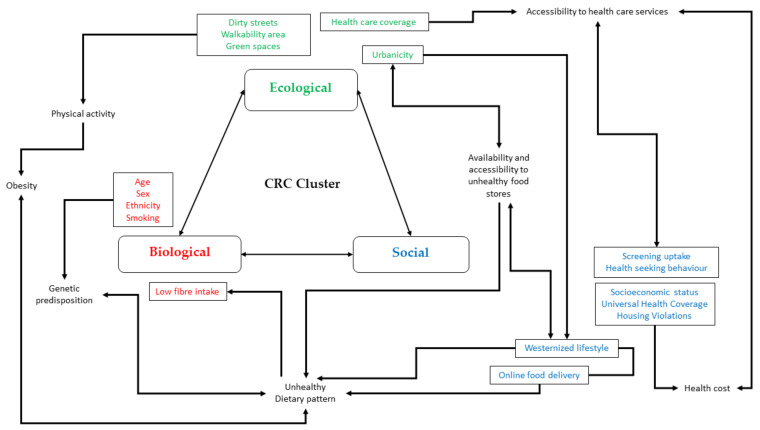
The increasing pattern of colorectal cancer (CRC) in specific geographic region, compounded by interaction of multifactorial determinants, showed the tendency to cluster. The review aimed to identify and synthesize available evidence on clustering patterns of CRC incidence, specifically related to the associated determinants. Articles were systematically searched from four databases, Scopus, Web of Science, PubMed, and EBSCOHost. The approach for identification of the final articles follows PRISMA guidelines. Selected full-text articles were published between 2016 and 2021 of English language and spatial studies focusing on CRC cluster identification. Articles of systematic reviews, conference proceedings, book chapters, and reports were excluded. Of the final 12 articles, data on the spatial statistics used and associated factors were extracted. Identified factors linked with CRC cluster were further classified into ecology (health care accessibility, urbanicity, dirty streets, tree coverage), biology (age, sex, ethnicity, overweight and obesity, daily consumption of milk and fruit), and social determinants (median income level, smoking status, health cost, employment status, housing violations, and domestic violence). Future spatial studies that incorporate physical environment related to CRC cluster and the potential interaction between the ecology, biology and social determinants are warranted to provide more insights to the complex mechanism of CRC cluster pattern.
特定地理区域结直肠癌(CRC)发病率不断上升,加上多种因素的相互作用,表现出聚集的趋势。本综述旨在确定和综合现有关于 CRC 发病率聚集模式的证据,特别是与相关决定因素有关的证据。文章从 Scopus、Web of Science、PubMed 和 EBSCOHost 四个数据库中系统地进行了搜索。最终文章的确定方法遵循 PRISMA 指南。选定的全文文章发表于 2016 年至 2021 年,为英文语言和关注 CRC 集群识别的空间研究。排除了系统评价文章、会议记录、书籍章节和报告。在最终的 12 篇文章中,提取了有关所使用的空间统计数据和相关因素的数据。确定与 CRC 集群相关的因素进一步分为生态学(医疗保健可及性、城市化、肮脏的街道、树木覆盖率)、生物学(年龄、性别、种族、超重和肥胖、牛奶和水果的日常消耗)和社会决定因素(中位收入水平、吸烟状况、健康费用、就业状况、住房违规和家庭暴力)。未来的空间研究需要纳入与 CRC 集群相关的物理环境,并研究生态学、生物学和社会决定因素之间的潜在相互作用,以更深入地了解 CRC 集群模式的复杂机制。