Lopes Dos Santos Santiago Guido, Brusselle Guy, Dauwe Kenny, Deschaght Pieter, Verhofstede Chris, Vaneechoutte Dries, Deschepper Ellen, Jordens Paul, Joos Guy, Vaneechoutte Mario
Laboratory Bacteriology Research, Department Clinical Chemistry, Microbiology & Immunology, Faculty of Medicine & Health Sciences, University of Ghent, Ghent, Belgium.
Department of Respiratory Medicine, Ghent University Hospital, Ghent, Belgium.
BMC Microbiol. 2017 May 10;17(1):109. doi: 10.1186/s12866-017-1022-6.
This study of the oropharyngeal microbiome complements the previously published AZIthromycin in Severe ASThma (AZISAST) clinical trial, where the use of azithromycin was assessed in subjects with exacerbation-prone severe asthma. Here, we determined the composition of the oropharyngeal microbial community by means of deep sequencing of the amplified 16S rRNA gene in oropharyngeal swabs from patients with exacerbation-prone severe asthma, at baseline and during and after 6 months treatment with azithromycin or placebo.
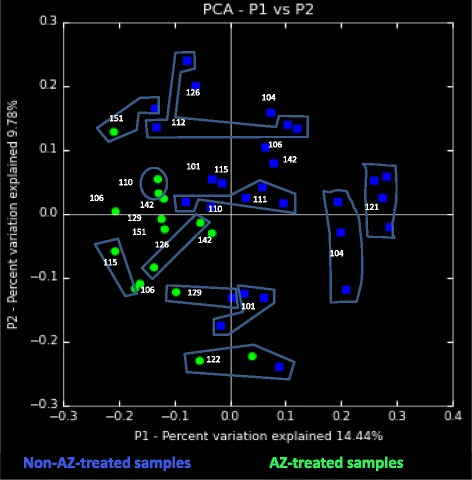
A total of 1429 OTUs were observed, of which only 59 were represented by more than 0.02% of the reads. Firmicutes, Bacteroidetes, Fusobacteria, Proteobacteria and Actinobacteria were the most abundant phyla and Streptococcus and Prevotella were the most abundant genera in all the samples. Thirteen species only accounted for two thirds of the reads and two species only, i.e. Prevotella melaninogenica and Streptococcus mitis/pneumoniae, accounted for one fourth of the reads. We found that the overall composition of the oropharyngeal microbiome in patients with severe asthma is comparable to that of the healthy population, confirming the results of previous studies. Long term treatment (6 months) with azithromycin increased the species Streptococcus salivarius approximately 5-fold and decreased the species Leptotrichia wadei approximately 5-fold. This was confirmed by Boruta feature selection, which also indicated a significant decrease of L. buccalis/L. hofstadtii and of Fusobacterium nucleatum. Four of the 8 treated patients regained their initial microbial composition within one month after cessation of treatment.
Despite large diversity of the oropharyngeal microbiome, only a few species predominate. We confirm the absence of significant differences between the oropharyngeal microbiomes of people with and without severe asthma. Possibly, long term azithromycin treatment may have long term effects on the composition of the oropharygeal microbiome in half of the patients.
本项关于口咽微生物群的研究是对先前发表的重度哮喘阿奇霉素治疗研究(AZISAST)临床试验的补充,该试验评估了阿奇霉素在易加重的重度哮喘患者中的应用。在此,我们通过对易加重的重度哮喘患者口咽拭子中扩增的16S rRNA基因进行深度测序,确定了基线时、阿奇霉素或安慰剂治疗6个月期间及之后口咽微生物群落的组成。
共观察到1429个操作分类单元(OTU),其中只有59个的读数占比超过0.02%。厚壁菌门、拟杆菌门、梭杆菌门、变形菌门和放线菌门是所有样本中最丰富的菌门,链球菌属和普雷沃菌属是最丰富的菌属。13个物种仅占读数的三分之二,只有两个物种,即产黑色素普雷沃菌和缓症链球菌/肺炎链球菌,占读数的四分之一。我们发现重度哮喘患者口咽微生物群的总体组成与健康人群相当,证实了先前研究的结果。阿奇霉素长期治疗(6个月)使唾液链球菌的数量增加了约5倍,使沃氏纤毛菌的数量减少了约5倍。这一点通过Boruta特征选择得到了证实,该选择还表明颊纤毛菌/霍氏纤毛菌和具核梭杆菌显著减少。8名接受治疗的患者中有4名在停止治疗后1个月内恢复了其初始微生物组成。
尽管口咽微生物群具有很大的多样性,但只有少数物种占主导地位。我们证实,有和没有重度哮喘的人群的口咽微生物群之间没有显著差异。长期使用阿奇霉素治疗可能会对一半患者的口咽微生物群组成产生长期影响。