Shen Na, Peng Jing, Wang Xiong, Zhu Yaowu, Liu Weiyong, Liu Aiguo, Lu Yanjun
Department of Laboratory Medicine, Tongji Hospital, Tongji Medical College, Huazhong University of Science and Technology, Wuhan 430030, China.
Department of Otorhinolaryngology, Tongji Hospital, Tongji Medical College, Huazhong University of Science and Technology, Wuhan 430030, China.
Oncotarget. 2017 Jul 11;8(28):46681-46690. doi: 10.18632/oncotarget.17325.
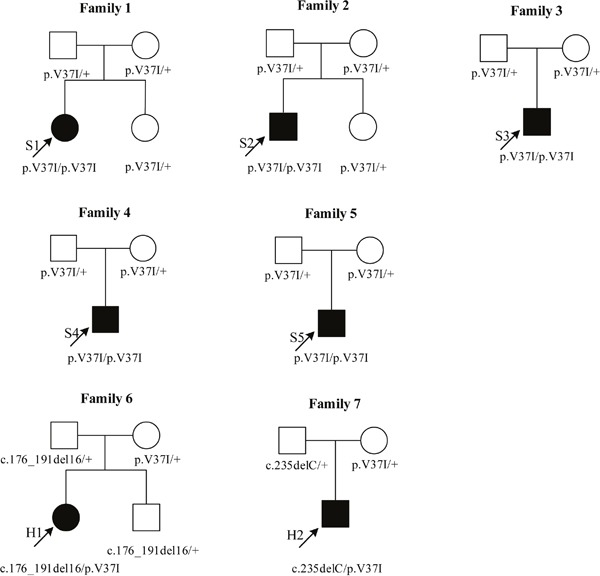
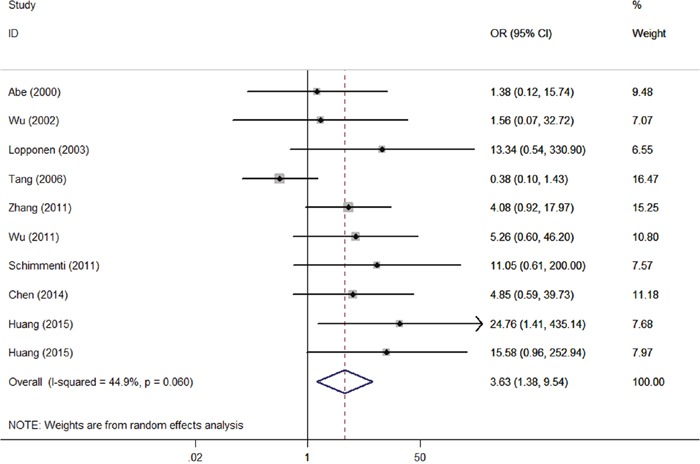
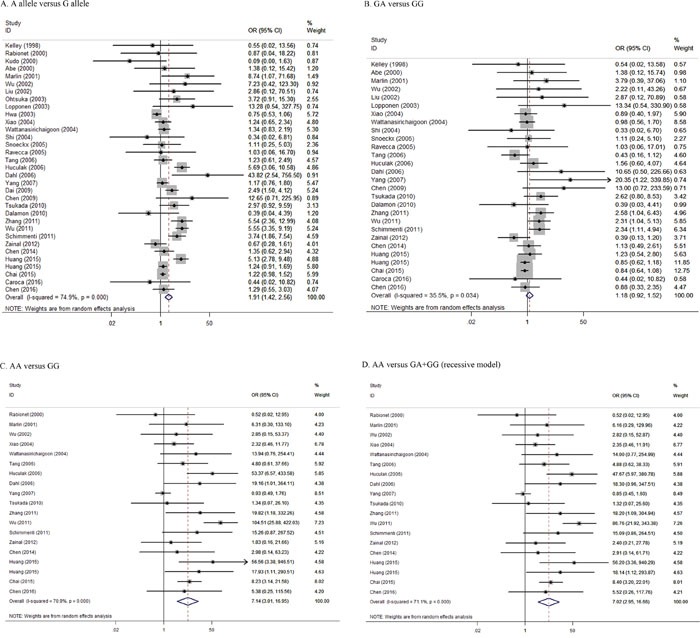
Pathogenic variants in the gap junction protein beta-2 (GJB2) gene are the most common cause of hearing loss. Of these, the p.V37I variant of GJB2 has a high allele frequency (up to 10%) in East Asians. Characterization of the phenotypic spectrum associated with p.V37I, as well as the role of this variant in the onset of hearing loss could have a remarkable effect on future diagnostic strategies. Here, we performed a pedigree analysis of unrelated families exhibiting various hearing phenotypes, and then conducted a meta-analysis to comprehensively assess the association between the p.V37I and the risk of hearing loss. Pedigree analyses showed that both homozygous p.V37I variants, as well as compound heterozygous p.V37I with other GJB2 pathogenic variants, contributed to various phenotypes of hearing loss. Meanwhile, meta-analysis demonstrated that, compared with those in the wild type group, both p.V37I homozygotes and compound heterozygous p.V37I variants were at significantly higher risk of developing hearing loss (odds ratios = 7.14 and 3.63; 95% confidence intervals = 3.01-16.95 and 1.38-9.54, respectively). Conversely, heterozygous p.V37I variants alone did not increase the risk of hearing loss. Given the high allele carriage rate of p.V37I (up to 10%) within the general population, our work not only provides information that might influence future genetic screening policies, but also offers insight into clinical risk evaluation and genetic counseling regarding hearing loss.
缝隙连接蛋白β-2(GJB2)基因中的致病变异是听力损失最常见的原因。其中,GJB2基因的p.V37I变异在东亚人群中具有较高的等位基因频率(高达10%)。对与p.V37I相关的表型谱进行表征,以及该变异在听力损失发病中的作用,可能会对未来的诊断策略产生显著影响。在此,我们对表现出各种听力表型的无关家族进行了系谱分析,然后进行荟萃分析,以全面评估p.V37I与听力损失风险之间的关联。系谱分析表明,纯合p.V37I变异以及p.V37I与其他GJB2致病变异的复合杂合变异,均导致了各种听力损失表型。同时,荟萃分析表明,与野生型组相比,p.V37I纯合子和p.V37I复合杂合变异发生听力损失的风险均显著更高(优势比分别为7.14和3.63;95%置信区间分别为3.01-16.95和1.38-9.54)。相反,单独的杂合p.V37I变异不会增加听力损失风险。鉴于p.V37I在普通人群中的高等位基因携带率(高达10%),我们的工作不仅提供了可能影响未来基因筛查政策的信息,还为听力损失的临床风险评估和遗传咨询提供了见解。