He Chuan, Chen Yongcan, Yang Kaixuan, Zhai Zhengxiao, Zhao Wenjing, Liu Shuyun, Ding Jinmei, Dai Ronghua, Yang Lingyu, Xu Ke, Zhou Zhenxiang, Gu Caiju, Huang Qizhong, Meng He
Department of Animal Science, School of Agriculture and Biology, Shanghai Jiao Tong University; Shanghai Key Laboratory of Veterinary Biotechnology, Shanghai, China.
Animal Husbandry and Veterinary Research Institute, Shanghai Academy of Agricultural Science, Shanghai, China.
PLoS One. 2017 May 10;12(5):e0176113. doi: 10.1371/journal.pone.0176113. eCollection 2017.
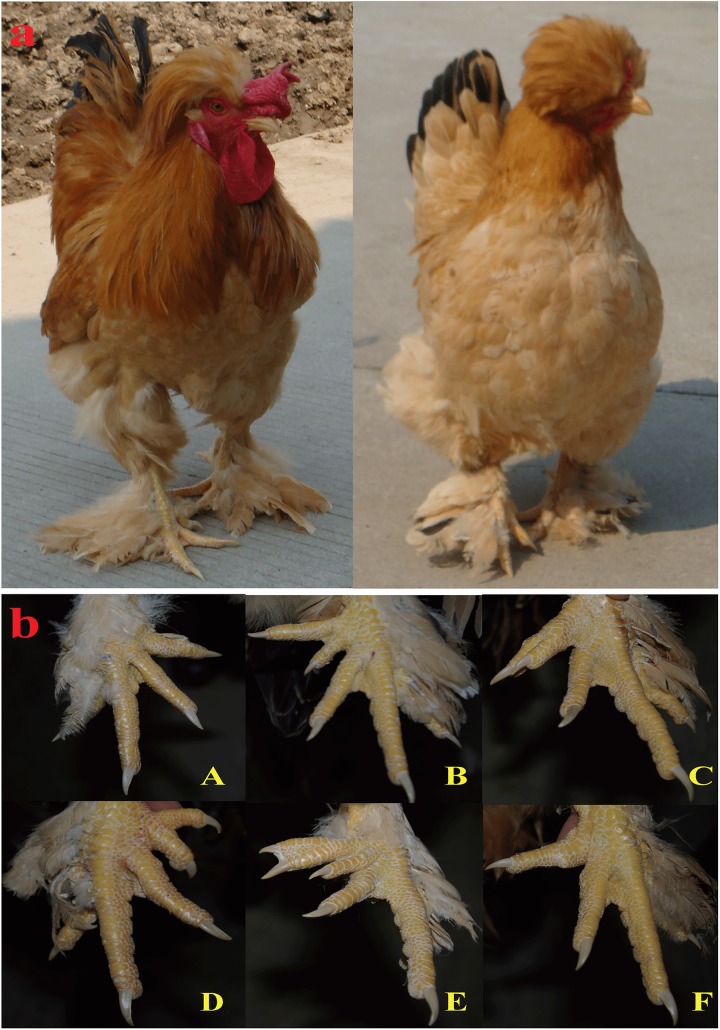
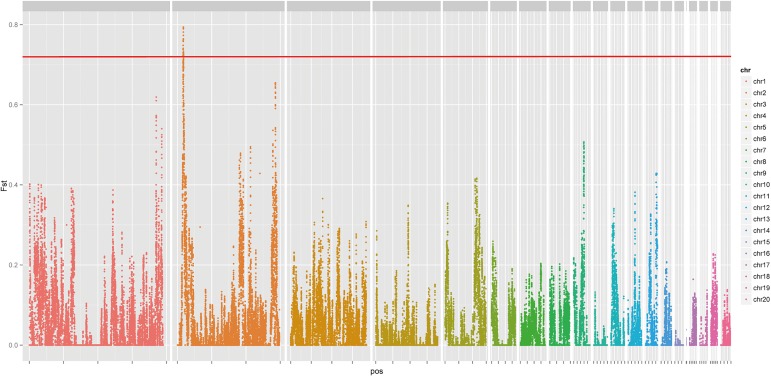
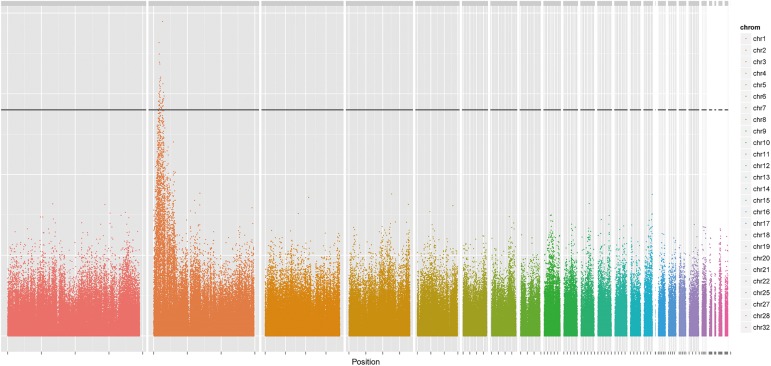
Polydactyly, a common heritable limb malformation in vertebrates, is characterized by supernumerary digits. In chickens, basic characteristics and rough dominant genes have been explored in past decades; however, the elaborate pattern of inheritance and the determinant gene remain obscure. In this study, different types of polydactylism were classified by the numbers and the shapes of toes, including the newly defined subtypes of B' and G, for the Beijing fatty chicken, a native breed of chicken from China. Through experiments on hybridization, we demonstrated a complete dominant inheritance of polydactyly instead of an incomplete penetrance or genetic modification of the previous conjecture. In particular, by using the F2 population of the five-digit purebred line of Beijing fatty chicken backcrossed to Shiqiza chicken and by using restriction-site associated DNA based markers, we performed a genome-wide association study on the trait of polydactyly. Furthermore, whole genome resequencing strategy was applied to sweep SNPs across the whole genome. An outlier-based Fst approach was employed to search for signatures of selection, and results indicated that the determinant mutation was found in the region ranging from 8.3 Mb to 8.7 Mb, where the polydactyly candidate gene LMBR1 was located. The G/T mutation of rs80659072 was identified to be highly associated with polydactyly in our resequencing and was validated in random samples from an expanded population. Thus, we confirmed that LMBR1 was the causative gene of polydactyly in the Beijing fatty chicken by using GWAS with restriction-site associated DNA based markers and resequencing.
多指畸形是脊椎动物中一种常见的可遗传肢体畸形,其特征是出现多余的指(趾)。在过去几十年里,人们已经对鸡的基本特征和大致的显性基因进行了探索;然而,其详细的遗传模式和决定性基因仍不清楚。在本研究中,根据趾的数量和形状对北京油鸡(一种中国本土鸡种)的不同类型多指畸形进行了分类,包括新定义的B'和G亚型。通过杂交实验,我们证明了多指畸形是完全显性遗传,而非之前推测的不完全显性或基因修饰。具体而言,利用北京油鸡五趾纯系与石岐杂鸡回交的F2群体,并使用基于限制性位点相关DNA的标记,我们对多指畸形性状进行了全基因组关联研究。此外,应用全基因组重测序策略在全基因组范围内扫描单核苷酸多态性(SNP)。采用基于离群值的Fst方法寻找选择信号,结果表明决定性突变位于8.3 Mb至8.7 Mb区域,该区域是多指畸形候选基因LMBR1的所在位置。在我们的重测序中,rs80659072的G/T突变被确定与多指畸形高度相关,并在来自扩大群体的随机样本中得到验证。因此,我们通过使用基于限制性位点相关DNA的标记进行全基因组关联研究和重测序,证实了LMBR1是北京油鸡多指畸形的致病基因。