
一种用于将药物递送至表达叶酸受体的病理细胞细胞核的新型模块化纳米转运体的研发与评估。
Development and evaluation of a new modular nanotransporter for drug delivery into nuclei of pathological cells expressing folate receptors.
作者信息
Slastnikova Tatiana A, Rosenkranz Andrey A, Khramtsov Yuri V, Karyagina Tatiana S, Ovechko Sergey A, Sobolev Alexander S
机构信息
Laboratory of Molecular Genetics of Intracellular Transport, Institute of Gene Biology, Russian Academy of Sciences.
Department of Biophysics, Faculty of Biology, Lomonosov Moscow State University, Moscow, Russia.
出版信息
Drug Des Devel Ther. 2017 Apr 26;11:1315-1334. doi: 10.2147/DDDT.S127270. eCollection 2017.
PURPOSE
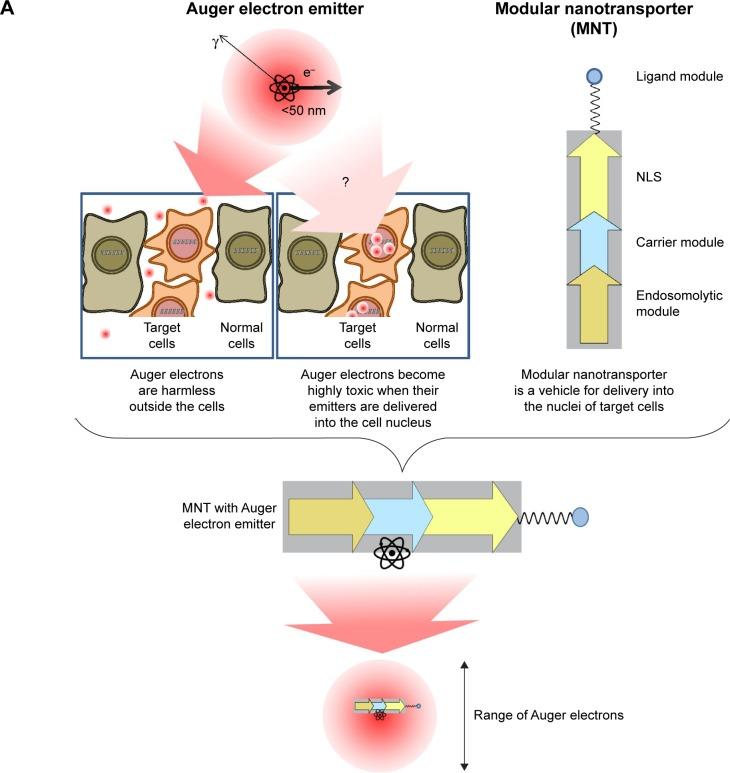
Modular nanotransporters (MNTs) are artificial multifunctional systems designed to facilitate receptor-specific transport from the cell surface into the cell nucleus through inclusion of polypeptide domains for accomplishing receptor binding and internalization, as well as sequential endosomal escape and nuclear translocation. The objective of this study was to develop a new MNT targeted at folate receptors (FRs) for precise delivery of therapeutic cargo to the nuclei of FR-positive cells and to evaluate its potential, particularly for delivery of therapeutic agents (eg, the Auger electron emitter In) into the nuclei of target cancer cells.
METHODS
A FR-targeted MNT was developed by site-specific derivatization of ligand-free MNT with maleimide-polyethylene glycol-folic acid. The ability of FR-targeted MNT to accumulate in target FR-expressing cells was evaluated using flow cytometry, and intracellular localization of this MNT was assessed using confocal laser scanning microscopy of cells. The cytotoxicity of the In-labeled FR-targeted MNT was evaluated on HeLa and U87MG cancer cell lines expressing FR. In vivo micro-single-photon emission computed tomography/CT imaging and antitumor efficacy studies were performed with intratumoral injection of In-labeled FR-targeted MNT in HeLa xenograft-bearing mice.
RESULTS
The resulting FR-targeted MNT accumulated in FR-positive HeLa cancer cell lines specifically and demonstrated the ability to reach its target destination - the cell nuclei. In-labeled FR-targeted MNT demonstrated efficient and specific FR-positive cancer cell eradication. A HeLa xenograft in vivo model revealed prolonged retention of In delivered by FR-targeted MNT and significant tumor growth delay (up to 80% growth inhibition).
CONCLUSION
The FR-targeted MNT met expectations of its ability to deliver active cargo into the nuclei of target FR-positive cells efficiently and specifically. As a result of this finding the new FR-targeted MNT approach warrants broad evaluation.
目的
模块化纳米转运体(MNTs)是人工多功能系统,其设计目的是通过包含用于实现受体结合和内化以及连续的内体逃逸和核转位的多肽结构域,促进从细胞表面到细胞核的受体特异性转运。本研究的目的是开发一种靶向叶酸受体(FRs)的新型MNT,用于将治疗性货物精确递送至FR阳性细胞的细胞核,并评估其潜力,特别是用于将治疗剂(例如俄歇电子发射体铟)递送至靶癌细胞的细胞核。
方法
通过用马来酰亚胺-聚乙二醇-叶酸对无配体的MNT进行位点特异性衍生化,开发了一种靶向FR的MNT。使用流式细胞术评估靶向FR的MNT在表达靶FR的细胞中积累的能力,并使用细胞的共聚焦激光扫描显微镜评估该MNT的细胞内定位。在表达FR的HeLa和U87MG癌细胞系上评估铟标记的靶向FR的MNT的细胞毒性。对荷HeLa异种移植瘤的小鼠进行瘤内注射铟标记的靶向FR的MNT,进行体内微型单光子发射计算机断层扫描/CT成像和抗肿瘤疗效研究。
结果
所得的靶向FR的MNT特异性地积聚在FR阳性的HeLa癌细胞系中,并显示出到达其靶标目的地——细胞核的能力。铟标记的靶向FR的MNT显示出有效且特异性地根除FR阳性癌细胞。体内HeLa异种移植模型显示,靶向FR的MNT递送的铟保留时间延长,肿瘤生长明显延迟(生长抑制高达80%)。
结论
靶向FR的MNT达到了其将活性货物有效且特异性地递送至靶FR阳性细胞细胞核的能力的预期。基于这一发现,新的靶向FR的MNT方法值得广泛评估。



 Zotero 插件