Dollerup Jens, Vestbo Jørgen, Murray-Thomas Tarita, Kaplan Alan, Martin Richard J, Pizzichini Emilio, Pizzichini Marcia M M, Burden Anne, Martin Jessica, Price David B
Dollerup Medical Consultancy, Kongens Lyngby, Denmark.
Division of Infection, Immunity and Respiratory Medicine, School of Biological Sciences, University of Manchester, Manchester, UK.
Clin Epidemiol. 2017 Apr 26;9:231-243. doi: 10.2147/CLEP.S127775. eCollection 2017.
Previous research suggests exposure to nicotine replacement therapy (NRT) may be associated with an increased risk of cardiovascular disease (CVD).
Using data from the United Kingdom's Clinical Practice Research Datalink, this study aimed to evaluate CVD events and survival among individuals who attempted smoking cessation with the support of NRT compared with those aided by smoking cessation advice only. We studied CVD outcomes over 4 and 52 weeks in 50,214 smokers attempting to quit - 33,476 supported by smoking cessation advice and 16,738 with the support of NRT prescribed by their primary care physician. Patients were matched (2 smoking cessation advice patients:1 NRT patient) on demographic and clinical characteristics during a baseline year preceding their quit attempt. Cox proportional hazard regression, conditional negative binomial regression model, and conditional logistic regression were used to analyze data.
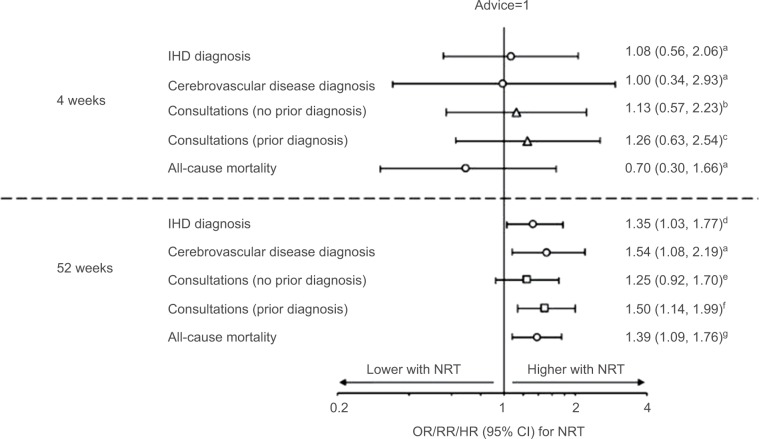
Mean (standard deviation) population age was 47 (11.2) years; 51% were females. Time to first diagnosis of ischemic heart disease (IHD) among NRT and smoking cessation advice patients was similar within the first 4 weeks, but shorter for NRT patients over 52 weeks (hazard ratio [HR]: 1.35, 95% confidence interval [CI]: 1.03-1.77). A similar trend was observed for cerebrovascular disease (HR: 1.54, 95% CI: 1.08-2.19). NRT patients with a prior diagnosis of IHD or cerebrovascular disease had a higher rate of primary or secondary care consultations for IHD or cerebrovascular disease by 52 weeks (rate ratio: 1.50, 95% CI: 1.14-1.99). Patients prescribed NRT had a shorter survival time over 52 weeks, compared with those receiving advice only (HR: 1.39, 95% CI: 1.09-1.76).
Our findings suggest that treatment with NRT over 4 weeks does not appear to have an impact on cardiovascular risks. However, a longer follow-up period of 52 weeks resulted in an increase in cardiovascular events for patients prescribed NRT, compared with those receiving smoking cessation advice only.
先前的研究表明,使用尼古丁替代疗法(NRT)可能与心血管疾病(CVD)风险增加有关。
利用英国临床实践研究数据链的数据,本研究旨在评估在NRT支持下尝试戒烟的个体与仅接受戒烟建议的个体相比的心血管疾病事件和生存率。我们研究了50214名尝试戒烟的吸烟者在4周和52周内的心血管疾病结局——33476名接受戒烟建议,16738名在其初级保健医生开具的NRT支持下。在戒烟尝试前的基线年份,根据人口统计学和临床特征对患者进行匹配(2名接受戒烟建议的患者:1名接受NRT的患者)。使用Cox比例风险回归、条件负二项回归模型和条件逻辑回归分析数据。
平均(标准差)人群年龄为47(11.2)岁;51%为女性。NRT组和接受戒烟建议组患者首次诊断缺血性心脏病(IHD)的时间在前4周内相似,但在52周内NRT组患者更短(风险比[HR]:1.35,95%置信区间[CI]:1.03 - 1.77)。脑血管疾病也观察到类似趋势(HR:1.54,95%CI:1.08 - 2.19)。既往诊断为IHD或脑血管疾病的NRT组患者在52周时因IHD或脑血管疾病进行初级或二级保健咨询的比例更高(率比:1.50,95%CI:1.14 - 1.99)。与仅接受建议的患者相比,开具NRT的患者在52周内的生存时间更短(HR:1.39,95%CI:1.09 - 1.76)。
我们的研究结果表明,4周的NRT治疗似乎对心血管风险没有影响。然而,与仅接受戒烟建议的患者相比,52周的更长随访期导致开具NRT的患者心血管事件增加。