Wang Qian J, Knoeferle Klemens, Spence Charles
Crossmodal Research Laboratory, Department of Experimental Psychology, Oxford UniversityOxford, UK.
Department of Marketing, BI Norwegian Business SchoolOslo, Norway.
Front Psychol. 2017 Apr 26;8:638. doi: 10.3389/fpsyg.2017.00638. eCollection 2017.
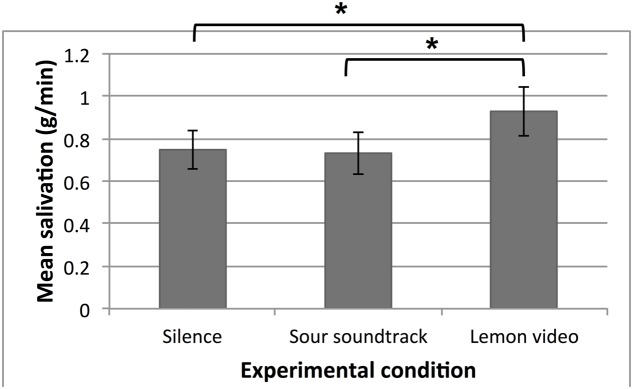
People robustly associate various sound attributes with specific smells/tastes, and soundtracks that are associated with specific tastes can influence people's evaluation of the taste of food and drink. However, it is currently unknown whether such soundtracks directly impact the eating experience via physiological changes (an embodiment account), or whether they act at a higher cognitive level, or both. The present research assessed a version of the embodiment account, where a soundtrack associated with sourness is hypothesized to induce a physiological response in the listener by increasing salivary flow. Salivation was measured while participants were exposed to three different experimental conditions - a sour soundtrack, a muted lemon video showing a man eating a lemon, and a silent baseline condition. The results revealed that salivation during the lemon video condition was significantly greater than in the sour soundtrack and baseline conditions. However, contrary to our hypothesis, there was no significant difference between salivation levels in the sour soundtrack compared to the baseline condition. These results are discussed in terms of potential mechanisms underlying the auditory modulation of taste perception/evaluation.
人们会将各种声音属性与特定的气味/味道紧密联系起来,与特定味道相关的配乐会影响人们对食物和饮料味道的评价。然而,目前尚不清楚这类配乐是通过生理变化(一种具身化解释)直接影响进食体验,还是在更高的认知层面起作用,亦或是两者皆有。本研究评估了具身化解释的一个版本,即假设与酸味相关的配乐会通过增加唾液分泌来诱导听众产生生理反应。在参与者暴露于三种不同实验条件下时测量唾液分泌情况——酸味配乐、播放一名男子吃柠檬的静音柠檬视频以及无声基线条件。结果显示,在柠檬视频条件下的唾液分泌显著多于酸味配乐和基线条件下的唾液分泌。然而,与我们的假设相反,酸味配乐条件下的唾液分泌水平与基线条件相比并无显著差异。我们将根据味觉感知/评价的听觉调制潜在机制来讨论这些结果。