Reynolds Bryson B, Patrie James, Henry Erich J, Goodkin Howard P, Broshek Donna K, Wintermark Max, Druzgal T Jason
Institute of Imaging Science, Vanderbilt University Medical Center, Nashville, Tennessee, USA.
Public Health Sciences, University of Virginia, Charlottesville, Virginia, USA.
Orthop J Sports Med. 2017 Apr 24;5(4):2325967117701708. doi: 10.1177/2325967117701708. eCollection 2017 Apr.
The effects of head impact in sports are of growing interest for clinicians, scientists, and athletes. Soccer is the most popular sport worldwide, but the burden of head impact in collegiate soccer is still unknown.
To quantify head impact associated with practicing and playing collegiate soccer using wearable accelerometers.
Descriptive epidemiological study.
Mastoid patch accelerometers were used to quantify head impact in soccer, examining differences in head impact as a function of sex and event type (practice vs game). Seven female and 14 male collegiate soccer players wore mastoid patch accelerometers that measured head impacts during team events. Data were summarized for each athletic exposure, and statistical analyses evaluated the mean number of impacts, mean peak linear acceleration, mean peak rotational acceleration, and cumulative linear and rotational acceleration, each grouped by sex and event type.
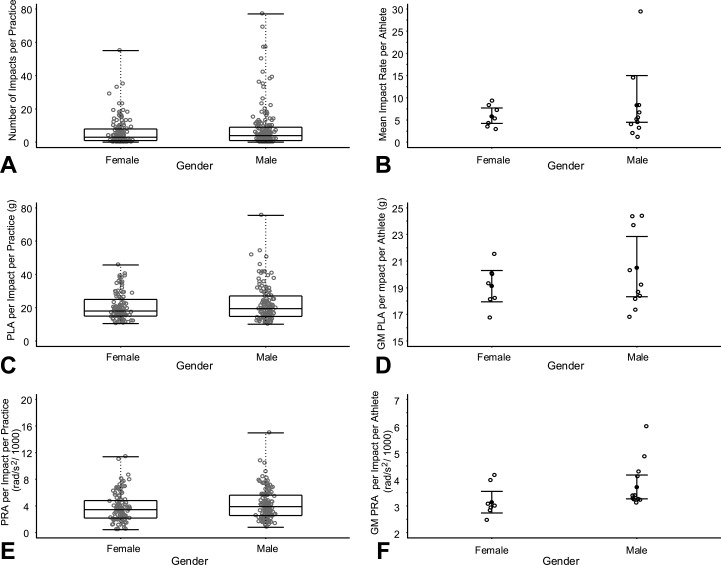
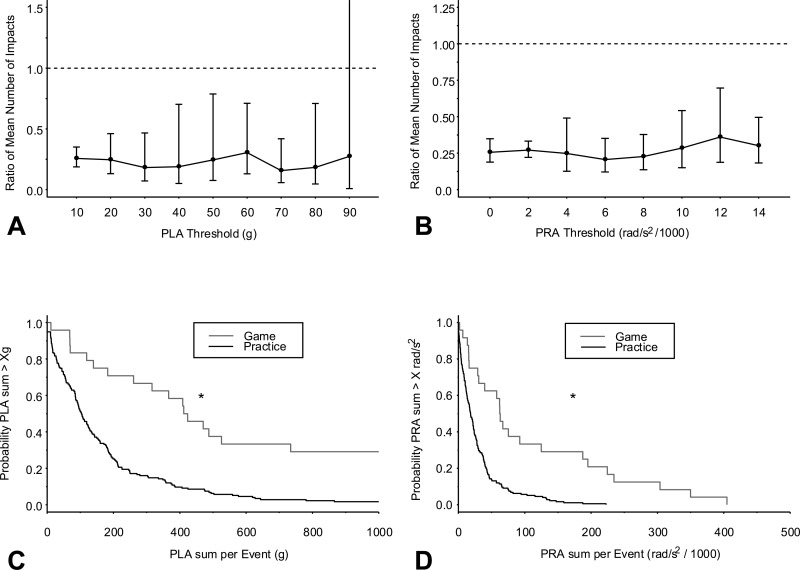
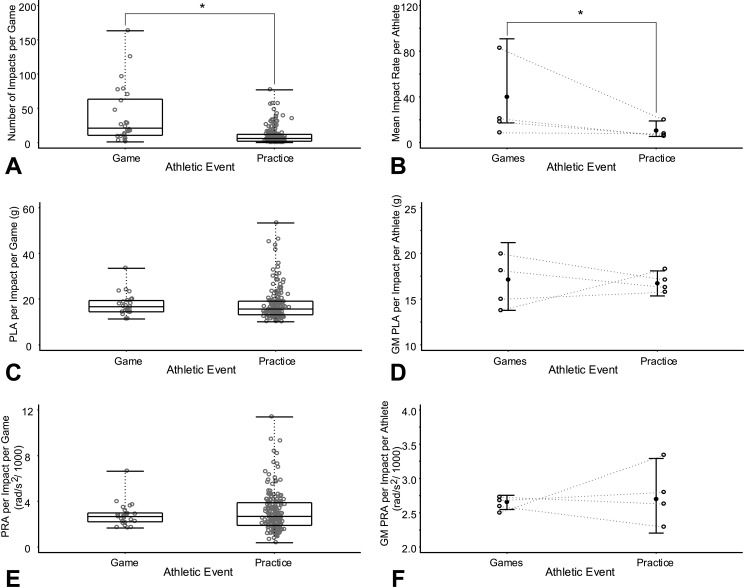
There were no differences in the frequency or severity of head impacts between men's and women's soccer practices. For men's soccer, games resulted in 285% more head impacts than practices, but there were no event-type differences in mean impact severity. Men's soccer games resulted in more head impacts than practices across nearly all measured impact severities, which also resulted in men's soccer games producing a greater cumulative impact burden.
Similar to other sports, men's soccer games have a greater impact burden when compared with practices, and this effect is driven by the quantity rather than severity of head impacts. In contrast, there were no differences in the quantity or severity of head impacts in men's and women's soccer practices. These data could prompt discussions of practical concern to collegiate soccer, such as understanding sex differences in head impact and whether games disproportionately contribute to an athlete's head impact burden.
头部撞击对体育运动的影响越来越受到临床医生、科学家和运动员的关注。足球是全球最受欢迎的运动,但大学足球运动中头部撞击的负担仍不明确。
使用可穿戴加速度计量化与大学足球训练和比赛相关的头部撞击情况。
描述性流行病学研究。
使用乳突贴片加速度计量化足球运动中的头部撞击,研究头部撞击在性别和事件类型(训练与比赛)方面的差异。14名男性和7名女性大学足球运动员佩戴乳突贴片加速度计,测量团队活动期间的头部撞击情况。对每次运动暴露的数据进行汇总,统计分析评估撞击次数平均值、峰值线性加速度平均值、峰值旋转加速度平均值以及累积线性和旋转加速度,按性别和事件类型进行分组。
男女足球训练在头部撞击的频率或严重程度上没有差异。对于男子足球,比赛导致的头部撞击次数比训练多285%,但平均撞击严重程度在事件类型上没有差异。在几乎所有测量的撞击严重程度方面,男子足球比赛导致的头部撞击次数都比训练多,这也使得男子足球比赛产生更大的累积撞击负担。
与其他运动类似,与训练相比,男子足球比赛的撞击负担更大,这种影响是由头部撞击的数量而非严重程度驱动的。相比之下,男女足球训练在头部撞击的数量或严重程度上没有差异。这些数据可能引发对大学足球实际问题的讨论,比如了解头部撞击中的性别差异以及比赛是否对运动员的头部撞击负担有不成比例的影响。