Dabare Chamila, Le Marshall Kim, Leung Albert, Page Carolyn J, Choong Peter F, Lim Keith K
Rheumatology Unit, Western Health, Department of Medicine, Melbourne Medical School - Western Precinct, The University of Melbourne, Melbourne, Victoria, Australia.
Department of Orthopaedics, The University of Melbourne and Western Health, Melbourne, Victoria, Australia.
Int J Rheum Dis. 2017 Oct;20(10):1350-1360. doi: 10.1111/1756-185X.13083. Epub 2017 May 10.
To describe the natural progression and the rates of arthroplasty of a cohort of hip and knee osteoarthritis (OA) patients.
An observational study of 247 consecutive patients who attended an OA clinic between May 2008 and August 2009. Follow-up survey was conducted from July 2014 to December 2014, with the primary end point being joint replacement surgery.
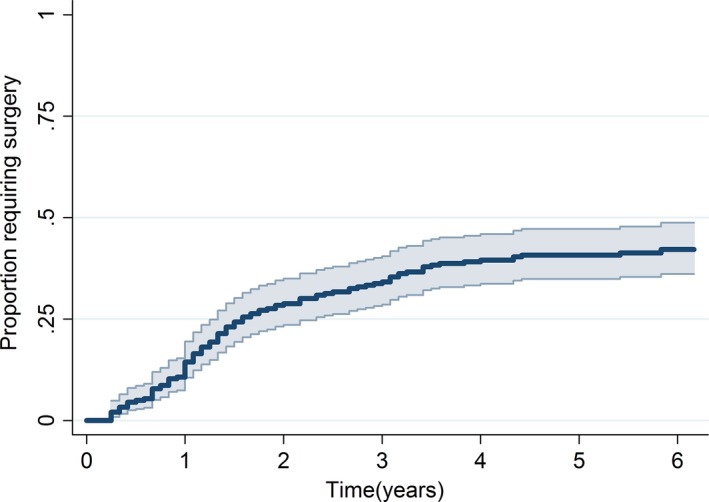
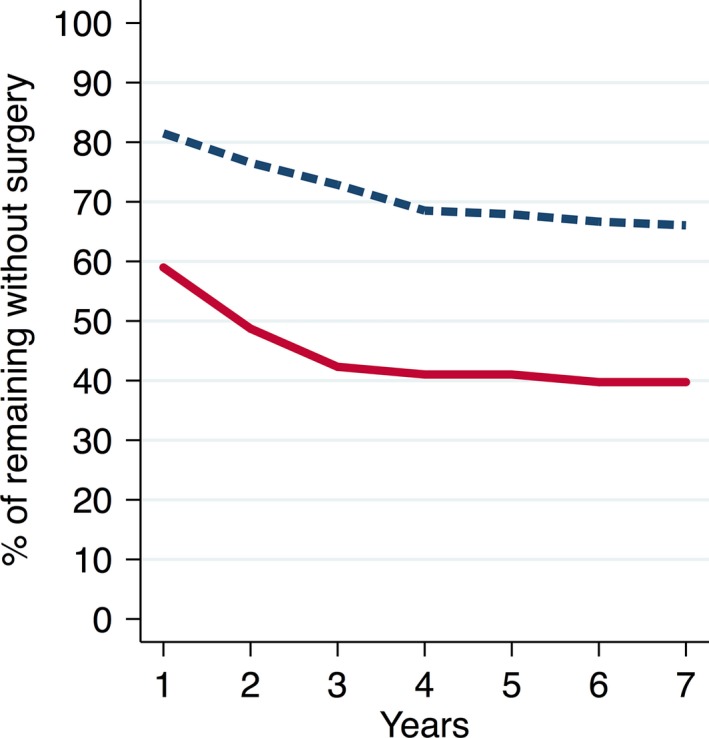
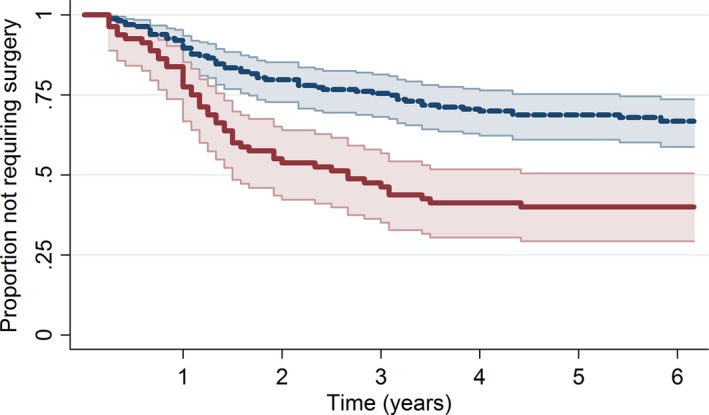
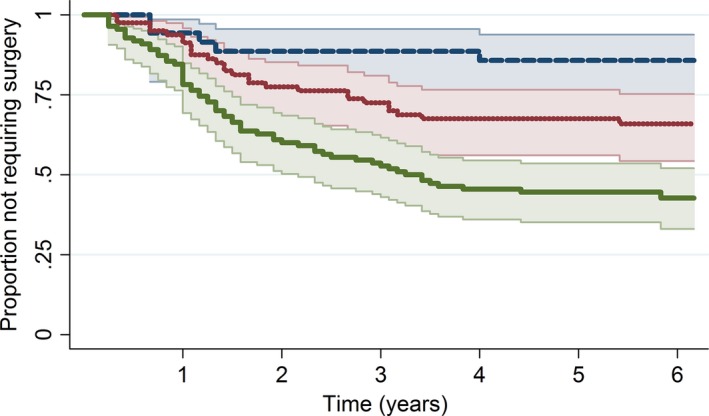
One hundred and sixty-seven patients had knee OA and 80 patients had hip OA. When adjusted for other variables (age, gender, body mass index, Kellgren-Lawrence stage, symptom duration, presence of OA elsewhere and pain score), patients with hip OA demonstrated 86% increased hazard of surgery compared to knee OA patients (95% CI increase of 19% to 193%). At 6 years after initial consultation, 67% of patients with knee OA did not require a knee replacement surgery, while 40% (30, 51) of hip OA patients did not undergo surgery (95% CI: 59-74%). Overall at 6 years, 58% of patients (95% CI: 51-64%) did not undergo joint replacement surgery.
Knee and hip OA patients appear to behave differently, with hip OA patients more likely to undergo arthroplasty. There is a significant number of both hip OA and knee OA patients who did not require arthroplasty at the end of 6 years, suggesting a major role for conservative therapy.
描述一组髋膝关节骨关节炎(OA)患者的自然病程及关节置换率。
对2008年5月至2009年8月间在OA门诊就诊的247例连续患者进行观察性研究。于2014年7月至12月进行随访调查,主要终点为关节置换手术。
167例患者为膝关节OA,80例为髋关节OA。在对其他变量(年龄、性别、体重指数、Kellgren-Lawrence分级、症状持续时间、其他部位OA的存在情况及疼痛评分)进行调整后,髋关节OA患者的手术风险比膝关节OA患者高86%(95%置信区间增加19%至193%)。初次就诊6年后,67%的膝关节OA患者不需要进行膝关节置换手术,而40%(30, 51)的髋关节OA患者未接受手术(95%置信区间:59 - 74%)。总体而言,6年后58%的患者(95%置信区间:51 - 64%)未接受关节置换手术。
膝关节和髋关节OA患者的表现似乎有所不同,髋关节OA患者更有可能接受关节置换术。在6年末,有相当数量的髋关节OA和膝关节OA患者不需要进行关节置换术,这表明保守治疗起着重要作用