Warner S C, Walsh D A, Laslett L L, Maciewicz R A, Soni A, Hart D J, Zhang W, Muir K R, Dennison E M, Leaverton P, Rampersaud E, Cooper C, Spector T D, Cicuttini F M, Arden N K, Jones G, Doherty M, Valdes A M
Academic Rheumatology, University of Nottingham, UK.
Department of Cardiovascular Sciences, Leicester Cardiovascular Biomedical Research Unit, University of Leicester and National Institute for Health Research, UK.
Eur J Pain. 2017 Aug;21(7):1277-1284. doi: 10.1002/ejp.1027. Epub 2017 May 11.
Substance P (SP) is a pain- and inflammation-related neuropeptide which preferentially binds to the neurokinin receptor 1 (NK ). SP and NK receptors have been implicated in joint pain, inflammation and damage in animal models and human studies of osteoarthritis (OA). The aim of this study was to test if genetic variation at the neurokinin 1 receptor gene (TACR1) is associated with pain in individuals with radiographic knee OA.
Participants from the Genetics of OA and Lifestyle study were used for the discovery group (n = 1615). Genotype data for six SNPs selected to cover most variation in the TACR1 gene were used to test for an association with symptomatic OA. Replication analysis was performed using data from the Chingford 1000 Women Study, Hertfordshire Cohort Study, Tasmanian Older Adult Cohort Study and the Clearwater OA Study. In total, n = 1715 symptomatic OA and n = 735 asymptomatic OA individuals were analysed.
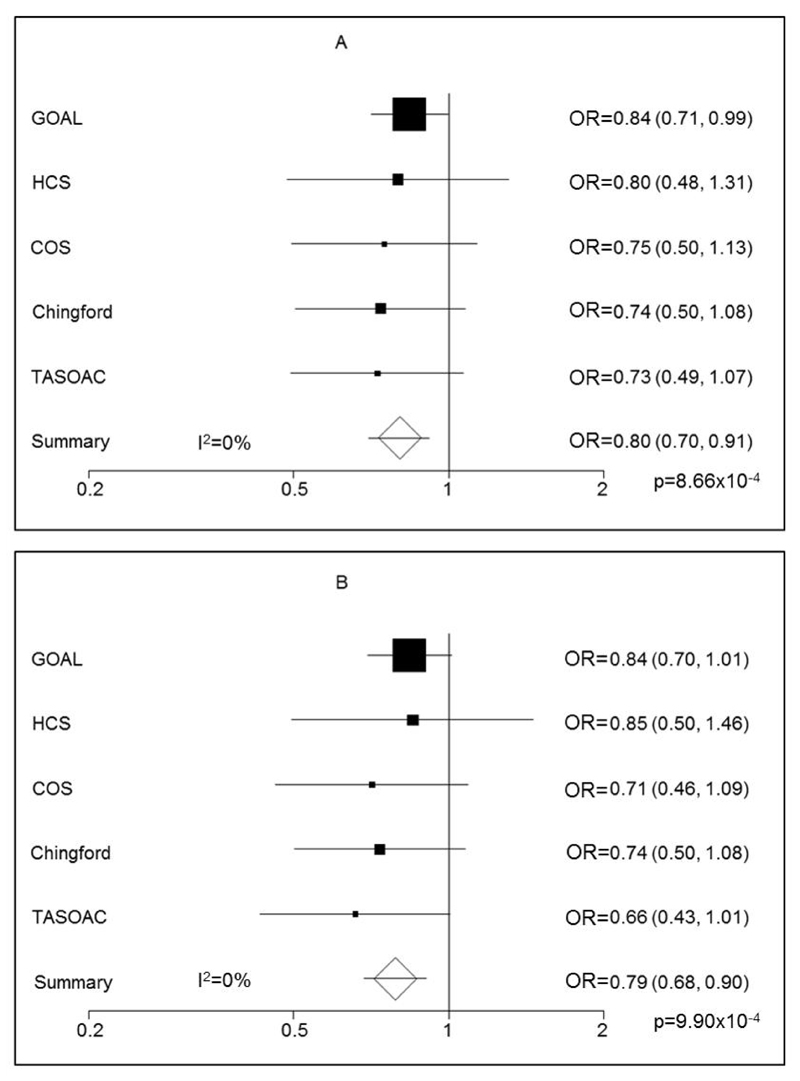
Out of six SNPs tested in the TACR1 gene, one (rs11688000) showed a nominally significant association with a decreased risk of symptomatic OA in the discovery cohort. This was then replicated in four additional cohorts. After adjusting for age, gender, body mass index and radiographic severity, the G (minor) allele at rs11688000 was associated with a decreased risk of symptomatic OA compared to asymptomatic OA cases (p = 9.90 × 10 , OR = 0.79 95% 0.68-0.90 after meta-analysis).
This study supports a contribution from the TACR1 gene in human OA pain, supporting further investigation of this gene's function in OA.
This study contributes to the knowledge of the genetics of painful osteoarthritis, a condition which affects millions of individuals worldwide. Specifically, a contribution from the TACR1 gene to modulating pain sensitivity in osteoarthritis is suggested.
P物质(SP)是一种与疼痛和炎症相关的神经肽,它优先与神经激肽受体1(NK)结合。在骨关节炎(OA)的动物模型和人体研究中,SP和NK受体与关节疼痛、炎症及损伤有关。本研究的目的是检验神经激肽1受体基因(TACR1)的基因变异是否与膝关节影像学OA患者的疼痛相关。
OA与生活方式遗传学研究的参与者作为发现组(n = 1615)。选择覆盖TACR1基因大部分变异的6个单核苷酸多态性(SNP)的基因型数据,用于检验与症状性OA的关联。使用来自钦福德千名女性研究、赫特福德郡队列研究、塔斯马尼亚老年成人队列研究和克利尔沃特OA研究的数据进行重复分析。总共分析了1715例症状性OA个体和735例无症状OA个体。
在TACR1基因检测的6个SNP中,一个(rs11688000)在发现队列中显示出与症状性OA风险降低存在名义上的显著关联。随后在另外四个队列中得到重复验证。在调整年龄、性别、体重指数和影像学严重程度后,与无症状OA病例相比,rs11688000处的G(次要)等位基因与症状性OA风险降低相关(荟萃分析后p = 9.90×10,OR = 0.79,95%置信区间为0.68 - 0.90)。
本研究支持TACR1基因在人类OA疼痛中发挥作用,支持进一步研究该基因在OA中的功能。
本研究有助于了解疼痛性骨关节炎的遗传学知识,这种疾病影响着全球数百万人。具体而言,提示TACR1基因对调节骨关节炎疼痛敏感性有作用。