Academic Rheumatology, School of Medicine, University of Nottingham, Nottingham City Hospital, Nottingham, UK.
NIHR Nottingham Biomedical Research Centre, University of Nottingham, Nottingham, UK.
Eur J Pain. 2022 Mar;26(3):740-753. doi: 10.1002/ejp.1902. Epub 2022 Jan 7.
Neuropathic pain symptoms and signs of increased pain sensitization in osteoarthritis (OA) patients may explain persistent pain after total joint replacement (TJR). Therefore, identifying genetic markers associated with pain sensitization and neuropathic-like pain phenotypes could be clinically important in identifying targets for early intervention.
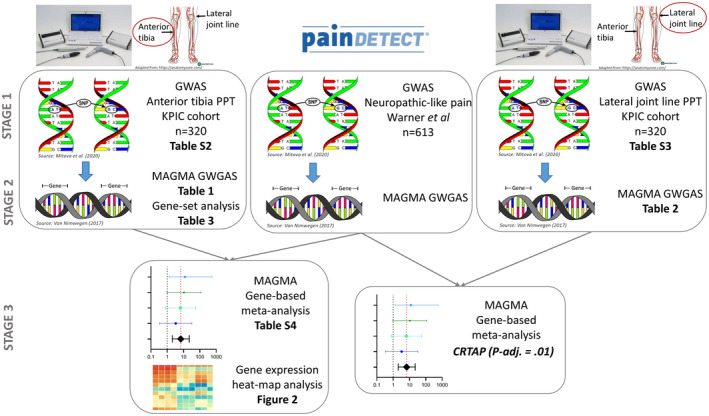
We performed a genome-wide gene-based association study (GWGAS) using pressure pain detection thresholds (PPTs) from distal pain-free sites (anterior tibia), a measure of distal sensitization, and from proximal pain-affected sites (lateral joint line), a measure of local sensitization, in 320 knee OA participants from the Knee Pain and related health in the Community (KPIC) cohort. We next performed gene-based fixed-effects meta-analysis of PPTs and a neuropathic-like pain phenotype using genome-wide association study (GWAS) data from KPIC and from an independent cohort of 613 post-TJR participants, respectively.
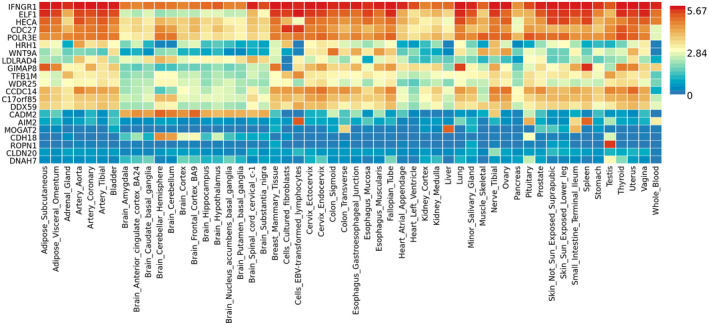
The most significant genes associated with distal and local sensitization were OR5B3 and BRDT, respectively. We also found previously identified neuropathic pain-associated genes-KCNA1, MTOR, ADORA1 and SCN3B-associated with PPT at the anterior tibia and an inflammatory pain gene-PTAFR-associated with PPT at the lateral joint line. Meta-analysis results of anterior tibia and neuropathic-like pain phenotypes revealed genes associated with bone morphogenesis, neuro-inflammation, obesity, type 2 diabetes, cardiovascular disease and cognitive function.
Overall, our results suggest that different biological processes might be involved in distal and local sensitization, and common genetic mechanisms might be implicated in distal sensitization and neuropathic-like pain. Future studies are needed to replicate these findings.
To the best of our knowledge, this is the first GWAS for pain sensitization and the first gene-based meta-analysis of pain sensitization and neuropathic-like pain. Higher pain sensitization and neuropathic pain symptoms are associated with persistent pain after surgery hence, identifying genetic biomarkers and molecular pathways associated with these traits is clinically relevant.
神经病理性疼痛症状和骨关节炎(OA)患者疼痛敏化的迹象可能解释了全膝关节置换(TJR)后的持续性疼痛。因此,确定与疼痛敏化和类神经病理性疼痛表型相关的遗传标志物在确定早期干预靶点方面可能具有重要的临床意义。
我们使用来自社区膝关节疼痛和相关健康(KPIC)队列的 320 名膝关节 OA 患者的远端无痛部位(胫骨前)的压力疼痛检测阈值(PPT)和近端疼痛部位(外侧关节线)的 PPT 进行了全基因组基因关联研究(GWGAS),这是一种远端敏化的测量方法,也是局部敏化的测量方法。接下来,我们分别使用 KPIC 的 GWAS 数据和 613 名 TJR 后患者的独立队列中的 GWAS 数据,对 PPT 和类神经病理性疼痛表型进行了基于基因的固定效应荟萃分析。
与远端和局部敏化最显著相关的基因分别是 OR5B3 和 BRDT。我们还发现了先前与胫骨前 PPT 相关的神经病理性疼痛相关基因-KCNA1、MTOR、ADORA1 和 SCN3B-以及与外侧关节线 PPT 相关的炎症性疼痛基因-PTAFR。胫骨前和类神经病理性疼痛表型的荟萃分析结果显示,与骨形态发生、神经炎症、肥胖、2 型糖尿病、心血管疾病和认知功能相关的基因。
总的来说,我们的研究结果表明,不同的生物学过程可能参与了远端和局部敏化,而常见的遗传机制可能与远端敏化和类神经病理性疼痛有关。需要进一步的研究来复制这些发现。
据我们所知,这是第一项关于疼痛敏化的全基因组关联研究,也是第一项关于疼痛敏化和类神经病理性疼痛的基于基因的荟萃分析。更高的疼痛敏化和神经病理性疼痛症状与手术后的持续性疼痛有关,因此,确定与这些特征相关的遗传生物标志物和分子途径具有重要的临床意义。