van Son Maren, Enger Eli Gjerlaug, Grove Harald, Ros-Freixedes Roger, Kent Matthew P, Lien Sigbjørn, Grindflek Eli
Norsvin SA, Storhamargata 44, , 2317, Hamar, Norway.
Centre for Integrative Genetics (CIGENE), Department for Animal and Aquacultural Sciences, Norwegian University of Life Sciences, P. O. Box 5003, 1432, Ås, Norway.
BMC Genomics. 2017 May 11;18(1):369. doi: 10.1186/s12864-017-3752-0.
Fatty acid composition contributes importantly to meat quality and is essential to the nutritional value of the meat. Identification of genetic factors underlying levels of fatty acids can be used to breed for pigs with healthier meat. The aim of this study was to conduct genome-wide association studies (GWAS) to identify QTL regions affecting fatty acid composition in backfat from the pig breeds Duroc and Landrace.
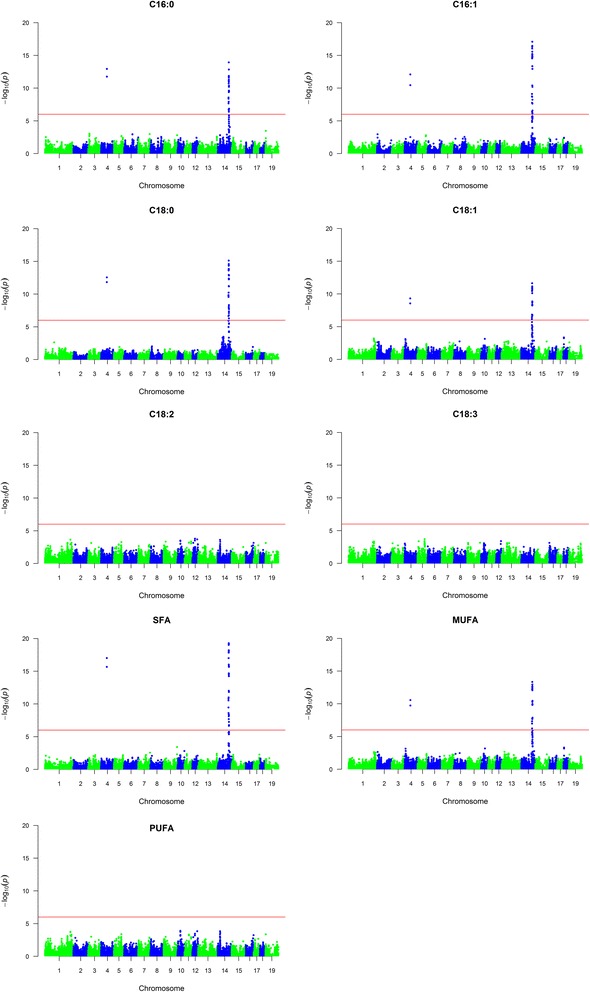
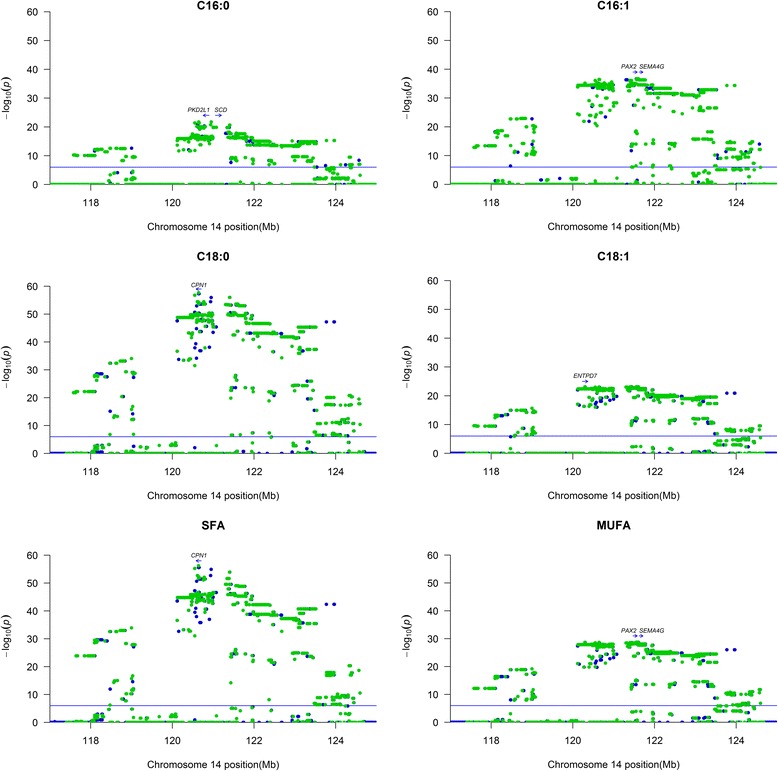
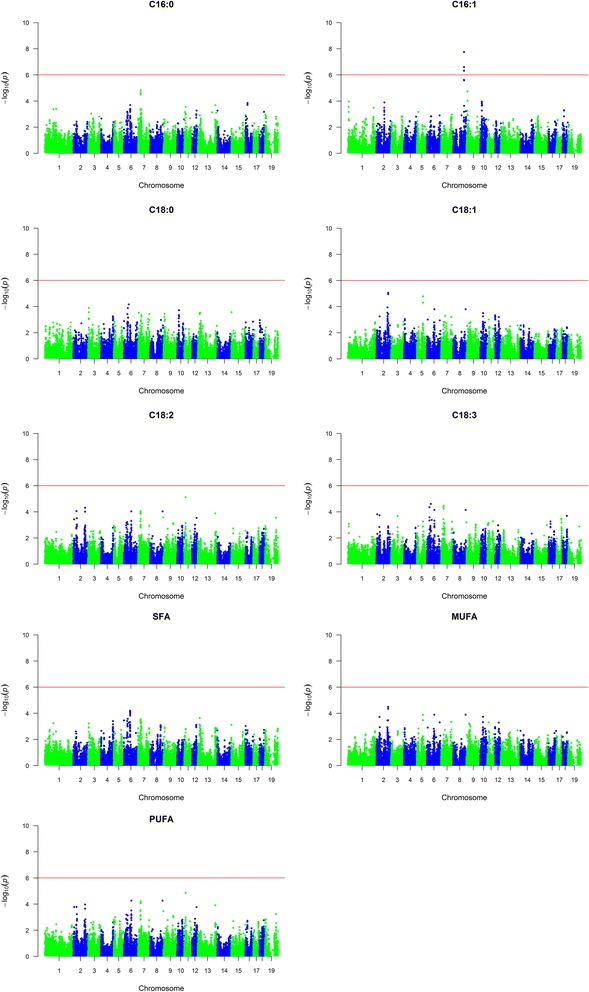
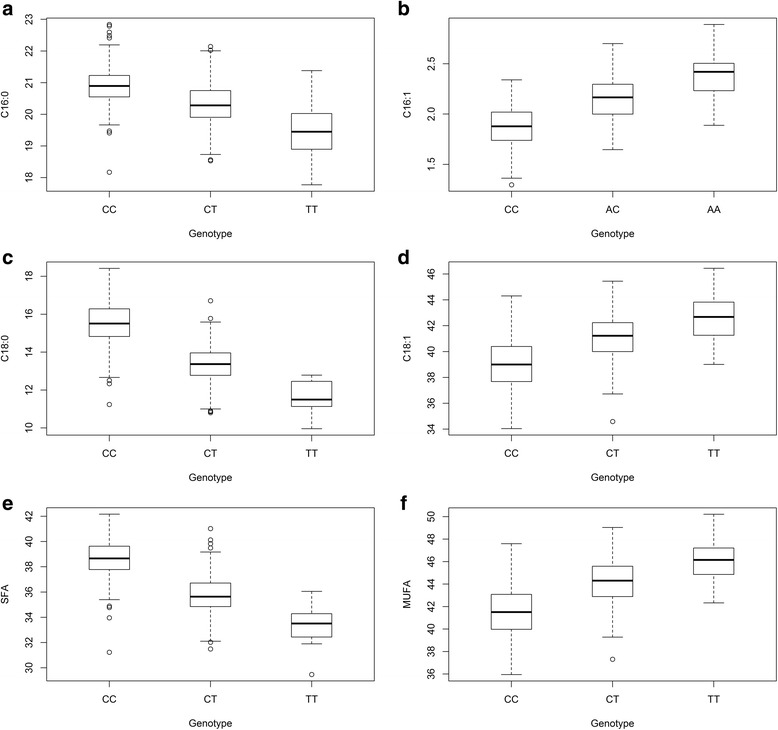
Using data from the Axiom porcine 660 K array, we performed GWAS on 454 Duroc and 659 Landrace boars for fatty acid phenotypes measured by near-infrared spectroscopy (NIRS) technology (C16:0, C16:1n-7, C18:0, C18:1n-9, C18:2n-6, C18:3n-3, total saturated fatty acids, monounsaturated fatty acids and polyunsaturated fatty acids). Two QTL regions on SSC4 and SSC14 were identified in Duroc for the de novo synthesized fatty acids traits, whereas one QTL on SSC8 was detected in Landrace for C16:1n-7. The QTL region on SSC14 has been reported in previous studies and a putative causative mutation has been suggested in the promoter region of the SCD gene. Whole genome re-sequencing data was used for genotype imputation and to fine map the SSC14 QTL region in Norwegian Duroc. This effort confirms the location of the QTL on this chromosome as well as suggesting other putative candidate genes in the region. The most significant single nucleotide polymorphisms (SNPs) located on SSC14 explain between 55 and 76% of the genetic variance and between 27 and 54% of the phenotypic variance for the de novo synthesized fatty acid traits in Norwegian Duroc. For the QTL region on SSC8 in Landrace, the most significant SNP explained 19% of the genetic variance and 5% of the phenotypic variance for C16:1n-7.
This study confirms a major QTL affecting fatty acid composition on SSC14 in Duroc, which can be used in genetic selection to increase the level of fatty acid desaturation. The SSC14 QTL was not segregating in the Landrace population, but another QTL on SSC8 affecting C16:1n-7 was identified and might be used to increase the level of desaturation in meat products from this breed.
脂肪酸组成对肉质有重要影响,且对肉的营养价值至关重要。鉴定影响脂肪酸水平的遗传因素可用于培育出具有更健康肉质的猪。本研究的目的是进行全基因组关联研究(GWAS),以鉴定影响杜洛克和长白猪品种背膘中脂肪酸组成的QTL区域。
利用来自Axiom猪660K芯片的数据,我们对454头杜洛克公猪和659头长白公猪进行了GWAS,分析通过近红外光谱(NIRS)技术测量的脂肪酸表型(C16:0、C16:1n-7、C18:0、C18:1n-9、C18:2n-6、C18:3n-3、总饱和脂肪酸、单不饱和脂肪酸和多不饱和脂肪酸)。在杜洛克中,在SSC4和SSC14上鉴定出两个QTL区域,与从头合成的脂肪酸性状有关,而在长白猪中,在SSC8上检测到一个与C16:1n-7有关的QTL。SSC14上的QTL区域在先前的研究中已有报道,并且在SCD基因的启动子区域已提出一个假定的致病突变。利用全基因组重测序数据进行基因型填充,并对挪威杜洛克猪的SSC14 QTL区域进行精细定位。这项工作证实了该QTL在这条染色体上的位置,并表明了该区域的其他假定候选基因。位于SSC14上的最显著单核苷酸多态性(SNP)解释了挪威杜洛克猪从头合成脂肪酸性状中55%至76%的遗传变异和27%至54%的表型变异。对于长白猪中SSC8上的QTL区域,最显著的SNP解释了C16:1n-7中19%的遗传变异和5%的表型变异。
本研究证实了杜洛克猪中一个影响脂肪酸组成的主要QTL位于SSC14上,可用于遗传选择以提高脂肪酸去饱和水平。SSC14 QTL在长白猪群体中未分离,但在SSC8上鉴定出另一个影响C16:1n-7的QTL,可用于提高该品种肉制品的去饱和水平。