Chung Min-Huey, Wang Yi-Wen, Chang Yung-Lung, Huang Shih-Ming, Lin Wei-Shiang
Graduate Institute of Nursing, College of Nursing, Taipei Medical University, Taipei 110, Taiwan, Republic of China.
Department of Biology and Anatomy, National Defense Medical Center, Taipei City 114, Taiwan, Republic of China.
Oncotarget. 2017 Jul 4;8(27):44203-44216. doi: 10.18632/oncotarget.17410.
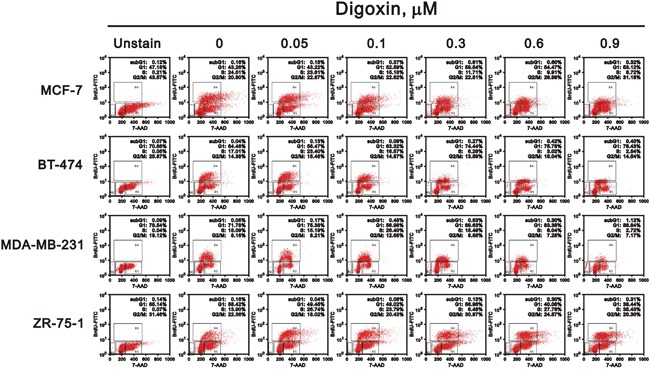
Heart failure (HF) is the leading cause of death in the world and digoxin remains one of the oldest therapies for HF. However, its safety and efficacy have been controversial since its initial use and there is uncertainty about its long-term efficacy and safety. Recently, the repositioning of cardiac glycosides is to function in anti-tumor activity via multiple working pathways. It is interesting to compare the potential effects of digoxin in clinical patients and cell lines. First, we analyze patient information retrieved from the National Health Insurance Research database of Taiwan between January 1, 2000 and December 31, 2000. This retrospective study included a study cohort (1,219 patients) and a comparison cohort. Our analytical data suggested that patients taking digoxin are at an increased risk of cancers, including breast, liver, and lung cancers, during the 10-year follow-up period. In contrast to the anti-tumor function of digoxin, we further examined the potential pathway of digoxin via the cell-based strategy using several breast cancer cell lines, including MCF-7, BT-474, MAD-MB-231, and ZR-75-1. Digoxin consistently exerted its cytotoxicity to these four cell lines with various range of concentration. However, the proliferation of ZR-75-1 cells was the only cell lines induced by digoxin and the others were dramatically suppressed by digoxin. The responsiveness of SRSF3 to digoxin might be involved with cell-type differences. In summary, we combined a cohort study for digoxin treatment for HF patients with a cell-based strategy that addresses the translation issue, which revealed the complexity of personalized medicine.
心力衰竭(HF)是全球主要的死亡原因,地高辛仍然是治疗HF最古老的疗法之一。然而,自其首次使用以来,其安全性和有效性一直存在争议,其长期疗效和安全性也存在不确定性。最近,强心苷的重新定位是通过多种作用途径发挥抗肿瘤活性。比较地高辛在临床患者和细胞系中的潜在作用很有意思。首先,我们分析了从台湾国民健康保险研究数据库中检索到的2000年1月1日至2000年12月31日期间的患者信息。这项回顾性研究包括一个研究队列(1219名患者)和一个对照队列。我们的分析数据表明,在10年的随访期内,服用地高辛的患者患癌症的风险增加,包括乳腺癌、肝癌和肺癌。与地高辛的抗肿瘤功能相反,我们使用包括MCF-7、BT-474、MAD-MB-231和ZR-75-1在内的几种乳腺癌细胞系,通过基于细胞的策略进一步研究了地高辛的潜在作用途径。地高辛在不同浓度范围内对这四种细胞系始终具有细胞毒性。然而,ZR-75-1细胞的增殖是唯一被地高辛诱导的细胞系,而其他细胞系则被地高辛显著抑制。SRSF3对地高辛的反应性可能与细胞类型差异有关。总之,我们将一项针对HF患者地高辛治疗的队列研究与一种解决转化问题的基于细胞的策略相结合,揭示了个性化医疗的复杂性。