Tai Chi-Jung, Yang Yi-Hsin, Tseng Tzyy-Guey, Chang Fang-Rong, Wang Hui-Chun
Graduate Institute of Natural Products, College of Pharmacy, Kaohsiung Medical University, Kaohsiung, Taiwan.
Department of Family Medicine, Pingtung Hospital, Ministry of Health and Welfare, Pingtung, Taiwan.
Front Pharmacol. 2021 Mar 31;12:564097. doi: 10.3389/fphar.2021.564097. eCollection 2021.
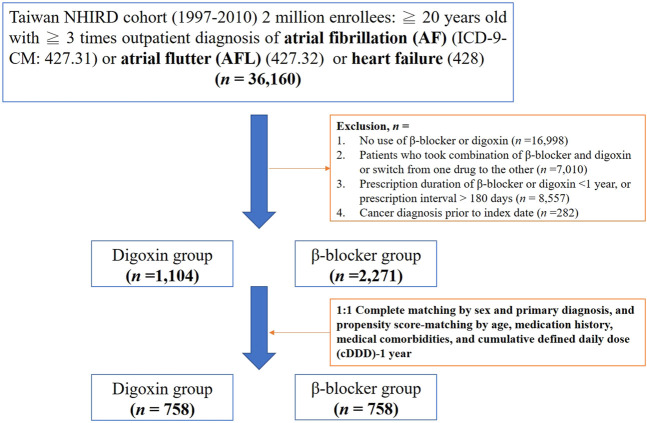
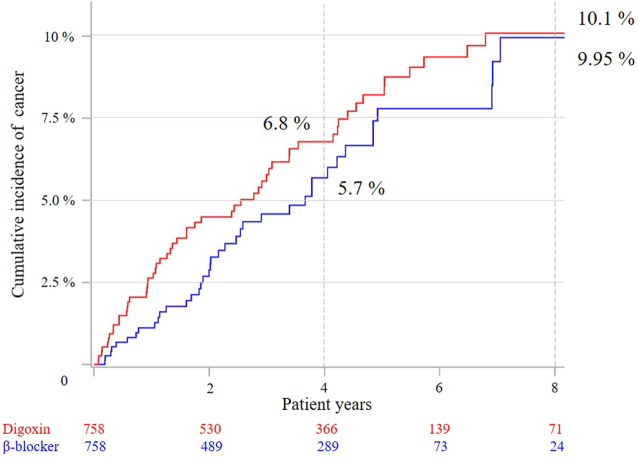
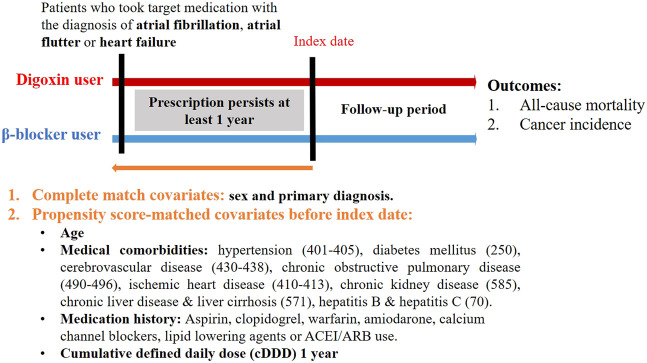
Previous studies neglected death as a critical competing risk while estimating the cancer risk for digoxin users. Therefore, the current study aims to assess the effectiveness of digoxin on cancer prevention by competing risk analysis. We performed a population-based retrospective cohort study using the Taiwan National Health Insurance Research database between 1998 and 2010. After one-to-one propensity score-matching from 36,160 patients with defined criteria, we enrolled 758 patients both in digoxin and β-blocker group for further analysis. The results showed that the digoxin group had higher all-cause mortality than the β-blocker group in the 4- year (10.4 vs. 4.9%) and 8 years (13.6 vs. 7.0%) follow-up. The subdistribution HR of cancer incidence in the digoxin group compared to the β-blocker group was 1.99 (95% confidence interval [CI]: 1.22-3.01) and 1.46 (95% CI: 1.01-2.15) in the 4 years and 8 years follow-up, respectively. The result of our study showed the usage of digoxin has no benefit in cancer prevention compared with β-blocker. The possibility of β-blocker as a new drug candidate for cancer prevention needs further clinical evaluation. The current study also emphasized the necessity of competing risk analysis applying to similar clinical researches.
以往的研究在评估地高辛使用者的癌症风险时,忽略了死亡作为一个关键的竞争风险。因此,本研究旨在通过竞争风险分析评估地高辛在预防癌症方面的有效性。我们利用台湾国民健康保险研究数据库进行了一项基于人群的回顾性队列研究,研究时间为1998年至2010年。在对36160名符合既定标准的患者进行一对一倾向评分匹配后,我们纳入了758名地高辛组和β受体阻滞剂组的患者进行进一步分析。结果显示,在4年(10.4%对4.9%)和8年(13.6%对7.0%)的随访中,地高辛组的全因死亡率高于β受体阻滞剂组。在4年和8年的随访中,地高辛组与β受体阻滞剂组相比,癌症发病率的亚分布风险比分别为1.99(95%置信区间[CI]:1.22 - 3.01)和1.46(95%CI:1.01 - 2.15)。我们的研究结果表明,与β受体阻滞剂相比,使用地高辛在预防癌症方面没有益处。β受体阻滞剂作为预防癌症新药候选的可能性需要进一步的临床评估。本研究还强调了竞争风险分析应用于类似临床研究的必要性。