Division of Gastroenterology and Hepatology, Department of Internal Medicine, National Taiwan University Hospital, Taipei, 10002, Taiwan.
Hepatitis Research Center, National Taiwan University Hospital, Taipei, 10002, Taiwan.
Sci Rep. 2017 May 11;7(1):1728. doi: 10.1038/s41598-017-01572-z.
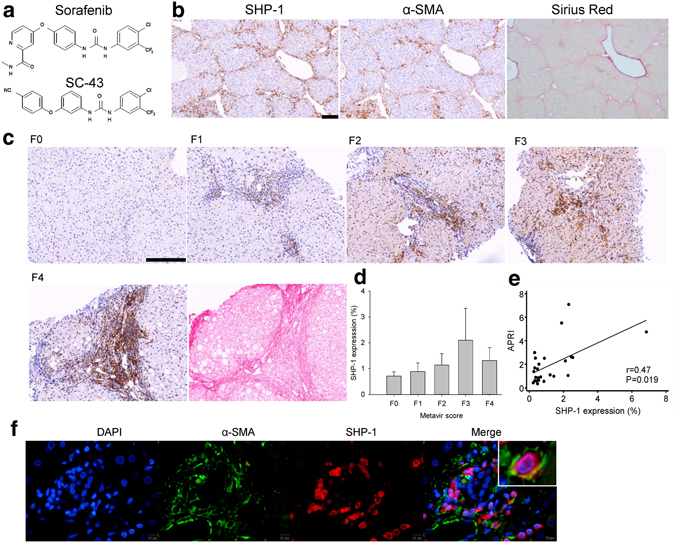
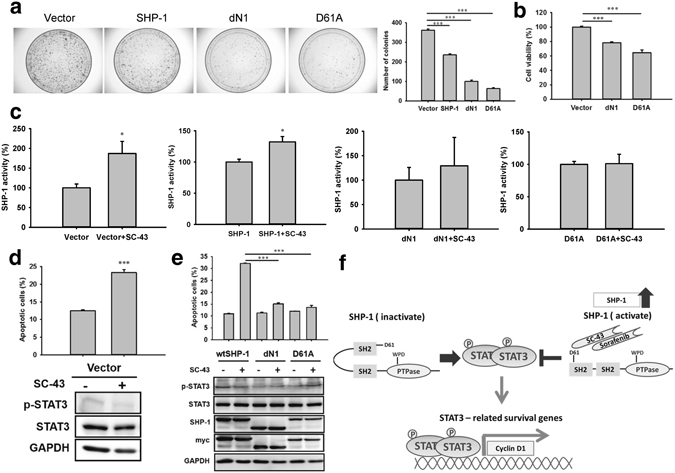
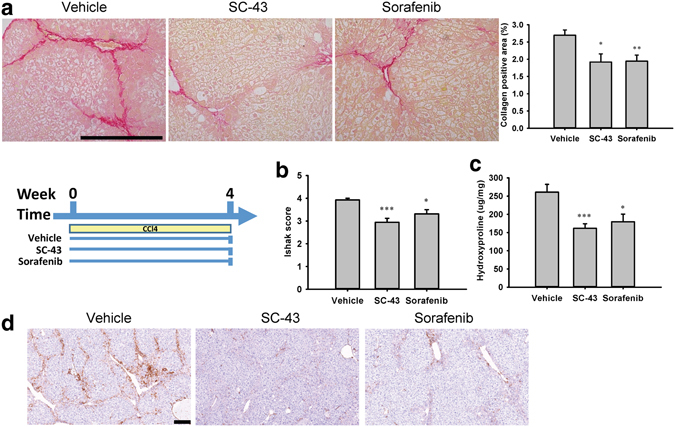
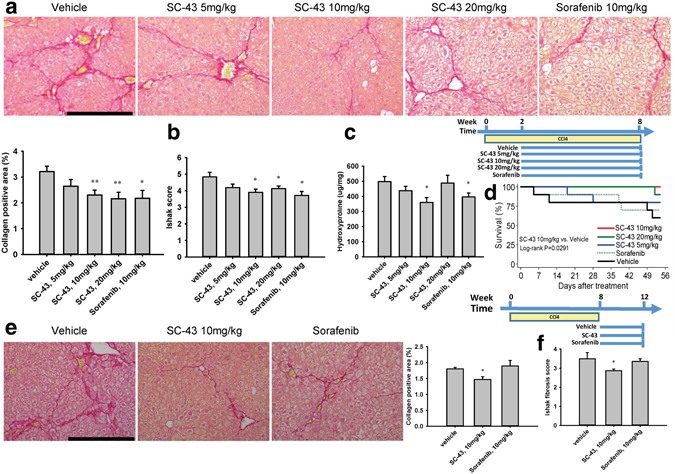
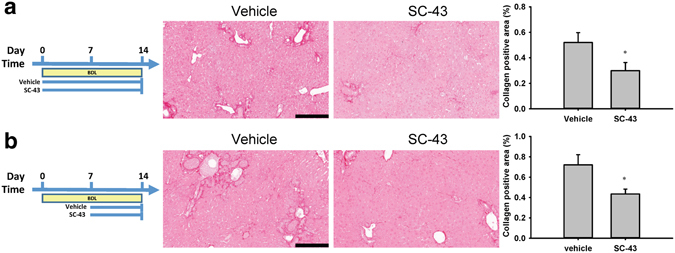
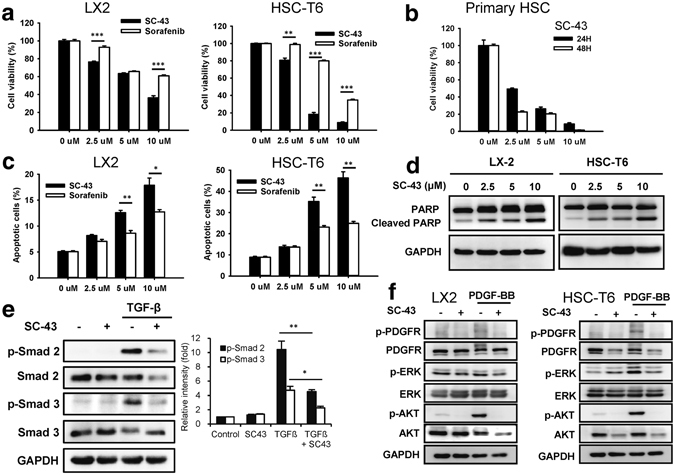
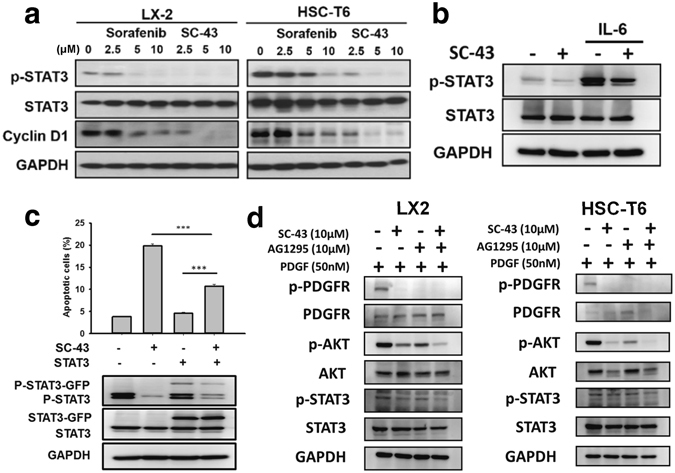
This study aimed to investigate the role of src-homology protein tyrosine phosphatase-1 (SHP-1)-signal transducer and activator of transcription 3 (STAT3) pathway in liver fibrogenesis and the anti-fibrotic effect of SHP-1 agonist. The antifibrotic activity of SC-43, a sorafenib derivative with an enhanced SHP-1 activity, was evaluated in two fibrosis mouse models by carbon tetrachloride induction and bile duct ligation. Rat, human, and primary mouse hepatic stellate cells (HSCs) were used for mechanistic investigations. The results showed that SHP-1 protein primarily localized in fibrotic areas of human and mouse livers. SC-43 treatment reduced the activated HSCs and thus effectively prevented and regressed liver fibrosis in both fibrosis mouse models and improved mouse survival. In vitro studies revealed that SC-43 promoted HSC apoptosis, increased the SHP-1 activity and inhibited phospho-STAT3. The enhanced SHP-1 activity in HSCs significantly inhibited HSC proliferation, whereas SHP-1 inhibition rescued SC-43-induced HSC apoptosis. Furthermore, SC-43 interacted with the N-SH2 domain of SHP-1 to enhance the activity of SHP-1 as its antifibrotic mechanism. In conclusion, the SHP-1-STAT3 pathway is crucial in fibrogenesis. SC-43 significantly ameliorates liver fibrosis through SHP-1 upregulation. A SHP-1-targeted antifibrotic therapy may represent a druggable strategy for antifibrotic drug discovery.
本研究旨在探讨 SRC 同源结构域蛋白酪氨酸磷酸酶-1(SHP-1)-信号转导子和转录激活子 3(STAT3)通路在肝纤维化中的作用,以及 SHP-1 激动剂的抗纤维化作用。通过四氯化碳诱导和胆管结扎两种纤维化小鼠模型,评估了索拉非尼衍生物 SC-43 的抗纤维化活性,该药物具有增强的 SHP-1 活性。利用大鼠、人和原代小鼠肝星状细胞(HSCs)进行了机制研究。结果表明,SHP-1 蛋白主要定位于人肝和鼠肝的纤维化区域。SC-43 治疗减少了激活的 HSCs,从而有效预防和逆转了两种纤维化小鼠模型中的肝纤维化,并提高了小鼠的存活率。体外研究表明,SC-43 促进 HSC 凋亡,增加 SHP-1 活性并抑制磷酸化 STAT3。HSCs 中增强的 SHP-1 活性显著抑制 HSC 增殖,而 SHP-1 抑制可挽救 SC-43 诱导的 HSC 凋亡。此外,SC-43 与 SHP-1 的 N-SH2 结构域相互作用,增强 SHP-1 的活性,这是其抗纤维化的机制。总之,SHP-1-STAT3 通路在纤维化中起关键作用。SC-43 通过上调 SHP-1 显著改善肝纤维化。靶向 SHP-1 的抗纤维化治疗可能代表抗纤维化药物发现的一种有前途的策略。