Youn Gi Soo, Cho Hyundong, Kim Donggyu, Choi Soo Young, Park Jinseu
Department of Biomedical Science and Research Institute for Bioscience & Biotechnology, Hallym University, Chunchon 24252, Kangwon-Do, Republic of Korea.
Department of Biomedical Science and Research Institute for Bioscience & Biotechnology, Hallym University, Chunchon 24252, Kangwon-Do, Republic of Korea.
Redox Biol. 2017 Aug;12:978-986. doi: 10.1016/j.redox.2017.05.001. Epub 2017 May 4.
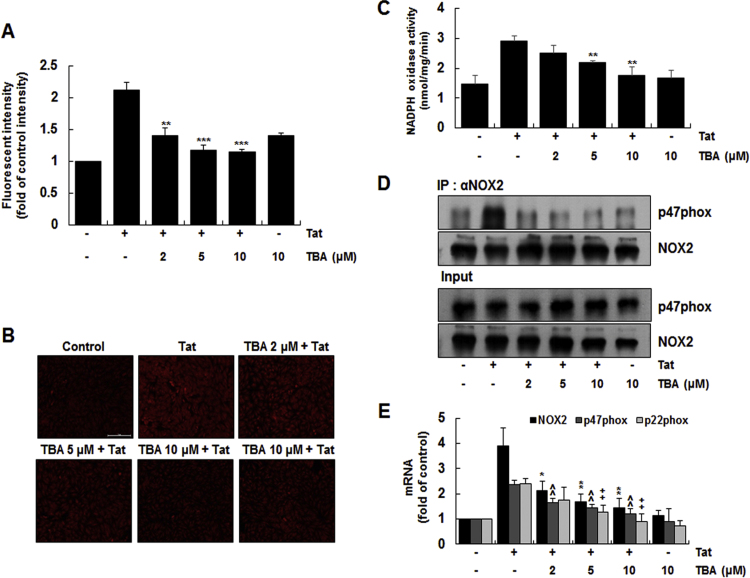
Histone deacetylase 6 (HDAC6) likely is important in inflammatory diseases. However, how HDAC6 exerts its effect on inflammatory processes remains unclear. HIV-1 transactivator of transcription (Tat) activates NADPH oxidase resulting in generation of reactive oxygen species (ROS), leading to extensive neuro-inflammation in the central nervous system. We investigated the correlation of HDAC6 and NADPH oxidase in HIV-1 Tat-stimulated astrocytes. HDAC6 knockdown attenuated HIV-1 Tat-induced ROS generation and NADPH oxidase activation. HDAC6 knockdown suppressed HIV-1 Tat-induced expression of NADPH oxidase subunits, such as Nox2, p47phox, and p22phox. Specific inhibition of HDAC6 using tubastatin A suppressed HIV-1 Tat-induced ROS generation and activation of NADPH oxidase. N-acetyl cysteine, diphenyl iodonium, and apocynin suppressed HIV-1 Tat-induced expression of HDAC6 and the pro-inflammatory chemokines CCL2, CXCL8, and CXCL10. Nox2 knockdown attenuated HIV-1 Tat-induced HDAC6 expression and subsequent expression of chemokines. The collective results point to the potential crosstalk between HDAC6 and NADPH oxidase, which could be a combined therapeutic target for relief of HIV-1 Tat-mediated neuro-inflammation.
组蛋白去乙酰化酶6(HDAC6)可能在炎症性疾病中起重要作用。然而,HDAC6如何对炎症过程发挥作用仍不清楚。HIV-1转录激活因子(Tat)激活NADPH氧化酶,导致活性氧(ROS)生成,进而在中枢神经系统引发广泛的神经炎症。我们研究了HIV-1 Tat刺激的星形胶质细胞中HDAC6与NADPH氧化酶的相关性。敲低HDAC6可减弱HIV-1 Tat诱导的ROS生成和NADPH氧化酶激活。敲低HDAC6可抑制HIV-1 Tat诱导的NADPH氧化酶亚基如Nox2、p47phox和p22phox的表达。使用tubastatin A特异性抑制HDAC6可抑制HIV-1 Tat诱导的ROS生成和NADPH氧化酶激活。N-乙酰半胱氨酸、二苯基碘鎓和夹竹桃麻素可抑制HIV-1 Tat诱导的HDAC6表达以及促炎趋化因子CCL2、CXCL8和CXCL10的表达。敲低Nox2可减弱HIV-1 Tat诱导的HDAC6表达及随后趋化因子的表达。这些结果共同表明HDAC6与NADPH氧化酶之间可能存在相互作用,这可能是缓解HIV-1 Tat介导的神经炎症的联合治疗靶点。