Cooper Crystal, Thompson R C Andrew, Botero Adriana, Kristancic Amanda, Peacock Christopher, Kirilak Yaowanuj, Clode Peta L
Centre for Microscopy, Characterisation and Analysis, The University of Western Australia, Crawley, WA, 6009, Australia.
School of Veterinary and Life Sciences, Murdoch University, Murdoch, WA, 6150, Australia.
Parasit Vectors. 2017 May 12;10(1):234. doi: 10.1186/s13071-017-2173-x.
Molecular and structural information on avian Trypanosoma spp. throughout Australia is limited despite their intrinsic value in understanding trypanosomatid evolution, diversity, and structural biology. In Western Australia tissue samples (n = 429) extracted from 93 birds in 25 bird species were screened using generic PCR primers to investigate the diversity of Trypanosoma spp. To investigate avian trypanosome structural biology the first 3-dimensional ultrastructural models of a Trypanosoma spp. (Trypanosoma sp. AAT) isolated from a bird (currawong, Strepera spp.) were generated using focussed ion beam milling combined with scanning electron microscopy (FIB-SEM).
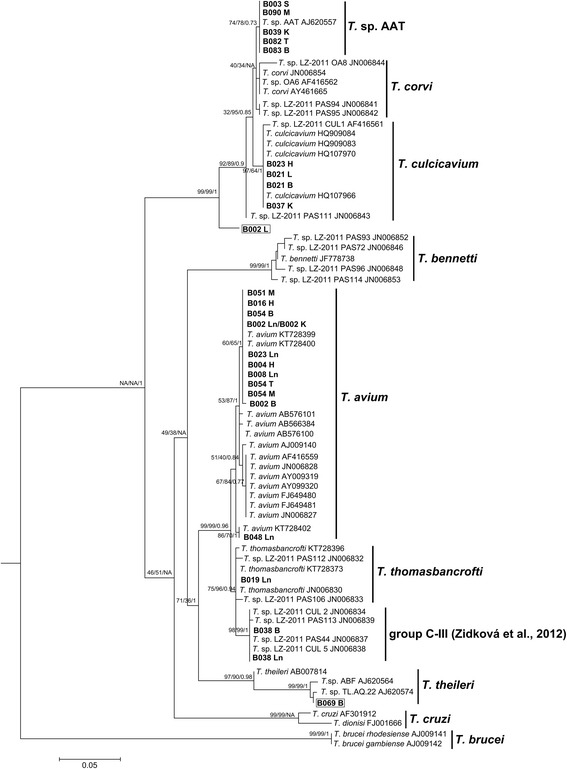
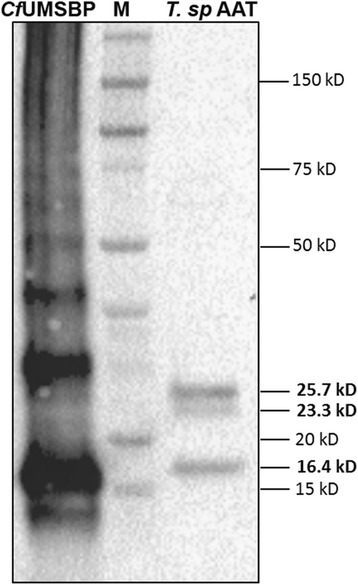
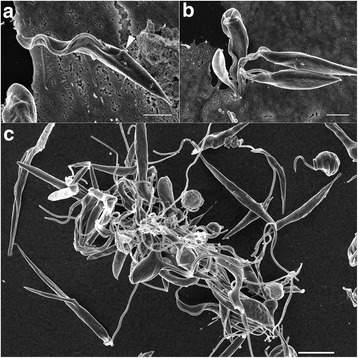
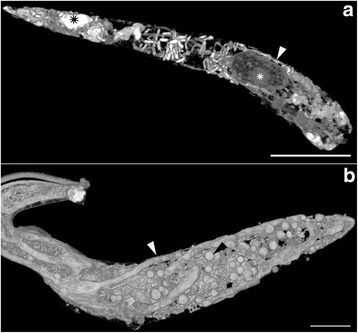
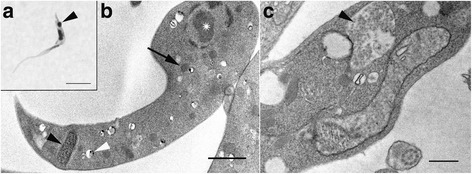
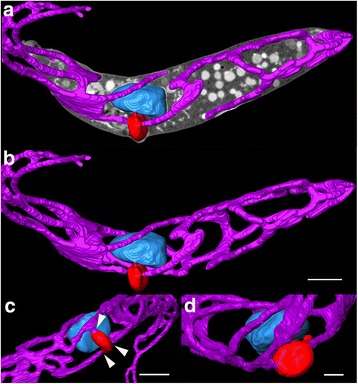
Here, we confirm four intercontinental species of avian trypanosomes in native Australian birds, and identify a new avian Trypanosoma. Trypanosome infection was identified in 18 birds from 13 different bird species (19%). A single new genotype was isolated and found to be closely related to T. culicavium (Trypanosoma sp. CC2016 B002). Other Trypanosoma spp. identified include T. avium, T. culicavium, T. thomasbancrofti, Trypanosoma sp. TL.AQ.22, Trypanosoma sp. AAT, and an uncharacterised Trypanosoma sp. (group C-III sensu Zidková et al. (Infect Genet Evol 12:102-112, 2012)), all previously identified in Australia or other continents. Serially-sectioning Trypanosoma sp. AAT epimastigotes using FIB-SEM revealed the disc-shaped kinetoplast pocket attached perpendicular to the branching mitochondrion. Additionally, the universal minicircle sequence within the kinetoplast DNA and the associated binding protein were determined in Trypanosoma sp. AAT.
These results indicate that bird trypanosomes are relatively conserved across continents, while being locally diverse, which supports the hypothesis that bird trypanosomes exist as fewer species than described in the literature. Evidence exists that avian Trypanosoma spp. are infecting mammals and could be transmitted by haemadipsid leeches. Trypanosoma sp. AAT is most likely a separate species currently found only in Australia and the first 3-dimentional ultrastructural analysis of an avian trypanosome provides interesting information on their morphology and organelle arrangement.
尽管鸟类锥虫在理解锥虫进化、多样性和结构生物学方面具有内在价值,但关于澳大利亚各地鸟类锥虫的分子和结构信息有限。在西澳大利亚州,从25种鸟类的93只鸟身上提取了组织样本(n = 429),使用通用PCR引物进行筛选,以研究锥虫的多样性。为了研究鸟类锥虫的结构生物学,利用聚焦离子束铣削结合扫描电子显微镜(FIB-SEM)生成了从一只鸟(噪钟鹊,Strepera spp.)分离出的一种锥虫(锥虫AAT)的首个三维超微结构模型。
在此,我们在澳大利亚本土鸟类中确认了四种洲际鸟类锥虫物种,并鉴定出一种新的鸟类锥虫。在13种不同鸟类的18只鸟中发现了锥虫感染(19%)。分离出一个单一的新基因型,发现它与库蚊锥虫(锥虫CC2016 B002)密切相关。鉴定出的其他锥虫物种包括禽锥虫、库蚊锥虫、托马斯班克罗夫特锥虫、锥虫TL.AQ.22、锥虫AAT,以及一种未鉴定的锥虫(Zidková等人(《感染、遗传与进化》12:102 - 112,2012)定义的C-III组),所有这些之前在澳大利亚或其他大陆都有鉴定。使用FIB-SEM对锥虫AAT的前鞭毛体进行连续切片,揭示了垂直于分支线粒体附着的盘状动质体袋。此外,还确定了锥虫AAT动质体DNA内的通用微小环序列以及相关的结合蛋白。
这些结果表明,鸟类锥虫在各大洲相对保守,同时在当地具有多样性,这支持了鸟类锥虫物种数量比文献中描述的更少的假设。有证据表明鸟类锥虫正在感染哺乳动物,并且可能通过山蛭传播。锥虫AAT很可能是目前仅在澳大利亚发现的一个独立物种,对鸟类锥虫的首次三维超微结构分析为其形态和细胞器排列提供了有趣的信息。