Kosaraju Rasagna, Guesdon William, Crouch Miranda J, Teague Heather L, Sullivan E Madison, Karlsson Erik A, Schultz-Cherry Stacey, Gowdy Kymberly, Bridges Lance C, Reese Lauren R, Neufer P Darrell, Armstrong Michael, Reisdorph Nichole, Milner J Justin, Beck Melinda, Shaikh Saame Raza
Department of Biochemistry and Molecular Biology, Brody School of Medicine, East Carolina University, Greenville, NC 27834.
East Carolina Diabetes and Obesity Institute, East Carolina University, Greenville, NC 27834.
J Immunol. 2017 Jun 15;198(12):4738-4752. doi: 10.4049/jimmunol.1601031. Epub 2017 May 12.
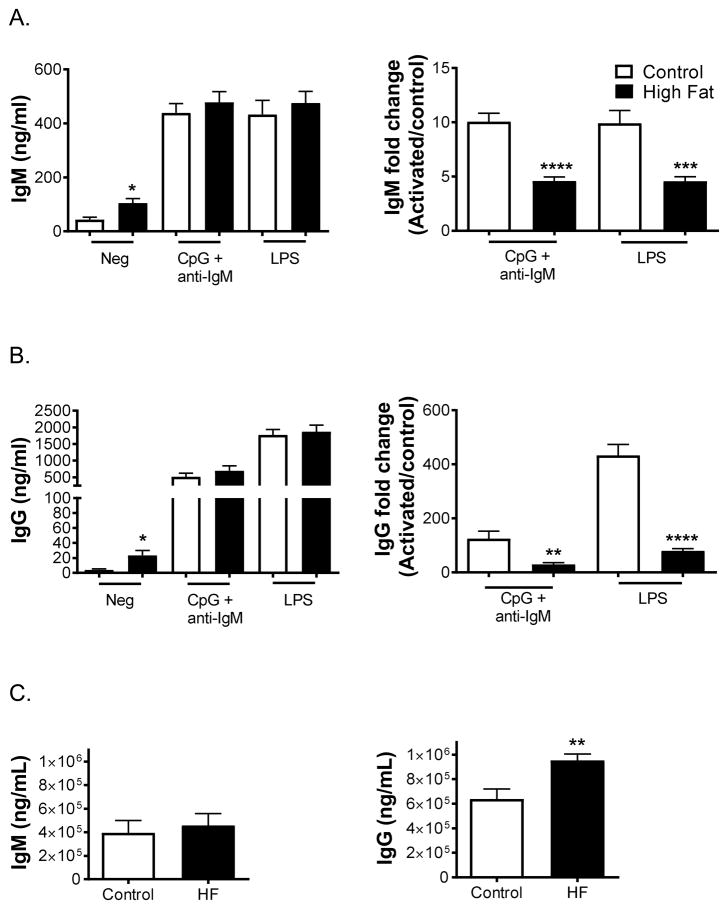
Obesity is associated with increased risk for infections and poor responses to vaccinations, which may be due to compromised B cell function. However, there is limited information about the influence of obesity on B cell function and underlying factors that modulate B cell responses. Therefore, we studied B cell cytokine secretion and/or Ab production across obesity models. In obese humans, B cell IL-6 secretion was lowered and IgM levels were elevated upon ex vivo anti-BCR/TLR9 stimulation. In murine obesity induced by a high fat diet, ex vivo IgM and IgG were elevated with unstimulated B cells. Furthermore, the high fat diet lowered bone marrow B cell frequency accompanied by diminished transcripts of early lymphoid commitment markers. Murine B cell responses were subsequently investigated upon influenza A/Puerto Rico/8/34 infection using a Western diet model in the absence or presence of docosahexaenoic acid (DHA). DHA, an essential fatty acid with immunomodulatory properties, was tested because its plasma levels are lowered in obesity. Relative to controls, mice consuming the Western diet had diminished Ab titers whereas the Western diet plus DHA improved titers. Mechanistically, DHA did not directly target B cells to elevate Ab levels. Instead, DHA increased the concentration of the downstream specialized proresolving lipid mediators (SPMs) 14-hydroxydocosahexaenoic acid, 17-hydroxydocosahexaenoic acid, and protectin DX. All three SPMs were found to be effective in elevating murine Ab levels upon influenza infection. Collectively, the results demonstrate that B cell responses are impaired across human and mouse obesity models and show that essential fatty acid status is a factor influencing humoral immunity, potentially through an SPM-mediated mechanism.
肥胖与感染风险增加以及疫苗接种反应不佳有关,这可能是由于B细胞功能受损所致。然而,关于肥胖对B细胞功能的影响以及调节B细胞反应的潜在因素的信息有限。因此,我们在不同的肥胖模型中研究了B细胞细胞因子分泌和/或抗体产生情况。在肥胖人群中,体外抗BCR/TLR9刺激后,B细胞IL-6分泌降低,IgM水平升高。在高脂饮食诱导的小鼠肥胖模型中,未刺激的B细胞体外培养时IgM和IgG升高。此外,高脂饮食降低了骨髓B细胞频率,同时早期淋巴细胞定向标志物的转录本减少。随后,我们使用西方饮食模型,在有无二十二碳六烯酸(DHA)的情况下,研究了甲型流感病毒/波多黎各/8/34感染后小鼠B细胞的反应。DHA是一种具有免疫调节特性的必需脂肪酸,由于其在肥胖人群中的血浆水平降低,因此对其进行了测试。相对于对照组,食用西方饮食的小鼠抗体滴度降低,而西方饮食加DHA则提高了抗体滴度。从机制上讲,DHA并非直接作用于B细胞来提高抗体水平。相反,DHA增加了下游特异性促消退脂质介质(SPM)14-羟基二十二碳六烯酸、17-羟基二十二碳六烯酸和保护素DX的浓度。发现所有这三种SPM在流感感染后均能有效提高小鼠抗体水平。总的来说,结果表明在人类和小鼠肥胖模型中B细胞反应均受损,并表明必需脂肪酸状态是影响体液免疫的一个因素,可能是通过一种SPM介导的机制。