Lee Augustine C, Driban Jeffrey B, Price Lori Lyn, Harvey William F, Rodday Angie Mae, Wang Chenchen
Center for Complementary and Integrative Medicine, Division of Rheumatology, Tufts Medical Center, Boston, Massachusetts.
Institute for Clinical Research and Health Policy Studies, Tufts Medical Center, Boston, Massachusetts; Tufts Clinical and Translational Science Institute, Tufts University, Boston, Massachusetts.
J Pain. 2017 Sep;18(9):1096-1110. doi: 10.1016/j.jpain.2017.05.001. Epub 2017 May 10.
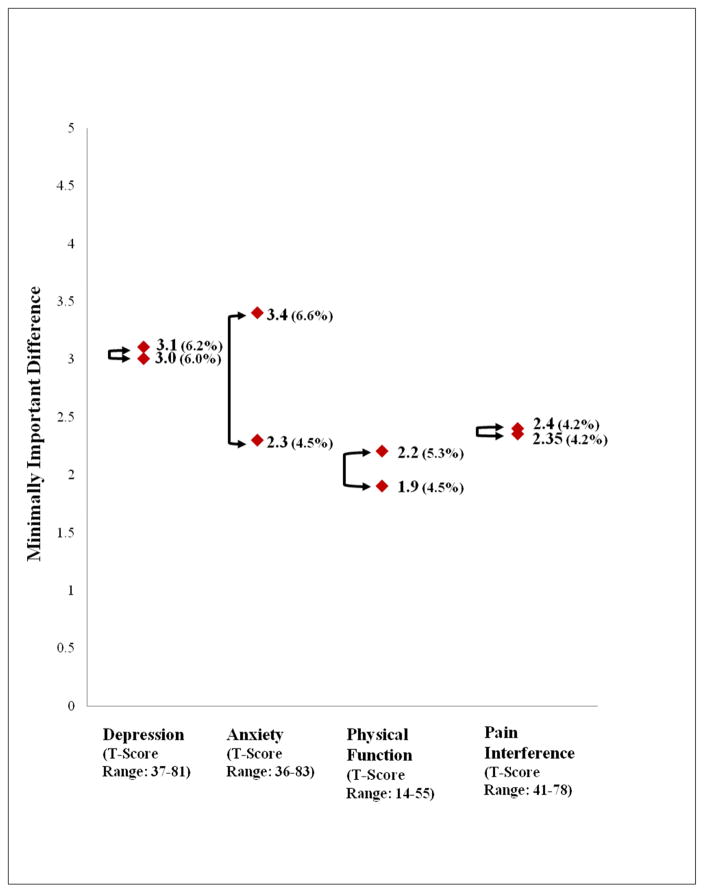
Patient-Reported Outcomes Measurement Information System (PROMIS) instruments can provide valid, interpretable measures of health status among adults with osteoarthritis (OA). However, their ability to detect meaningful change over time is unknown. We evaluated the responsiveness and minimally important differences (MIDs) for 4 PROMIS Short Forms: Physical Function, Pain Interference, Depression, and Anxiety. We analyzed adults with symptomatic knee OA from our randomized trial comparing Tai Chi and physical therapy. Using baseline and 12-week scores, responsiveness was evaluated according to consensus standards by testing 6 a priori hypotheses of the correlations between PROMIS and legacy change scores. Responsiveness was considered high if ≥5 hypotheses were confirmed, and moderate if 3 or 4 were confirmed. MIDs were evaluated according to prospective change for people achieving previously-established MID on legacy comparators. The lowest and highest MIDs meeting a priori quality criteria formed a MID range for each PROMIS Short Form. Among 165 predominantly female (70%) and white (57%) participants, mean age was 61 years and body mass index was 33. PROMIS Physical Function had 5 confirmed hypotheses and Pain Interference, Depression, and Anxiety had 3 or 4. MID ranges were: Depression = 3.0 to 3.1; Anxiety = 2.3 to 3.4; Physical Function = 1.9 to 2.2; and Pain Interference = 2.35 to 2.4. PROMIS Physical Function has high responsiveness, and Depression, Anxiety, and Pain Interference have moderate responsiveness among adults with knee OA. We established the first MIDs for PROMIS in this population, and provided an important standard of reference to better apply or interpret PROMIS in future trials or clinical practice.
This study examined whether PROMIS Short Form instruments (Physical Function, Pain Interference, Depression, and Anxiety) were able to detect change over time among adults with knee OA, and provided minimally important change estimates for each measure. This standard of reference can help apply or interpret these instruments in the future.
患者报告结局测量信息系统(PROMIS)工具可为骨关节炎(OA)成人患者的健康状况提供有效、可解释的测量指标。然而,其随时间检测有意义变化的能力尚不清楚。我们评估了4种PROMIS简表的反应性和最小重要差异(MID):身体功能、疼痛干扰、抑郁和焦虑。我们分析了来自我们比较太极拳和物理治疗的随机试验中的有症状膝骨关节炎成人患者。使用基线和12周评分,根据共识标准通过测试6个关于PROMIS与传统变化评分之间相关性的先验假设来评估反应性。如果≥5个假设得到证实,则反应性被认为高;如果3或4个假设得到证实,则反应性被认为中等。根据在传统比较指标上达到先前确定的MID的人群的前瞻性变化来评估MID。符合先验质量标准的最低和最高MID形成每个PROMIS简表的MID范围。在165名主要为女性(70%)和白人(57%)的参与者中,平均年龄为61岁,体重指数为33。PROMIS身体功能有5个得到证实的假设,疼痛干扰、抑郁和焦虑有3或4个。MID范围为:抑郁=3.0至3.1;焦虑=2.3至3.4;身体功能=1.9至2.2;疼痛干扰=2.35至2.4。在膝骨关节炎成人患者中,PROMIS身体功能具有高反应性,抑郁、焦虑和疼痛干扰具有中等反应性。我们在此人群中建立了PROMIS的首个MID,并提供了一个重要的参考标准,以便在未来试验或临床实践中更好地应用或解释PROMIS。
本研究检查了PROMIS简表工具(身体功能、疼痛干扰、抑郁和焦虑)是否能够检测膝骨关节炎成人患者随时间的变化,并为每个测量指标提供了最小重要变化估计值。这个参考标准有助于在未来应用或解释这些工具。