Kim Youngeun, Jho Eek-Hoon
Department of Life Science, University of Seoul, Seoul 02504, Korea.
BMB Rep. 2017 Jun;50(6):281-282. doi: 10.5483/bmbrep.2017.50.6.078.
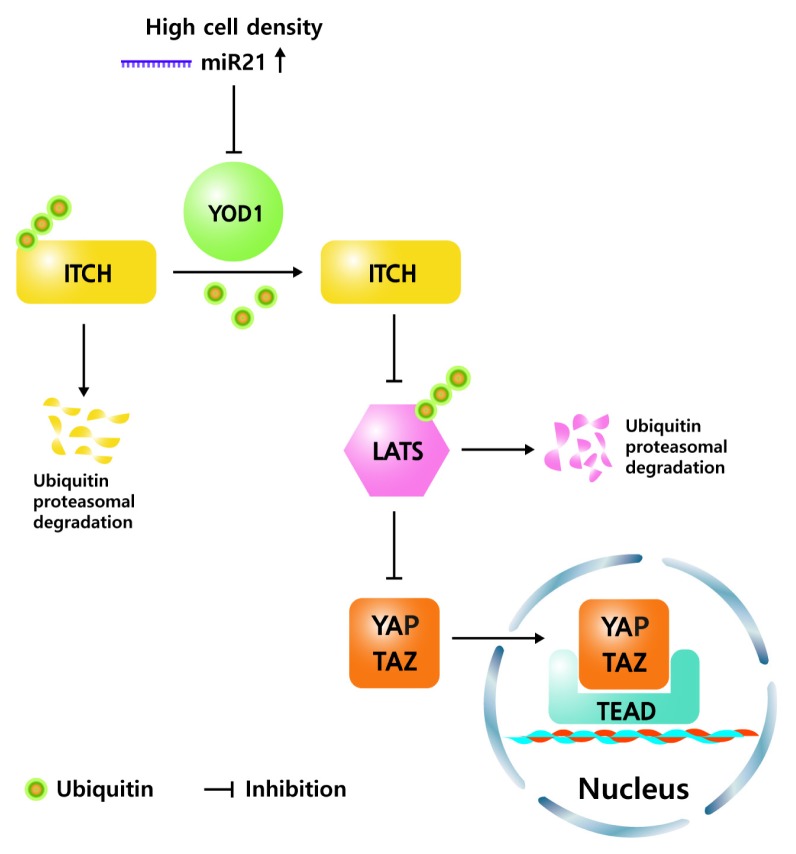
Advances in the understanding of the Hippo signaling as a key regulatory pathway of proliferation and apoptosis have provided mechanical insights for controlling organ size and tumorigenicity. Recently, much attention has been directed to the regulation of LATS1/2 (large tumor suppressor) kinases that phosphorylate YAP/TAZ, a transcriptional co-activator in the Hippo pathway, and control the level and nuclear localization of YAP/TAZ. In our recent work, we showed that deubiquitinase YOD1 stabilizes ITCH, and facilitates ITCH-mediated LATS1/2 ubiquitination and degradation, resulting in increased YAP/TAZ level. Furthermore, we found that the YOD1- ITCH-LATS1/2-YAP/TAZ signaling axis is controlled by the differential expression of miR-21 in a cell-density-dependent manner. Using a transgenic mouse model, we showed that the inducible expression of YOD1 enhances the proliferation of hepatocytes and leads to hepatomegaly in a YAP/TAZ-activitydependent manner. Moreover, a strong correlation was observed between YOD1 and YAP expression in liver cancer patients. Overall, our data suggest that YOD1 is a novel regulator of the Hippo pathway, and thereby a potential therapeutic target for liver cancer. [BMB Reports 2017; 50(6): 281-282].
对作为增殖和凋亡关键调控途径的Hippo信号通路理解的进展,为控制器官大小和肿瘤发生提供了机制性见解。最近,人们将大量注意力转向了对LATS1/2(大肿瘤抑制因子)激酶的调控,该激酶使YAP/TAZ磷酸化,YAP/TAZ是Hippo通路中的一种转录共激活因子,并控制YAP/TAZ的水平和核定位。在我们最近的工作中,我们表明去泛素化酶YOD1使ITCH稳定,并促进ITCH介导的LATS1/2泛素化和降解,从而导致YAP/TAZ水平升高。此外,我们发现YOD1-ITCH-LATS1/2-YAP/TAZ信号轴以细胞密度依赖的方式受miR-21差异表达的控制。使用转基因小鼠模型,我们表明YOD1的诱导表达以YAP/TAZ活性依赖的方式增强肝细胞增殖并导致肝肿大。此外,在肝癌患者中观察到YOD1和YAP表达之间存在强相关性。总体而言,我们的数据表明YOD1是Hippo通路的一种新型调节因子,因此是肝癌的潜在治疗靶点。[《BMB报告》2017年;50(6):281 - 282]