Yang Rui, Liu Xinhua, Thakolwiboon Smathorn, Zhu Jianhui, Pei Xiucong, An Mingrui, Tan Zhijing, Lubman David M
Department of Surgery, University of Michigan Medical Center, Ann Arbor, Michigan 48109, USA.
Experimental Center for Science and Technology, Shanghai University of Traditional Chinese Medicine, Shanghai 201203, China.
J Proteomics Bioinform. 2016 Oct;9(10):238-247. doi: 10.4172/jpb.1000412. Epub 2016 Oct 3.
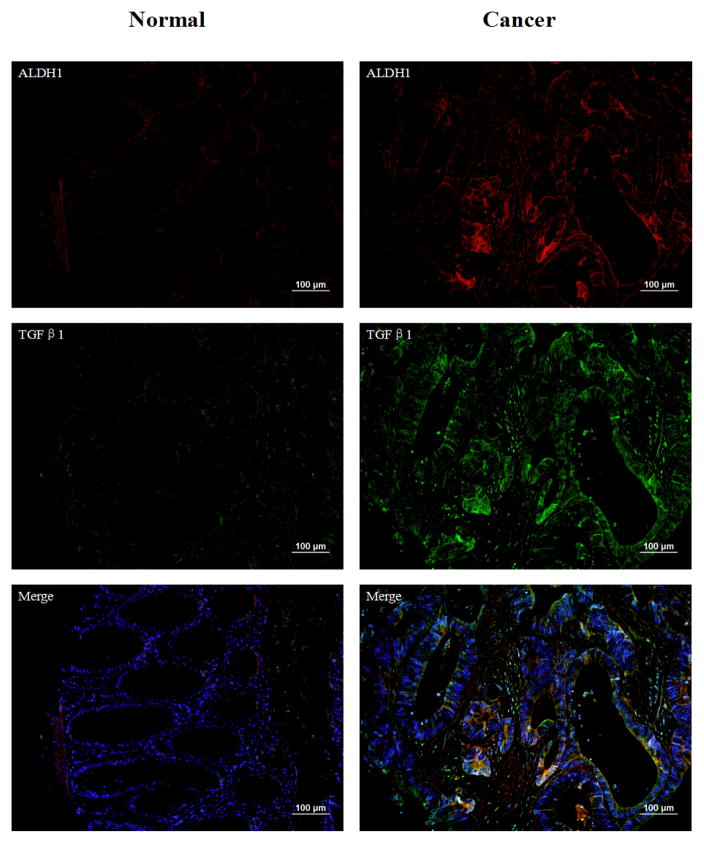
ALDH has been shown to be a marker that denotes a sub-population of cancer stem cells in colorectal and other cancers. This sub-population of cells shows an increased risk for tumor initiation, metastasis, and resistance to chemotherapy and radiation resulting in recurrence and death. It is thus essential to identify the important signaling pathways related to ALDH1+ CSCs in colon cancer. The essential issue becomes to isolate pure sub-populations of cells from heterogeneous tissues for further analysis. To achieve this goal, tissues from colorectal cancer Stage III patients were immuno-stained with ALDH1 antibody. Target ALDH1+ and ALDH1- cells from the same tissue were micro-dissected using Laser Capture Microdissection (LCM). Captured cells were lysed and analyzed using LC-MS/MS where around 20,000 cells were available for analysis. This analysis resulted in 134 proteins which were differentially expressed between ALDH1+ and ALDH1- cells in three patient sample pairs. Based on these differentially expressed proteins an IPA pathway analysis was performed that showed two key pathways in cell to cell signaling and organismal injury and abnormalities. The IPA analysis revealed β-catenin, NFκB (p65) and TGFβ1 as important cancer-related proteins in these pathways. A TMA validation using immunofluorescence staining of tissue micro-arrays including 170 cases was used to verify that these key proteins were highly overexpressed in ALDH1+ cells in colon cancer tissues compared to ALDH1- cells.
醛脱氢酶(ALDH)已被证明是一种标志物,可指示结直肠癌和其他癌症中的癌症干细胞亚群。该细胞亚群显示出肿瘤起始、转移以及对化疗和放疗产生耐药性的风险增加,从而导致复发和死亡。因此,确定与结肠癌中ALDH1+癌症干细胞相关的重要信号通路至关重要。关键问题在于从异质性组织中分离出纯细胞亚群以进行进一步分析。为实现这一目标,对III期结直肠癌患者的组织用ALDH1抗体进行免疫染色。使用激光捕获显微切割(LCM)技术从同一组织中显微切割出目标ALDH1+和ALDH1-细胞。捕获的细胞经裂解后使用液相色谱-串联质谱(LC-MS/MS)进行分析,大约有20000个细胞可供分析。该分析产生了134种在三对患者样本的ALDH1+和ALDH1-细胞之间差异表达的蛋白质。基于这些差异表达的蛋白质进行了IPA通路分析,结果显示在细胞间信号传导以及机体损伤和异常方面有两条关键通路。IPA分析揭示β-连环蛋白、NFκB(p65)和TGFβ1是这些通路中重要的癌症相关蛋白。使用包括170个病例的组织微阵列免疫荧光染色进行组织微阵列分析(TMA)验证,以证实与ALDH1-细胞相比,这些关键蛋白在结肠癌组织的ALDH1+细胞中高度过表达。