Pupo Gulietta M, Boyd Suzanah C, Fung Carina, Carlino Matteo S, Menzies Alexander M, Pedersen Bernadette, Johansson Peter, Hayward Nicholas K, Kefford Richard F, Scolyer Richard A, Long Georgina V, Rizos Helen
Centre for Cancer Research, The Westmead Millennium Institute for Medical Research, University of Sydney, Westmead Hospital, Westmead, NSW Australia.
Melanoma Institute Australia, Sydney, NSW Australia.
Biomark Res. 2017 May 11;5:17. doi: 10.1186/s40364-017-0098-3. eCollection 2017.
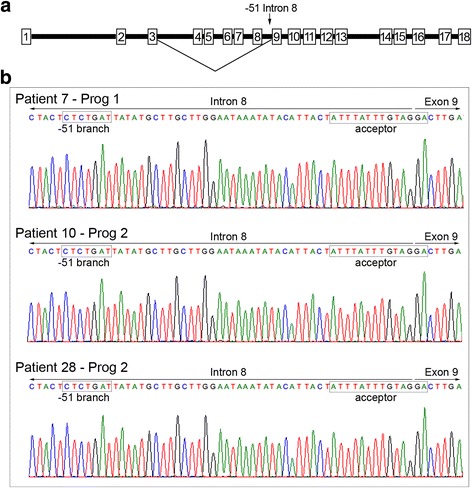
Alternate BRAF splicing is the most common mechanism of acquired resistance to BRAF inhibitor treatment in melanoma. Recently, alternate BRAF exon 4-8 splicing was shown to involve an intronic mutation, located 51 nucleotides upstream of exon 9 within a predicted splicing branch point. This intronic mutation was identified in a single cell line but has not been examined in vivo. Herein we demonstrate that in three melanomas biopsied from patients with acquired resistance to BRAF inhibitors, alternate BRAF exon 4-8 splicing is not associated with this intronic branch point mutation. We also confirm that melanoma cells expressing BRAF splicing variants retain exquisite sensitivity to existing FDA-approved MEK inhibitors.
BRAF可变剪接是黑色素瘤中获得性BRAF抑制剂耐药最常见的机制。最近,BRAF外显子4-8可变剪接被证明涉及一个内含子突变,该突变位于外显子9上游51个核苷酸处的一个预测剪接分支点内。此内含子突变在一个单细胞系中被鉴定出来,但尚未在体内进行研究。在此我们证明,在取自对BRAF抑制剂获得性耐药患者的三个黑色素瘤活检样本中,BRAF外显子4-8可变剪接与该内含子分支点突变无关。我们还证实,表达BRAF剪接变体的黑色素瘤细胞对现有的FDA批准的MEK抑制剂仍保持高度敏感性。