Lacombe Jerome, Brooks Carla, Hu Chengcheng, Menashi Emmanuel, Korn Ronald, Yang Farley, Zenhausern Frederic
a Center for Applied NanoBioscience and Medicine, University of Arizona, Chandler, Arizona 85226.
b Center for Applied NanoBioscience and Medicine, University of Arizona, Phoenix, Arizona 85004.
Radiat Res. 2017 Jul;188(1):75-81. doi: 10.1667/RR14707.1. Epub 2017 May 15.
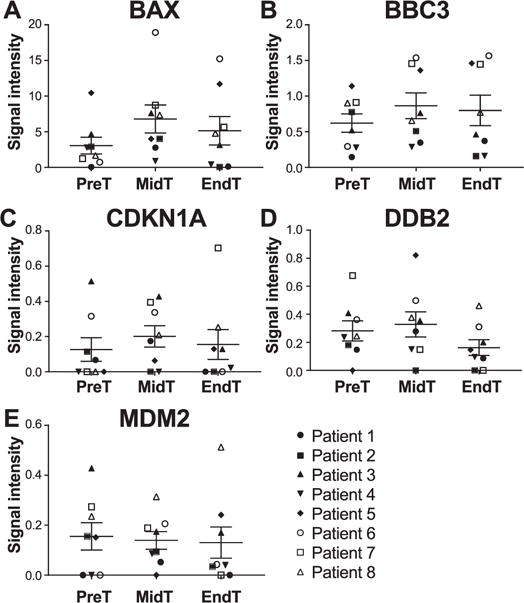
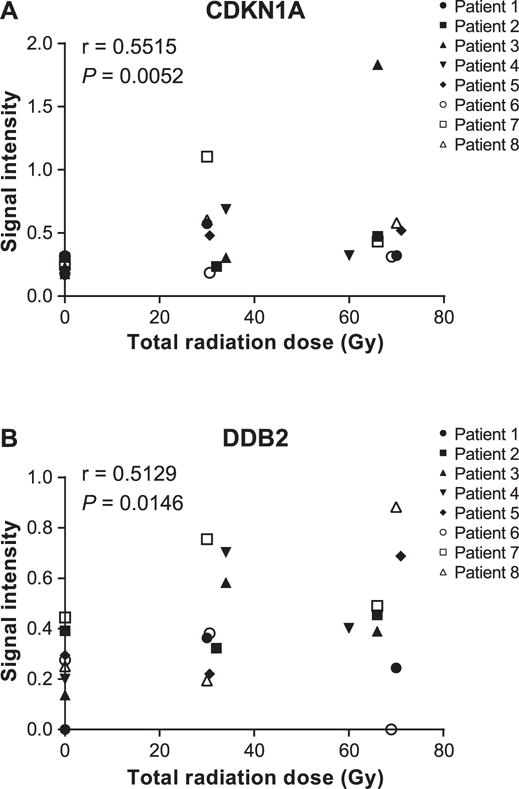
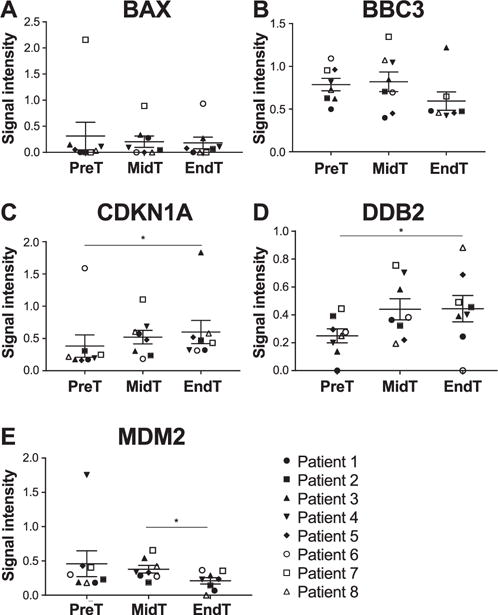
Saliva, a biological fluid, is a promising candidate for novel approaches to prognosis, clinical diagnosis, monitoring and management of patients with both oral and systemic diseases. However, to date, saliva has not been widely investigated as a biomarker for radiation exposure. Since white blood cells are also present in saliva, it should theoretically be possible to investigate the transcriptional biomarkers of radiation exposure classically studied in whole blood. Therefore, we collected whole blood and saliva samples from eight head and neck cancer patients before the start of radiation treatment, at mid-treatment and after treatment. We then used a panel of five genes: BAX, BBC3, CDKN1A, DDB2 and MDM2, designated for assessing radiation dose in whole blood to evaluate gene expression changes that can occur during radiotherapy. The results revealed that the expression of the five genes did not change in whole blood. However, in saliva, CDKN1A and DDB2 were significantly overexpressed at the end, compared to the start, of radiotherapy, and MDM2 was significantly underexpressed between mid-treatment and at the end of treatment. Interestingly, CDKN1A and DDB2 expressions also showed an increasing monotonic relationship with total radiation dose received during radiotherapy. To our knowledge, these results show for the first time the ability to detect gene expression changes in saliva after head and neck cancer radiotherapy, and pave the way for further promising studies validating saliva as a minimally invasive means of biofluid collection to directly measure radiation dose escalation during treatment.
唾液作为一种生物流体,是口腔和全身性疾病患者预后、临床诊断、监测及管理新方法的一个有潜力的候选对象。然而,迄今为止,唾液尚未作为辐射暴露的生物标志物得到广泛研究。由于唾液中也存在白细胞,理论上应该可以研究全血中经典研究的辐射暴露转录生物标志物。因此,我们在放疗开始前、治疗中期和治疗后收集了8名头颈部癌患者的全血和唾液样本。然后,我们使用一组五个基因:BAX、BBC3、CDKN1A、DDB2和MDM2,这些基因用于评估全血中的辐射剂量,以评估放疗期间可能发生的基因表达变化。结果显示,这五个基因在全血中的表达没有变化。然而,在唾液中,与放疗开始时相比,放疗结束时CDKN1A和DDB2显著过表达,MDM2在治疗中期和治疗结束之间显著低表达。有趣的是,CDKN1A和DDB2的表达也与放疗期间接受的总辐射剂量呈单调递增关系。据我们所知,这些结果首次表明了在头颈部癌放疗后检测唾液中基因表达变化的能力,并为进一步开展有前景的研究铺平了道路,这些研究将验证唾液作为一种微创生物流体采集手段,用于直接测量治疗期间辐射剂量的增加。