Abera Semaw Ferede, Adane Kelemework
School of Public Health, College of Health Sciences, Mekelle University, Mekelle, Ethiopia.
Kilte Awlaelo- Health and Demographic Surveillance Site, Mekelle University, Tigray, Ethiopia.
BMC Public Health. 2017 May 15;17(1):449. doi: 10.1186/s12889-017-4410-9.
Despite the fact that prisoners are exposed to different health problems, prison health problems are often overlooked by researchers and no previous study has investigated nutritional problems of prisoners in Ethiopia.
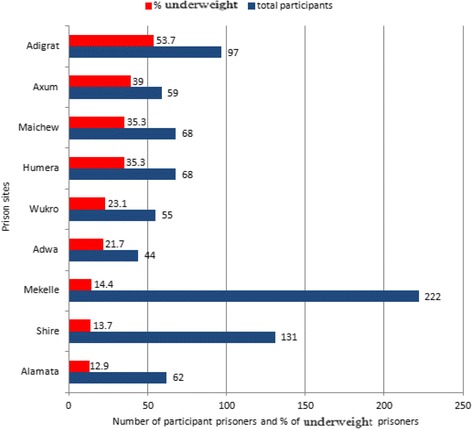
Cross-sectional data were collected from 809 prisoners from nine major prison setups in the Tigray region of Ethiopia. A proportional stratified sampling technique was used to select the total number of participants needed from each prison site. The outcome of this study was underweight defined as body mass index (BMI) of less than 18.5 kg/m. Multivariable binary logistic regression was performed to identify determinants of underweight at a p-value of less than 0.05.
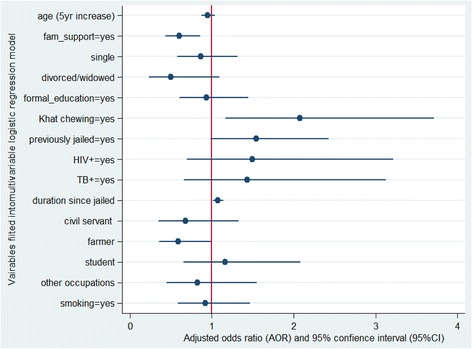
The prevalence of underweight was 25.2% (95% CI; 22.3%- 28.3%). Khat Chewing (OR = 2.08; 95% CI = 1.17, 3.70) and longer duration of incarceration (OR = 1.07; 95% CI = 1.01, 1.14) were associated with a significantly increased risk of underweight. Additionally, previous incarceration (OR = 1.54; 95% CI = 0.99, 2.42) was a relevant determinant of underweight with a borderline significance. In contrast, family support (OR = 0.61; 95% CI = 0.43, 0.85) and farmer occupation (OR = 0.59; 95% CI = 0.36, 0.98) compared to those who were unemployed were important protective determinants significantly associated with lower risk of underweight.
In summary, the burden of underweight was higher among prisoners in Tigray region who had respiratory tract infections. The study has enhanced our understanding of the determinants of underweight in the prison population. We strongly recommend that nutritional support, such as therapeutic feeding programs for severely or moderately underweight prisoners, and environmental health interventions of the prison setups should be urgently implemented to correct the uncovered nutritional problem and its associated factors for improving the health status of prisoners.
尽管囚犯面临各种健康问题,但监狱健康问题往往被研究人员忽视,此前尚无研究调查埃塞俄比亚囚犯的营养问题。
从埃塞俄比亚提格雷地区九个主要监狱设施的809名囚犯中收集横断面数据。采用比例分层抽样技术从每个监狱地点选取所需的参与者总数。本研究的结果是体重不足,定义为体重指数(BMI)低于18.5kg/m²。进行多变量二元逻辑回归以确定p值小于0.05时体重不足的决定因素。
体重不足的患病率为25.2%(95%CI:22.3%-28.3%)。咀嚼恰特草(OR=2.08;95%CI=1.17,3.70)和较长的监禁时间(OR=1.07;95%CI=1.01,1.14)与体重不足风险显著增加相关。此外,既往监禁(OR=1.54;95%CI=0.99,2.42)是体重不足的一个相关决定因素,具有临界显著性。相比之下,与失业者相比,家庭支持(OR=0.61;95%CI=0.43,0.85)和农民职业(OR=0.59;95%CI=0.36,0.98)是重要的保护决定因素,与体重不足风险较低显著相关。
总之,提格雷地区患有呼吸道感染的囚犯中体重不足的负担更高。该研究增进了我们对监狱人群体重不足决定因素的理解。我们强烈建议,应立即实施营养支持,如为严重或中度体重不足的囚犯提供治疗性喂养计划,以及监狱设施的环境卫生干预措施,以纠正未被发现的营养问题及其相关因素,从而改善囚犯的健康状况。