Zhang Haiwei, Chen Fanglin, He Yongpeng, Yi Lin, Ge Chuang, Shi Xiaolong, Tang Chao, Wang Donglin, Wu Yongzhong, Nian Weiqi
Key Laboratory of Oncology, Chongqing cancer Hospital & Institute & Cancer center, Chongqing 400030, P.R. China.
Chongqing Key Laboratory of Translational Research for Cancer Metastasis and Individualized Treatment, Chongqing Cancer Institute, Chongqing 400030, P.R. China.
Biosci Rep. 2017 Jun 21;37(3). doi: 10.1042/BSR20160478. Print 2017 Jun 30.
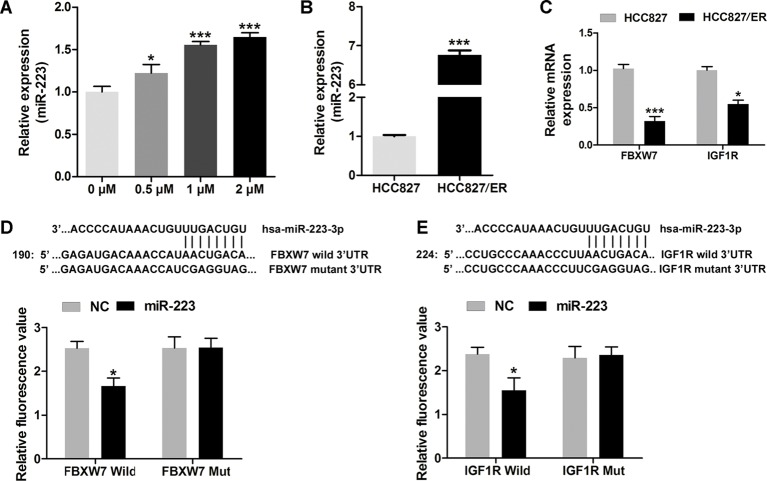
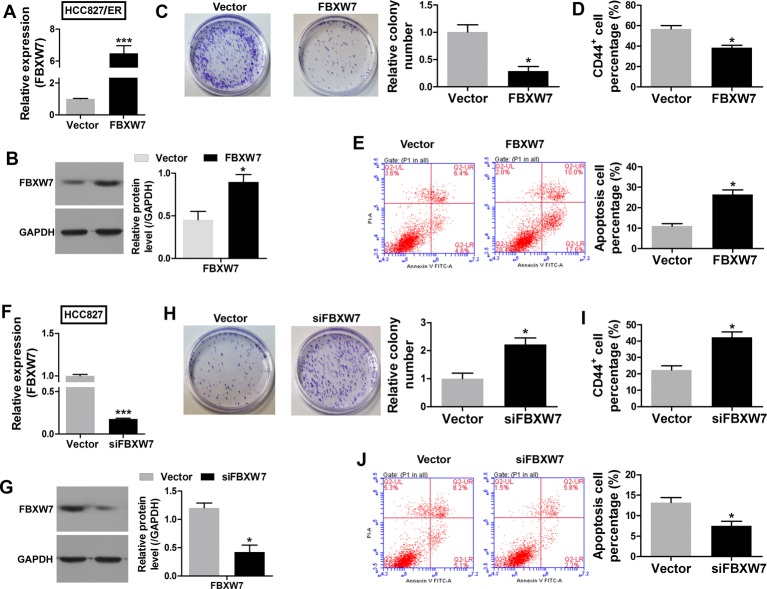
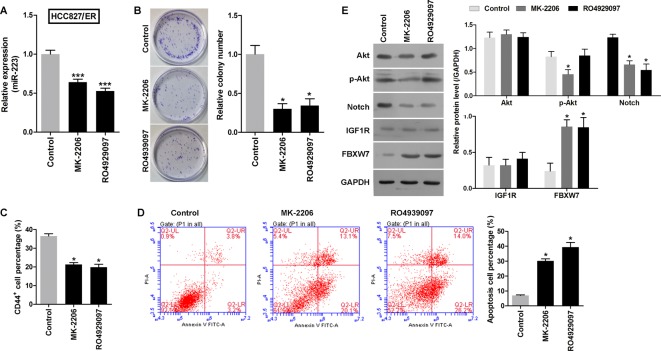
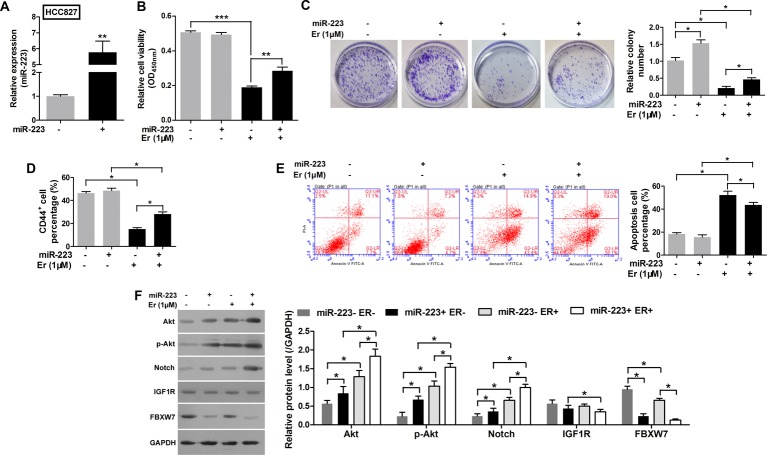
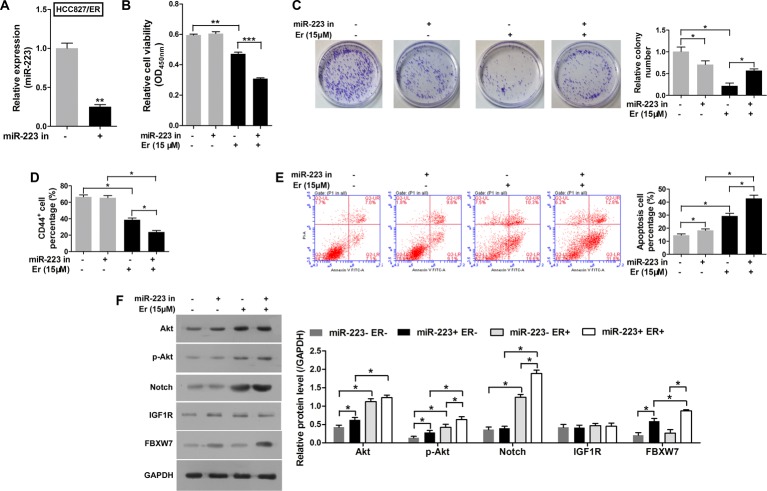
Recent evidence supports a role for microRNA-223 (miR-223) in modulating tumor cell sensitivity to chemotherapeutic drugs; however, its role in cellular resistance to the effects of epidermal growth factor receptor tyrosine kinase inhibitors (EGFR-TKIs) used in treatment of non-small cell lung cancer (NSCLC) remains to be elucidated. The levels of miR-223 in parental cell line (HCC827) and erlotinib resistant HCC827 cell line (HCC827/ER) were detected by qRT-PCR. HCC827/ER cells were treated with MK-2206 to block the Akt signaling pathway or RO4929097 to block the Notch signaling pathway, and then transfected with an miR-223 inhibitor or interference expression plasmid of F-Box/WD repeat-containing protein 7 (FBXW7) or insulin-like growth factor 1 receptor (IGF1R). HCC827 cells were transfected with miR-223 mimics. Next, CCK-8, colony formation, and flow cytometric apoptosis assays were used to assess cell resistance to erlotinib. When compared with its expression in HCC827 cells, miR-223 expression was significantly up-regulated in HCC827/ER cells. Blocking either the Akt or Notch signaling pathway and reducing miR-223 expression resulted in decreased resistance in HCC827/ER cells. Conversely, increasing miR-223 expression induced cell resistance to erlotinib in HCC827 cells. miR-223 enhanced resistance to erlotinib by down-regulating expression. Reducing expression lowered resistance to erlotinib in HCC827/ER cells, while interference with expression of produced no significant effect. This study demonstrated that NSCLC cells can up-regulate their levels of miR-223 expression via the Akt and Notch signaling pathways. miR-223 may serve as an important regulator of erlotinib sensitivity in NSCLC cells by targeting .
近期证据支持微小RNA-223(miR-223)在调节肿瘤细胞对化疗药物敏感性方面发挥作用;然而,其在细胞对用于治疗非小细胞肺癌(NSCLC)的表皮生长因子受体酪氨酸激酶抑制剂(EGFR-TKIs)效应的耐药性中的作用仍有待阐明。通过qRT-PCR检测亲本细胞系(HCC827)和厄洛替尼耐药的HCC827细胞系(HCC827/ER)中miR-223的水平。用MK-2206处理HCC827/ER细胞以阻断Akt信号通路,或用RO4929097处理以阻断Notch信号通路,然后用miR-223抑制剂或含F-Box/WD重复蛋白7(FBXW7)或胰岛素样生长因子1受体(IGF1R)的干扰表达质粒进行转染。用miR-223模拟物转染HCC827细胞。接下来,使用CCK-8、集落形成和流式细胞术凋亡分析来评估细胞对厄洛替尼的耐药性。与HCC827细胞中的表达相比,miR-223在HCC827/ER细胞中的表达显著上调。阻断Akt或Notch信号通路并降低miR-223表达导致HCC827/ER细胞耐药性降低。相反,增加miR-223表达诱导HCC827细胞对厄洛替尼产生耐药性。miR-223通过下调 表达增强对厄洛替尼的耐药性。降低 表达降低了HCC827/ER细胞对厄洛替尼的耐药性,而干扰 表达则未产生显著影响。本研究表明,NSCLC细胞可通过Akt和Notch信号通路上调其miR-223表达水平。miR-223可能通过靶向 成为NSCLC细胞中厄洛替尼敏感性的重要调节因子。