Spinal Cord Injury Center, University Hospital Balgrist, Forchstrasse 340, 8008, Zurich, Switzerland.
Department of Neurology, University Hospital Zurich, Frauenklinikstrasse 26, 8091, Zurich, Switzerland.
Sci Rep. 2017 May 15;7(1):1922. doi: 10.1038/s41598-017-02189-y.
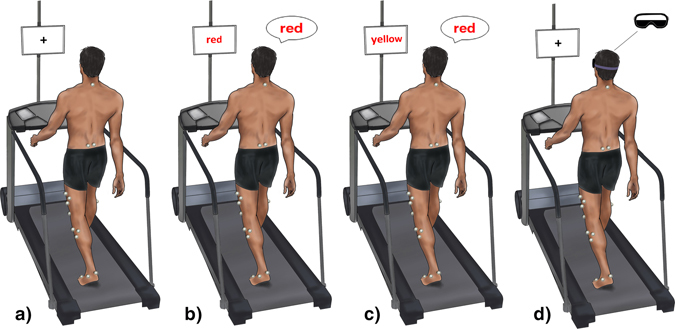
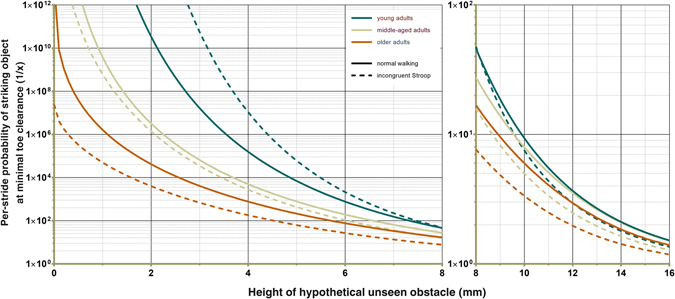
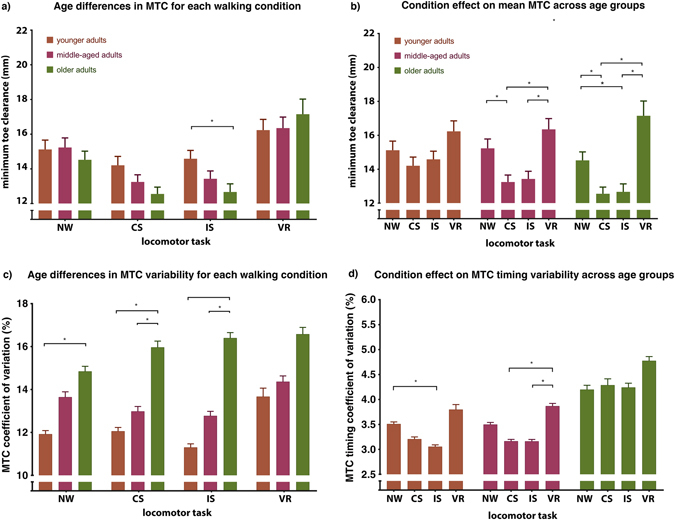
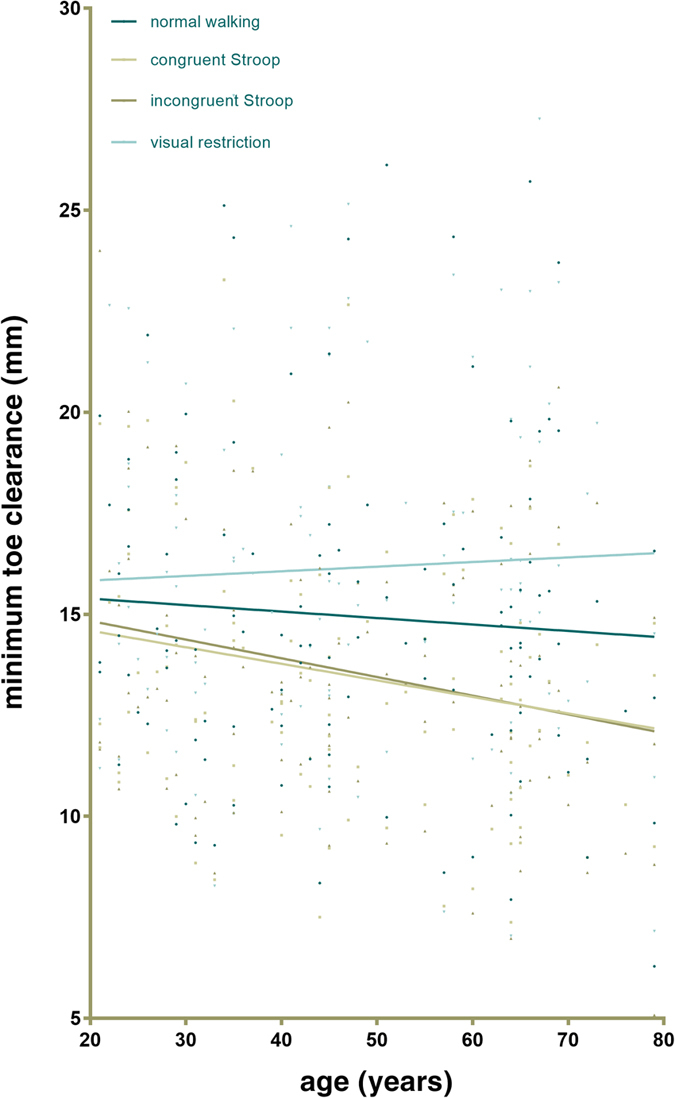
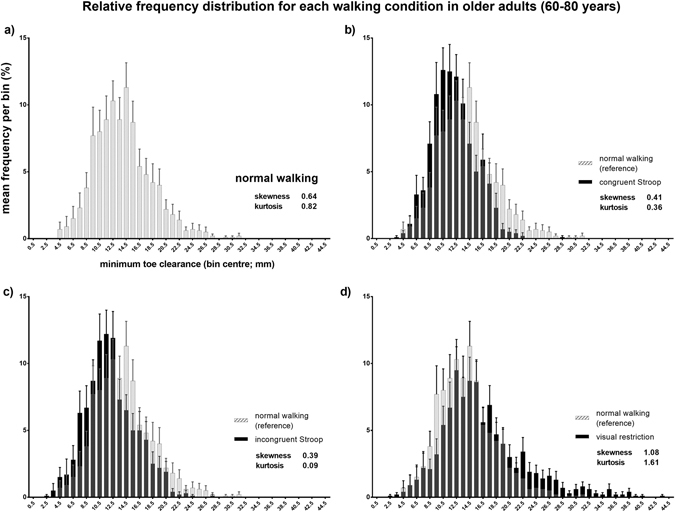
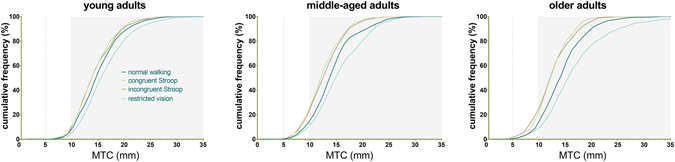
Minimum toe clearance (MTC) occurs during a highly dynamic phase of the gait cycle and is associated with the highest risk of unintentional contact with obstacles or the ground. Age, cognitive function, attention and visual feedback affect foot clearance but how these factors interact to influence MTC control is not fully understood. We measured MTC in 121 healthy individuals aged 20-80 under four treadmill walking conditions; normal walking, lower visual field restriction and two Stroop colour/word naming tasks of two difficulty levels. Competition for cognitive and attentional resources from the Stroop task resulted in significantly lower mean MTC in older adults, with the difficult Stroop task associated with a higher frequency of extremely low MTC values and subsequently an increased modelled probability of tripping in this group. While older adults responded to visual restriction by markedly skewing MTC distributions towards higher values, this condition was also associated with frequent, extremely low MTC values. We reveal task-specific, age-dependent patterns of MTC control in healthy adults. Age-related differences are most pronounced during heavy, distracting cognitive load. Analysis of critically-low MTC values during dual-task walking may have utility in the evaluation of locomotor control and fall risk in older adults and patients with motor control deficits.
最小脚趾间隙(MTC)发生在步态周期的高度动态阶段,与与障碍物或地面意外接触的最高风险相关。年龄、认知功能、注意力和视觉反馈会影响足间隙,但这些因素如何相互作用影响 MTC 控制尚不完全清楚。我们在四个跑步机行走条件下测量了 121 名 20-80 岁健康个体的 MTC:正常行走、下视场限制和两个难度水平的两种斯楚普颜色/单词命名任务。斯楚普任务对认知和注意力资源的竞争导致老年人大致的平均 MTC 显著降低,而困难的斯楚普任务与极低 MTC 值的更高频率相关,并且在该组中增加了绊倒的模型概率。虽然老年人通过明显将 MTC 分布向更高值倾斜来应对视觉限制,但这种情况也与频繁的极低 MTC 值相关。我们揭示了健康成年人中特定于任务、依赖年龄的 MTC 控制模式。在繁重、分散注意力的认知负荷下,与年龄相关的差异最为明显。在双重任务行走过程中分析临界低 MTC 值可能有助于评估老年人和运动控制障碍患者的运动控制和跌倒风险。