Killeen Tim, Easthope Christopher S, Filli Linard, Lőrincz Lilla, Schrafl-Altermatt Miriam, Brugger Peter, Linnebank Michael, Curt Armin, Zörner Björn, Bolliger Marc
Spinal Cord Injury Center , University Hospital Balgrist , Forchstrasse 340, 8008 Zurich , Switzerland.
Department of Neurology , University Hospital Zurich , Frauenklinikstrasse 26, 8091 Zurich , Switzerland.
R Soc Open Sci. 2017 Jan 25;4(1):160993. doi: 10.1098/rsos.160993. eCollection 2017 Jan.
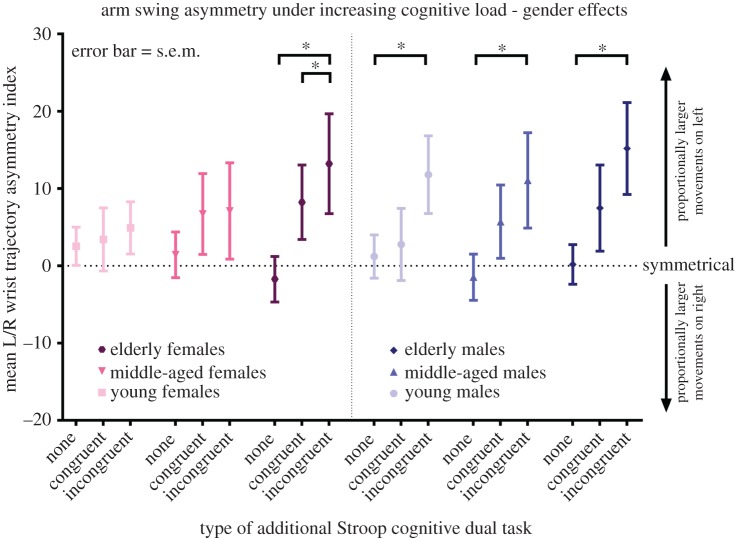
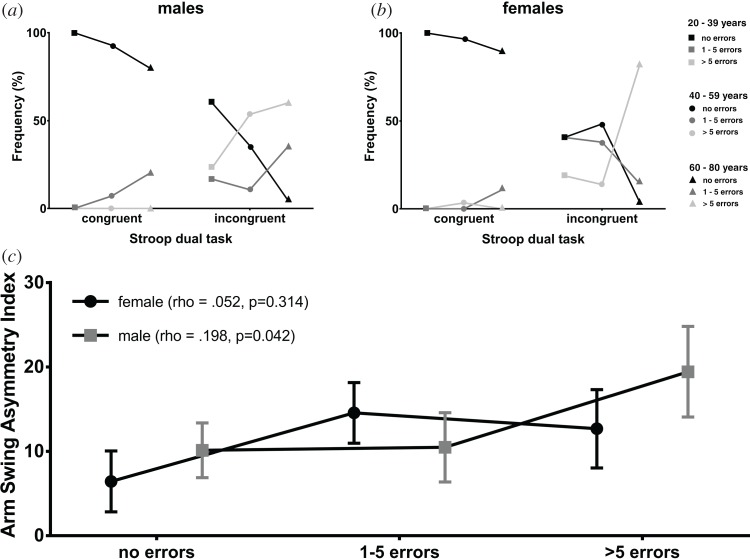
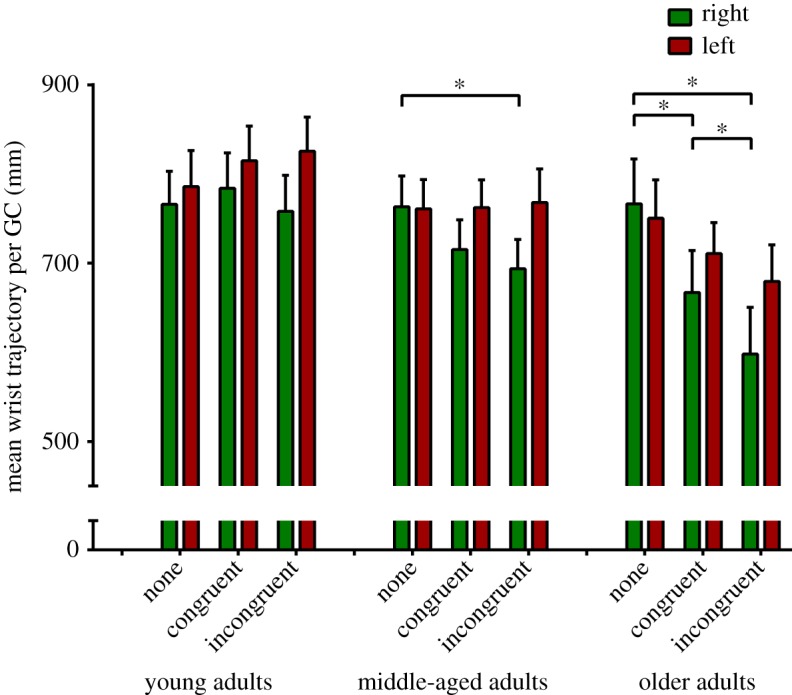
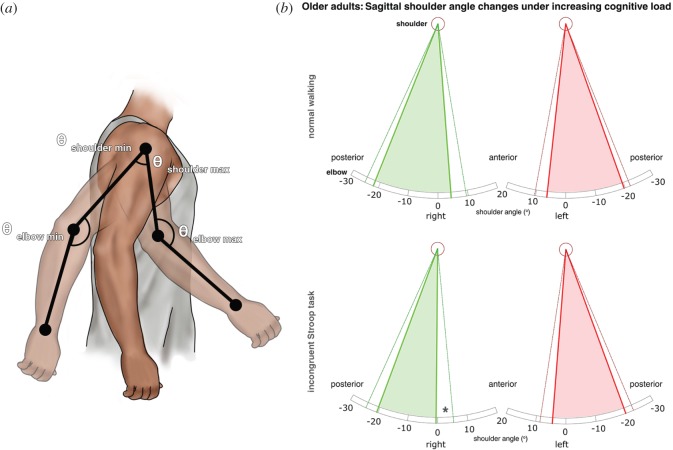
Human arm swing looks and feels highly automated, yet it is increasingly apparent that higher centres, including the cortex, are involved in many aspects of locomotor control. The addition of a cognitive task increases arm swing asymmetry during walking, but the characteristics and mechanism of this asymmetry are unclear. We hypothesized that this effect is lateralized and a Stroop word-colour naming task-primarily involving left hemisphere structures-would reduce right arm swing only. We recorded gait in 83 healthy subjects aged 18-80 walking normally on a treadmill and while performing a congruent and incongruent Stroop task. The primary measure of arm swing asymmetry-an index based on both three-dimensional wrist trajectories in which positive values indicate proportionally smaller movements on the right-increased significantly under dual-task conditions in those aged 40-59 and further still in the over-60s, driven by reduced right arm flexion. Right arm swing attenuation appears to be the norm in humans performing a locomotor-cognitive dual-task, confirming a prominent role of the brain in locomotor behaviour. Women under 60 are surprisingly resistant to this effect, revealing unexpected gender differences atop the hierarchical chain of locomotor control.
人类的手臂摆动看起来和感觉起来高度自动化,但越来越明显的是,包括皮层在内的高级中枢参与了运动控制的许多方面。执行认知任务会增加步行过程中手臂摆动的不对称性,但这种不对称性的特征和机制尚不清楚。我们假设这种效应是单侧化的,并且一项主要涉及左半球结构的斯特鲁普单词-颜色命名任务只会减少右臂摆动。我们记录了83名年龄在18至80岁之间的健康受试者在跑步机上正常行走以及执行一致和不一致的斯特鲁普任务时的步态。手臂摆动不对称性的主要测量指标——一个基于三维手腕轨迹的指数,其中正值表示右侧的运动比例较小——在40至59岁的受试者在双任务条件下显著增加,在60岁以上的受试者中增加得更多,这是由右臂屈曲减少所致。右臂摆动减弱似乎是执行运动-认知双任务的人类的常态,这证实了大脑在运动行为中的重要作用。60岁以下的女性对这种效应具有惊人的抵抗力,揭示了在运动控制层次链之上意想不到的性别差异。