Laboratory of Immunoregulation and Inflammation, Institut Pasteur de Montevideo, Montevideo, Uruguay.
Immunobiology Department, Montevideo Faculty of Medicine, University of the Republic, Montevideo, Uruguay.
Sci Rep. 2017 May 15;7(1):1892. doi: 10.1038/s41598-017-01836-8.
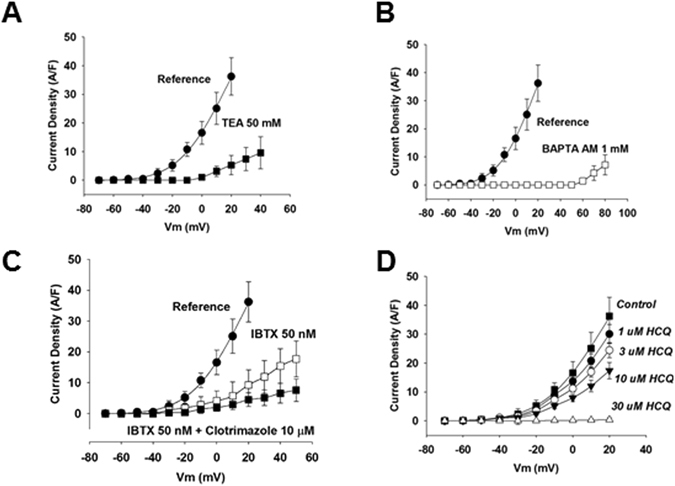
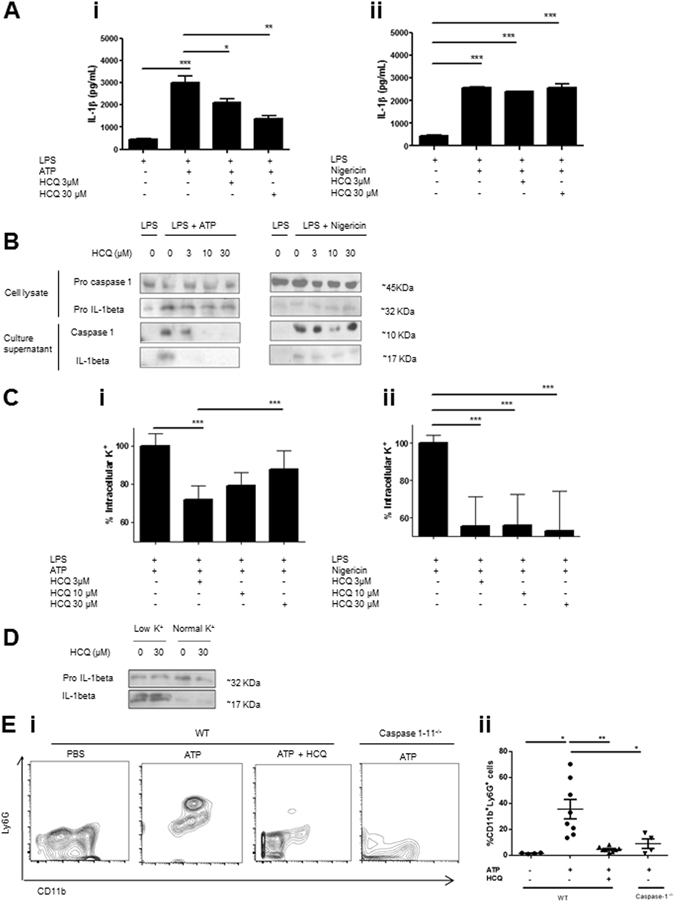
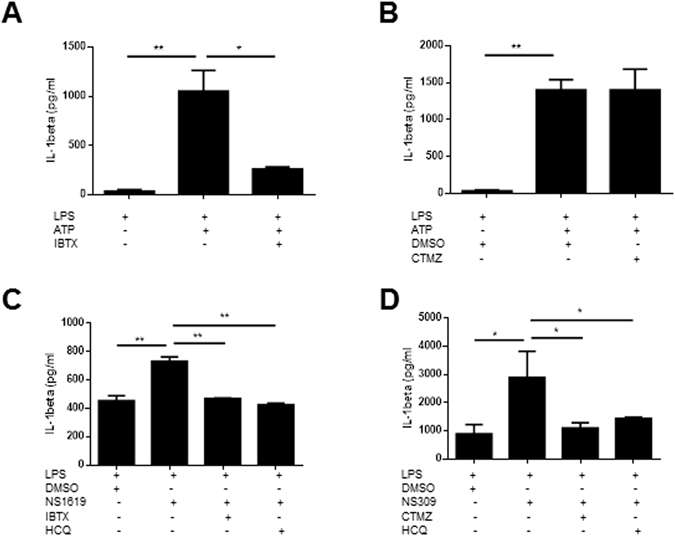
Antimalarials have demonstrated beneficial effects in Systemic Lupus Erithematosus and Rheumatoid Arthritis. However, the mechanisms and the molecular players targeted by these drugs remain obscure. Although hydroxychloroquine (HCQ) is a known ion channel inhibitor, this property has not been linked to its anti-inflammatory effects. We aimed to study whether HCQ inhibits pro-inflammatory ion channels. Electrophysiology experiments demonstrated that HCQ inhibited Ca-activated K conductance in THP-1 macrophages in a dose-dependent manner. In macrophages, ATP-induced K efflux plays a key role in activating the NLRP3 inflammasome. ATP-induced IL-1beta secretion was controlled by the KCa1.1 inhibitor iberiotoxin. NS1619 and NS309 (KCa1.1 and KCa3.1 activators respectively) induced the secretion of IL-1beta. This effect was inhibited by HCQ and also by iberiotoxin and clotrimazol (KCa3.1 inhibitor), arguing against off-target effect. In vitro, HCQ inhibited IL-1beta and caspase 1 activation induced by ATP in a dose-dependent manner. HCQ impaired K efflux induced by ATP. In vivo, HCQ inhibited caspase 1-dependent ATP-induced neutrophil recruitment. Our results show that HCQ inhibits Ca-activated K channels. This effect may lead to impaired inflammasome activation. These results are the basis for i) a novel anti-inflammatory mechanism for HCQ and ii) a new strategy to target pro-rheumatic Ca-activated K channels.
抗疟药在系统性红斑狼疮和类风湿关节炎中显示出有益的效果。然而,这些药物的作用机制和靶向的分子靶点仍然不清楚。虽然羟氯喹(HCQ)是一种已知的离子通道抑制剂,但这一特性尚未与其抗炎作用联系起来。我们旨在研究 HCQ 是否抑制促炎离子通道。电生理学实验表明,HCQ 以剂量依赖的方式抑制 THP-1 巨噬细胞中的 Ca 激活的 K 电导。在巨噬细胞中,ATP 诱导的 K 外流在激活 NLRP3 炎性小体中起着关键作用。ATP 诱导的 IL-1β分泌受 KCa1.1 抑制剂 Iberiotoxin 控制。NS1619 和 NS309(分别为 KCa1.1 和 KCa3.1 激活剂)诱导 IL-1β的分泌。HCQ 和 Iberiotoxin 以及克霉唑(KCa3.1 抑制剂)抑制了这种作用,这表明这不是脱靶效应。在体外,HCQ 以剂量依赖的方式抑制由 ATP 诱导的 IL-1β和 caspase 1 激活。HCQ 损害了由 ATP 诱导的 K 外流。在体内,HCQ 抑制了 caspase 1 依赖性 ATP 诱导的中性粒细胞募集。我们的研究结果表明,HCQ 抑制 Ca 激活的 K 通道。这种作用可能导致炎性小体激活受损。这些结果是 HCQ 的 i)一种新型抗炎机制和 ii)靶向促风湿性 Ca 激活的 K 通道的新策略的基础。