Department of Bioengineering, University of Tokyo, Tokyo 113-8656, Japan.
Department of Sensory and Motor System Medicine, University of Tokyo, Tokyo 113-0033, Japan.
Sci Adv. 2017 May 12;3(5):e1602875. doi: 10.1126/sciadv.1602875. eCollection 2017 May.
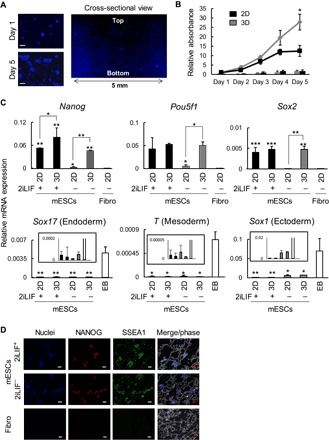
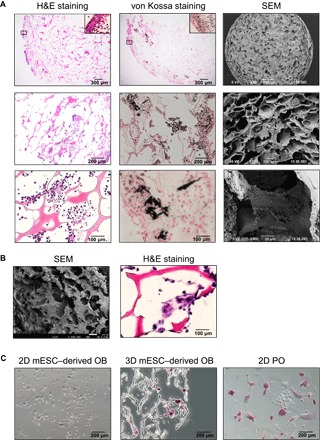
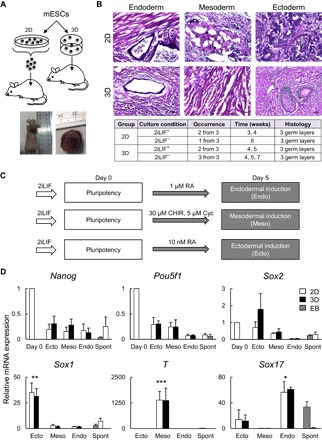
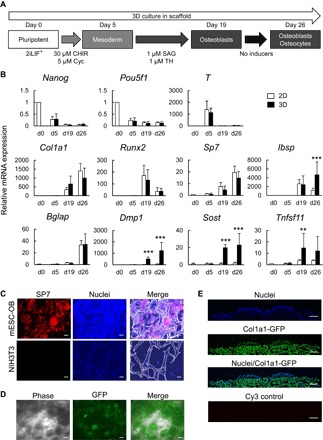
The development of in vitro models for the maintenance and differentiation of pluripotent stem cells (PSCs) is an active area of stem cell research. The strategies used so far are based mainly on two-dimensional (2D) cultures, in which cellular phenotypes are regulated by soluble factors. We show that a 3D culture system with atelocollagen porous scaffolds can significantly improve the outcome of the current platforms intended for the maintenance and lineage specification of mouse PSCs (mPSCs). Unlike 2D conditions, the 3D conditions maintained the undifferentiated state of mouse embryonic stem cells (mESCs) without exogenous stimulation and also supported endoderm, mesoderm, and ectoderm differentiation of mESCs under serum-free conditions. Moreover, 3D mPSC-derived mesodermal cells showed accelerated osteogenic differentiation, giving rise to functional osteoblast-osteocyte populations within calcified structures. The present strategy offers a 3D platform suitable for the formation of organoids that mimic in vivo organs containing various cell types, and it may be adaptable to the generation of ectoderm-, mesoderm-, and endoderm-derived tissues when combined with appropriate differentiation treatments.
体外模型的开发用于维持和分化多能干细胞(PSCs)是干细胞研究的一个活跃领域。迄今为止使用的策略主要基于二维(2D)培养,其中细胞表型通过可溶性因子调节。我们表明,具有原代胶原蛋白多孔支架的 3D 培养系统可以显著改善目前用于维持和谱系特化的小鼠 PSCs(mPSCs)的现有平台的结果。与 2D 条件不同,3D 条件在没有外源刺激的情况下维持了小鼠胚胎干细胞(mESCs)的未分化状态,并且在无血清条件下还支持 mESCs 的内胚层、中胚层和外胚层分化。此外,3D mPSC 衍生的中胚层细胞表现出加速的成骨分化,在矿化结构内产生功能性成骨细胞-骨细胞群体。本策略提供了一种适合形成类器官的 3D 平台,该类器官模拟含有各种细胞类型的体内器官,并且当与适当的分化处理结合使用时,可能适用于外胚层、中胚层和内胚层衍生组织的生成。