Fumasoli Alexandra, Bürgmann Helmut, Weissbrodt David G, Wells George F, Beck Karin, Mohn Joachim, Morgenroth Eberhard, Udert Kai M
Eawag, Swiss Federal Institute of Aquatic Science and Technology , 8600 Dübendorf, Switzerland.
Eawag, Swiss Federal Institute of Aquatic Science and Technology , 6047 Kastanienbaum, Switzerland.
Environ Sci Technol. 2017 Jun 20;51(12):6857-6866. doi: 10.1021/acs.est.7b00392. Epub 2017 Jun 5.
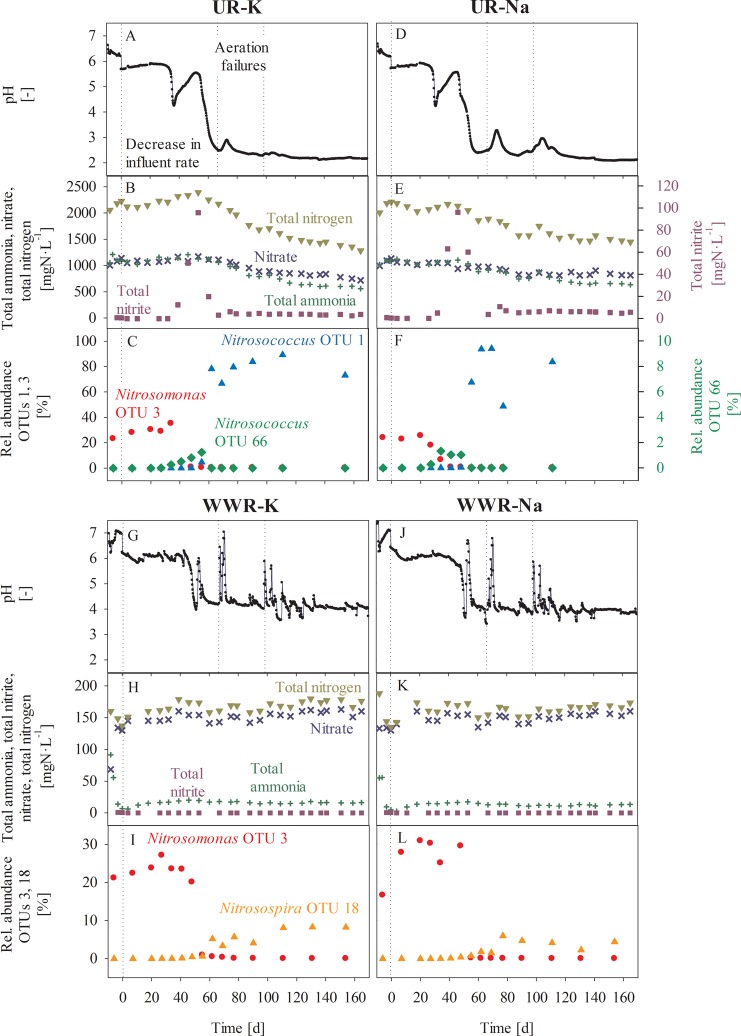
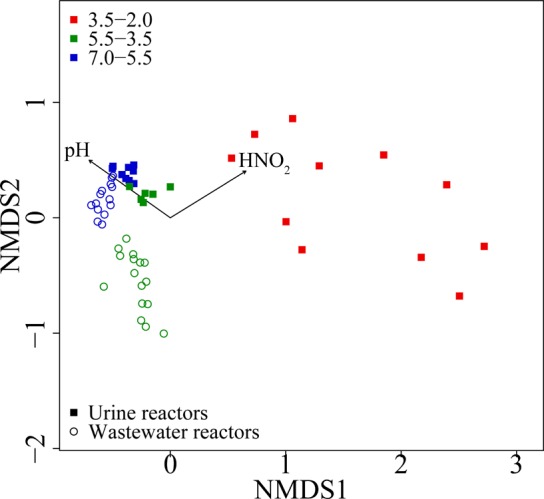
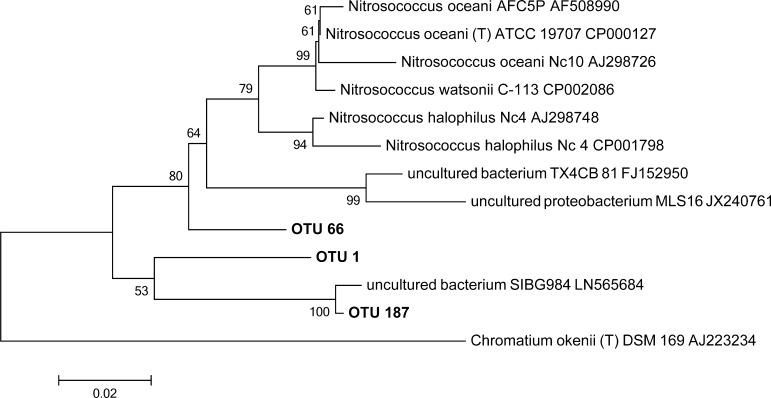
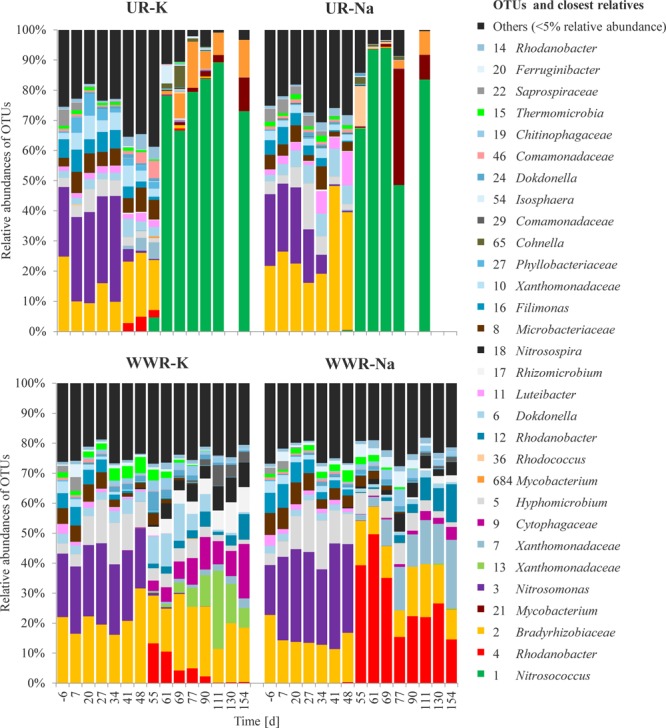
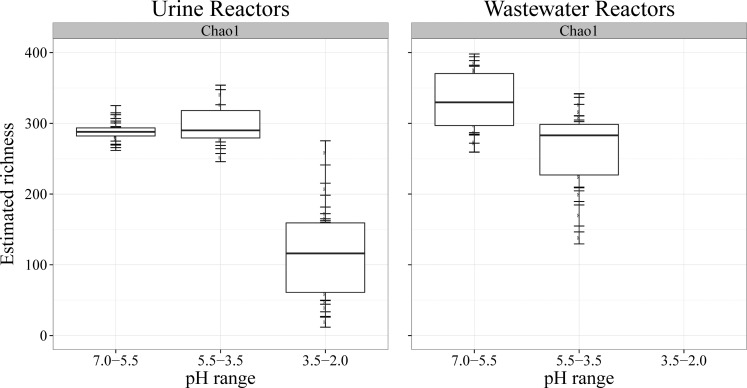
Ammonia oxidation decreases the pH in wastewaters where alkalinity is limited relative to total ammonia. The activity of ammonia oxidizing bacteria (AOB), however, typically decreases with pH and often ceases completely in slightly acidic wastewaters. Nevertheless, nitrification at low pH has been reported in reactors treating human urine, but it has been unclear which organisms are involved. In this study, we followed the population dynamics of ammonia oxidizing organisms and reactor performance in synthetic fully hydrolyzed urine as the pH decreased over time in response to a decrease in the loading rate. Populations of the β-proteobacterial Nitrosomonas europaea lineage were abundant at the initial pH close to 6, but the growth of a possibly novel Nitrosococcus-related AOB genus decreased the pH to the new level of 2.2, challenging the perception that nitrification is inhibited entirely at low pH values, or governed exclusively by β-proteobacterial AOB or archaea. With the pH shift, nitrite oxidizing bacteria were not further detected, but nitrous acid (HNO) was still removed through chemical decomposition to nitric oxide (NO) and nitrate. The growth of acid-tolerant γ-proteobacterial AOB should be prevented, by keeping the pH above 5.4, which is a typical pH limit for the N. europaea lineage. Otherwise, the microbial community responsible for high-rate nitrification can be lost, and strong emissions of hazardous volatile nitrogen compounds such as NO are likely.
在碱度相对于总氨含量有限的废水中,氨氧化会降低pH值。然而,氨氧化细菌(AOB)的活性通常会随着pH值的降低而下降,并且在微酸性废水中常常会完全停止。尽管如此,在处理人类尿液的反应器中已报道了低pH值下的硝化作用,但尚不清楚其中涉及哪些微生物。在本研究中,随着负荷率降低,pH值随时间下降,我们跟踪了合成完全水解尿液中氨氧化微生物的种群动态和反应器性能。在初始pH值接近6时,β-变形菌纲的欧洲亚硝化单胞菌谱系种群丰富,但一种可能的新型与硝化球菌相关的AOB属的生长将pH值降至2.2的新水平,这挑战了硝化作用在低pH值下完全受到抑制或仅由β-变形菌纲AOB或古菌控制的观念。随着pH值的变化,未进一步检测到亚硝酸氧化细菌,但亚硝酸(HNO)仍通过化学分解为一氧化氮(NO)和硝酸盐而被去除。通过将pH值保持在5.4以上,可以防止耐酸性γ-变形菌纲AOB的生长,5.4是欧洲亚硝化单胞菌谱系的典型pH值限制。否则,负责高速率硝化作用的微生物群落可能会丧失,并且可能会大量排放有害挥发性氮化合物,如NO。