Rich Stephen S
Center for Public Health Genomics and Department of Public Health Sciences, University of Virginia, Charlottesville, Virginia, USA.
Curr Opin Endocrinol Diabetes Obes. 2017 Aug;24(4):279-284. doi: 10.1097/MED.0000000000000347.
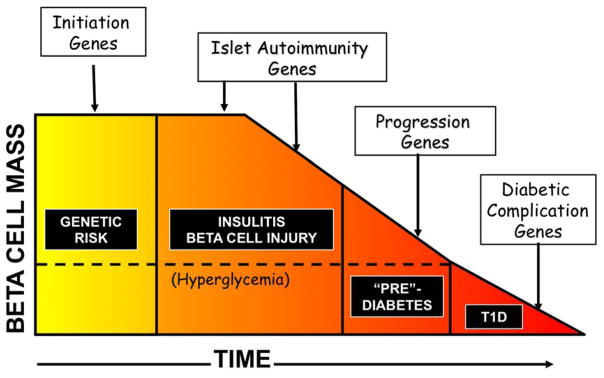
The genetic basis of type 1 diabetes (T1D) is being characterized through DNA sequence variation and cell type specificity. This review discusses the current understanding of the genes and variants implicated in risk of T1D and how genetic information can be used in prediction, intervention and components of clinical care.
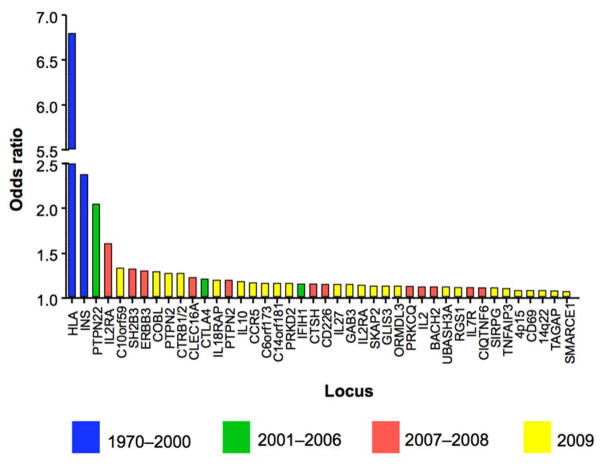
Fine mapping and functional studies has provided resolution of the heritable basis of T1D risk, incorporating novel insights on the dominant role of human leukocyte antigen (HLA) genes as well as the lesser impact of non-HLA genes. Evaluation of T1D-associated single nucleotide polymorphisms (SNPs), there is enrichment of genetic effects restricted to specific immune cell types (CD4 and CD8 T cells, CD19 B cells and CD34 stem cells), suggesting pathways to improved prediction. In addition, T1D-associated SNPs have been used to generate genetic risk scores (GRS) as a tool to distinguish T1D from type 2 diabetes (T2D) and to provide prediagnostic data to target those for autoimmunity screening (e.g. islet autoantibodies) as a prelude for continuous monitoring and entry into intervention trials.
Genetic susceptibility accounts for nearly one-half of the risk for T1D. Although the T1D-associated SNPs in white populations account for nearly 90% of the genetic risk, with high sensitivity and specificity, the low prevalence of T1D makes the T1D GRS of limited utility. However, identifying those with highest genetic risk may permit early and targeted immune monitoring to diagnose T1D months prior to clinical onset.
1型糖尿病(T1D)的遗传基础正通过DNA序列变异和细胞类型特异性进行表征。本综述讨论了目前对与T1D风险相关的基因和变异的理解,以及如何将遗传信息用于预测、干预和临床护理的各个方面。
精细定位和功能研究为T1D风险的遗传基础提供了分辨率,对人类白细胞抗原(HLA)基因的主导作用以及非HLA基因的较小影响有了新的认识。对与T1D相关的单核苷酸多态性(SNP)进行评估时,发现遗传效应在特定免疫细胞类型(CD4和CD8 T细胞、CD19 B细胞和CD34干细胞)中富集,这提示了改进预测的途径。此外,与T1D相关的SNP已被用于生成遗传风险评分(GRS),作为区分T1D与2型糖尿病(TID)的工具,并提供诊断前数据,以针对那些进行自身免疫筛查(如胰岛自身抗体)的人群,作为持续监测和进入干预试验的前奏。
遗传易感性占T1D风险的近一半。尽管白人人群中与T1D相关的SNP占遗传风险的近90%,具有高敏感性和特异性,但T1D的低患病率使得T1D的GRS效用有限。然而,识别出遗传风险最高的人群可能有助于在临床发病前数月进行早期和有针对性的免疫监测以诊断T1D。