Liu Jiao Jiao, Wei Zhen, Li Jia Hui
School of Life Sciences of East China Normal University, No.500, Dongchuan Rd, Shanghai, 200241, China.
No.2 Secondary School Attached to East China Normal University, No.555, Chenhui Rd, Shanghai, 201203, China.
Bot Stud. 2014 Dec;55(1):47. doi: 10.1186/s40529-014-0047-5. Epub 2014 May 27.
Copper is an important heavy metal pollutant, with strong toxicity and great harm, which is easy to accumulate in the plant body and is difficult for degradation. This paper adopts medium culture method, taking "Zheng Dan 958" maize seedlings as sample materials. With different copper ion concentration gradients for the simulation of metal copper stress on maize seedlings, it explored the effects on the membrane structure (POD activity, MDA content, membrane permeability) and root activity.
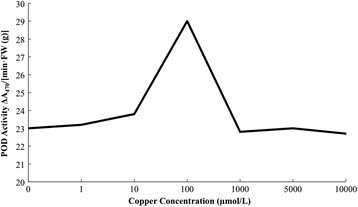
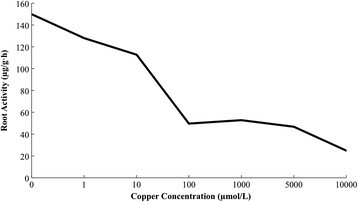
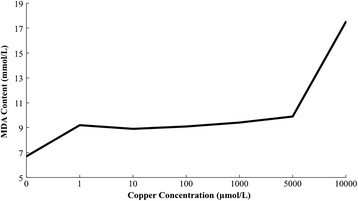
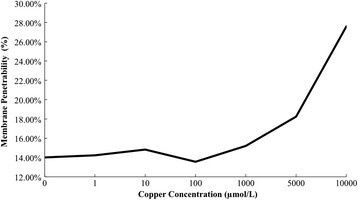
POD activity increases dramatically when the copper concentration is over 10 μmol/L. MDA content increases sharply when the copper concentration is over 1000 μmol/L, showing a rising trend. Membrane permeability increases greatly when the copper concentration is over 100 μmol/L. Root activity decreases significantly when the copper concentration is 100 μmol/L, showing a clear downward trend.
The copper concentration of 1000 μmol/L has exceeded the maize seedling tolerance to copper, and the activities of protective enzymes of maize seedlings are inhibited. Cell membrane lipid peroxidation has caused serious damage on the structure and function of membrane. Structure of root cells of maize seedling is also damaged, reducing the root activity, so the maize is irreversible hurt.
铜是一种重要的重金属污染物,毒性强、危害大,易在植物体内积累且难降解。本文采用培养基培养法,以“郑单958”玉米幼苗为样本材料。设置不同铜离子浓度梯度模拟金属铜胁迫对玉米幼苗的影响,探究其对膜结构(过氧化物酶活性、丙二醛含量、膜透性)及根系活力的影响。
铜浓度超过10 μmol/L时,过氧化物酶活性急剧增加。铜浓度超过1000 μmol/L时,丙二醛含量急剧上升,呈上升趋势。铜浓度超过100 μmol/L时,膜透性大幅增加。铜浓度为100 μmol/L时,根系活力显著下降,呈明显下降趋势。
1000 μmol/L的铜浓度已超过玉米幼苗对铜的耐受能力,玉米幼苗保护酶活性受到抑制。细胞膜脂质过氧化对膜的结构和功能造成严重损伤。玉米幼苗根细胞结构也受到破坏,根系活力降低,致使玉米受到不可逆伤害。