Lowrie Christopher, Pearson Amber L, Thomson George
Department of Geography, Environment, and Spatial Sciences, Michigan State University, East Lansing, MI, 48824, USA.
Department of Public Health, University of Otago, Wellington, 6021, New Zealand.
BMC Public Health. 2017 May 16;17(1):456. doi: 10.1186/s12889-017-4385-6.
Previous studies have found extensive geographic and demographic differences in tobacco use. These differences have been found to be reduced by effective public policies, including banning smoking in public spaces. Smokefree indoor and outdoor spaces reduce secondhand smoke exposure and denormalize smoking.
We evaluated regional and demographic differences in the proportion of the population covered by smokefree policies enacted in the United States prior to 2014, for both adults and children.
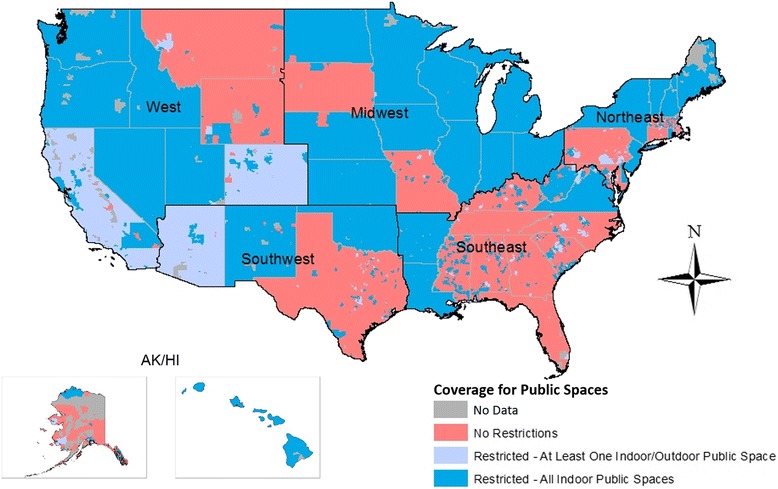
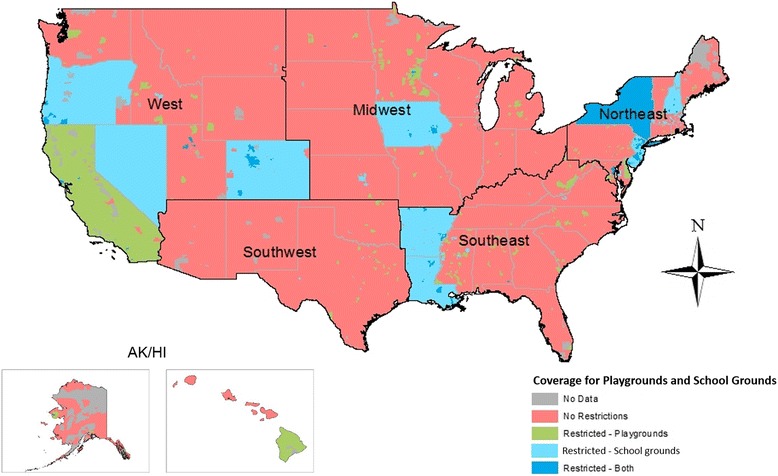
Significant differences in coverage were found by ethnicity, region, income, and education (p < 0.001). Smokefree policy coverage was lower for jurisdictions with higher proportions of poor households, households with no high school diploma and the Southeast region. Increased ethnic heterogeneity was found to be a significant predictor of coverage in indoor "public spaces generally", meaning that diversity is protective, with differential effect by region (p = 0.004) - which may relate to urbanicity. Children had a low level of protection in playgrounds and schools (~10% covered nationwide) - these spaces were found to be covered at lower rates than indoor spaces.
Disparities in smokefree space policies have potential to exacerbate existing health inequities. A national increase in smokefree policies to protect children in playgrounds and schools is a crucial intervention to reduce such inequities.
先前的研究发现,烟草使用存在广泛的地理和人口差异。人们发现,包括在公共场所禁烟在内的有效公共政策能够缩小这些差异。无烟的室内和室外空间可减少二手烟暴露,并使吸烟变得不再正常化。
我们评估了2014年之前美国实施的无烟政策覆盖的人口比例在地区和人口方面的差异,涉及成人和儿童。
按种族、地区、收入和教育程度划分,政策覆盖范围存在显著差异(p < 0.001)。对于贫困家庭比例较高、没有高中文凭的家庭比例较高的司法管辖区以及东南部地区,无烟政策的覆盖范围较低。研究发现,种族异质性增加是室内“一般公共场所”覆盖范围的一个重要预测因素,这意味着多样性具有保护作用,且因地区而异(p = 0.004)——这可能与城市化程度有关。儿童在操场和学校受到的保护水平较低(全国范围内约10%的场所覆盖无烟政策)——这些场所的覆盖比例低于室内空间。
无烟空间政策的差异有可能加剧现有的健康不平等。在全国范围内增加保护操场和学校儿童的无烟政策是减少此类不平等的关键干预措施。