
通过全局形状重建实现面部外地标定位
Extra Facial Landmark Localization via Global Shape Reconstruction.
作者信息
Tan Shuqiu, Chen Dongyi, Guo Chenggang, Huang Zhiqi
机构信息
School of Automation Engineering, University of Electronic Science and Technology of China, No. 2006, Xiyuan Ave, West Hi-Tech Zone, Chengdu 611731, China.
出版信息
Comput Intell Neurosci. 2017;2017:8710492. doi: 10.1155/2017/8710492. Epub 2017 Apr 23.
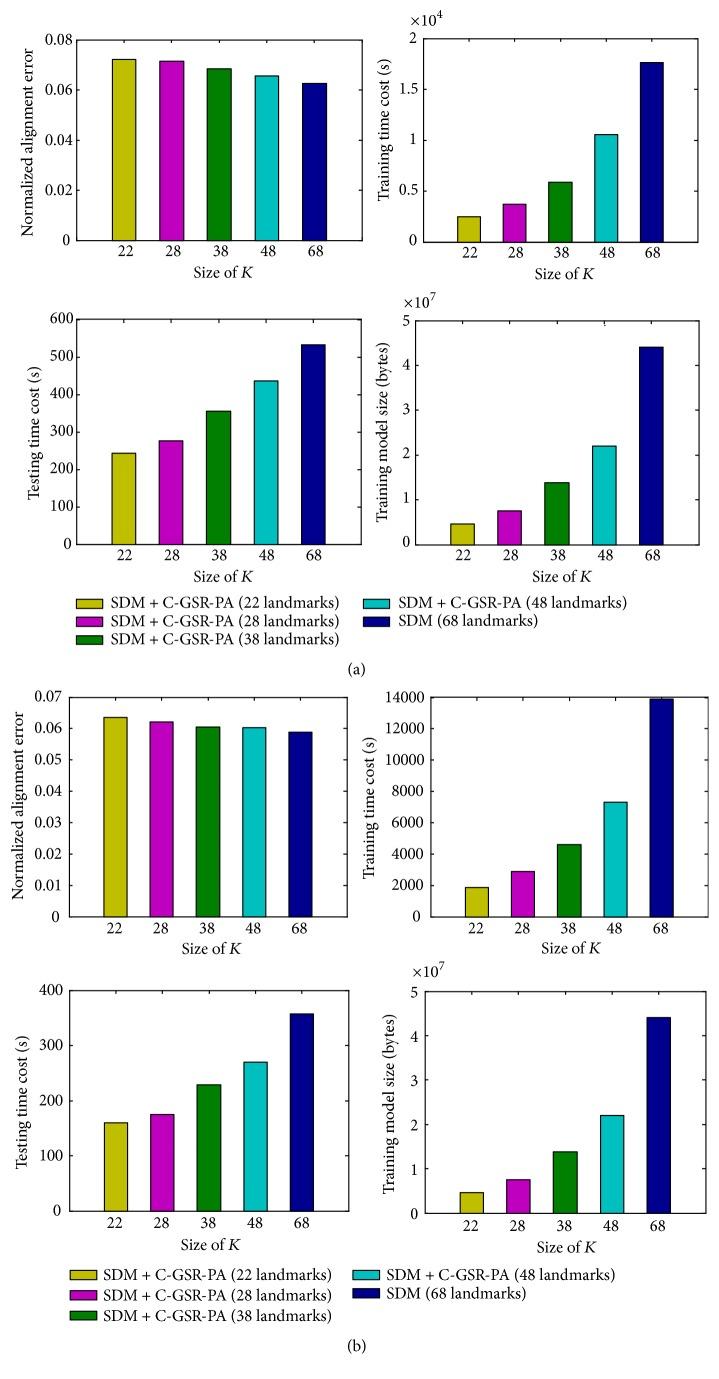
Localizing facial landmarks is a popular topic in the field of face analysis. However, problems arose in practical applications such as handling pose variations and partial occlusions while maintaining moderate training model size and computational efficiency still challenges current solutions. In this paper, we present a global shape reconstruction method for locating extra facial landmarks comparing to facial landmarks used in the training phase. In the proposed method, the reduced configuration of facial landmarks is first decomposed into corresponding sparse coefficients. Then explicit face shape correlations are exploited to regress between sparse coefficients of different facial landmark configurations. Finally extra facial landmarks are reconstructed by combining the pretrained shape dictionary and the approximation of sparse coefficients. By applying the proposed method, both the training time and the model size of a class of methods which stack local evidences as an appearance descriptor can be scaled down with only a minor compromise in detection accuracy. Extensive experiments prove that the proposed method is feasible and is able to reconstruct extra facial landmarks even under very asymmetrical face poses.
定位面部地标是面部分析领域的一个热门话题。然而,在实际应用中出现了一些问题,比如处理姿态变化和部分遮挡,同时保持适度的训练模型大小和计算效率仍然是当前解决方案面临的挑战。在本文中,我们提出了一种全局形状重建方法,用于定位与训练阶段使用的面部地标相比的额外面部地标。在所提出的方法中,首先将简化的面部地标配置分解为相应的稀疏系数。然后利用显式的面部形状相关性在不同面部地标配置的稀疏系数之间进行回归。最后,通过结合预训练的形状字典和稀疏系数的近似值来重建额外的面部地标。通过应用所提出的方法,一类将局部证据堆叠作为外观描述符的方法的训练时间和模型大小都可以缩小,而检测精度只会有轻微的损失。大量实验证明,所提出的方法是可行的,并且即使在非常不对称的面部姿态下也能够重建额外的面部地标。



 Zotero 插件