Harvard University, Center for Brain Science, Cambridge, MA, 02138, USA.
Harvard University, Psychology, Cambridge, MA, 02138, USA.
Sci Rep. 2017 May 17;7(1):2030. doi: 10.1038/s41598-017-02149-6.
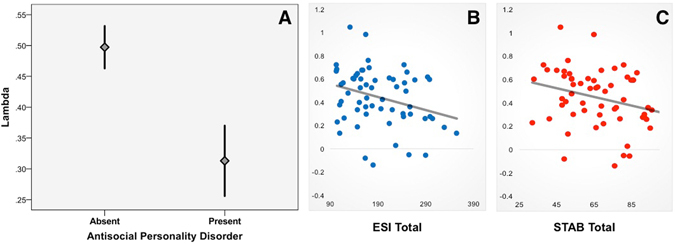
Antisocial behavior is often assumed to reflect aberrant risk processing. However, many of the most significant forms of antisocial behavior, including crime, reflect the outcomes of decisions made under conditions of ambiguity rather than risk. While risk and ambiguity are formally distinct and experimentally dissociable, little is known about ambiguity sensitivity in individuals who engage in chronic antisocial behavior. We used a financial decision-making task in a high-risk community-based sample to test for associations between sensitivity to ambiguity, antisocial behavior, and arrest history. Sensitivity to ambiguity was lower in individuals who met diagnostic criteria for Antisocial Personality Disorder. Lower ambiguity sensitivity was also associated with higher externalizing (but not psychopathy) scores, and with higher levels of aggression (but not rule-breaking). Finally, blunted sensitivity to ambiguity also predicted a greater frequency of arrests. Together, these data suggest that alterations in cost-benefit decision-making under conditions of ambiguity may promote antisocial behavior.
反社会行为通常被认为反映了异常的风险处理。然而,许多最显著的反社会行为形式,包括犯罪,反映了在模糊条件而非风险下做出的决策的结果。虽然风险和模糊性在形式上是不同的,并且在实验中是可分离的,但对于从事慢性反社会行为的个体的模糊性敏感性知之甚少。我们使用基于高风险社区的样本中的财务决策任务来测试模糊性敏感性、反社会行为和逮捕记录之间的关联。符合反社会人格障碍诊断标准的个体对模糊性的敏感性较低。较低的模糊性敏感性也与更高的外化(但不是精神病态)评分以及更高的攻击性(但不是违反规则)相关。最后,模糊性敏感性迟钝也预示着逮捕频率更高。总之,这些数据表明,在模糊条件下的成本效益决策的改变可能会促进反社会行为。