Vesprey Alexander, Yang Wentian
Department of Orthopaedics, Alpert Medical School and Rhode Island Hospital, Brown University, Providence, USA.
Bio Protoc. 2016 Jun 20;6(12). doi: 10.21769/BioProtoc.1836.
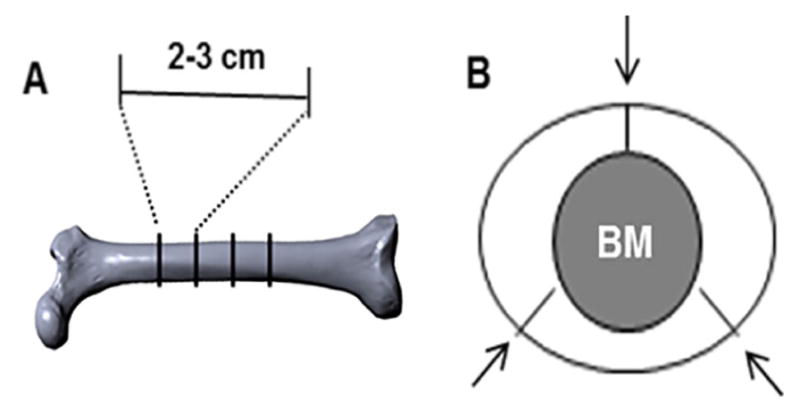
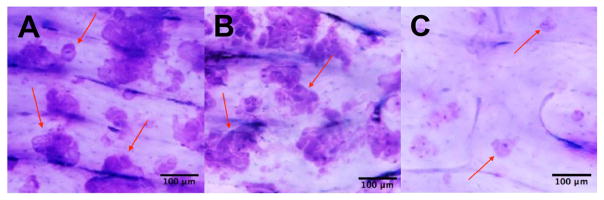
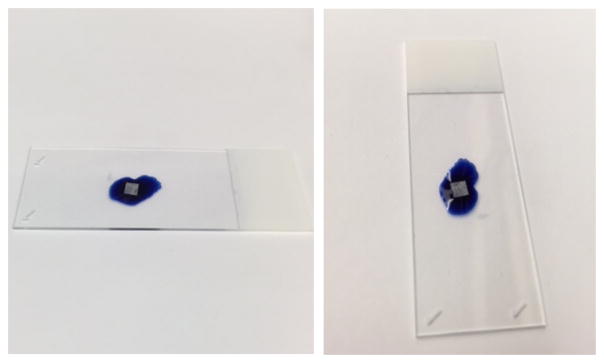
Although it is possible to use a tartrate-resistant acid phosphatase (TRAP) stain to assist in identifying osteoclasts, a separate method is needed to determine the bone resorption activity of osteoclasts. Since osteoclasts leave "pits" after bone matrix resorption (Charles ., 2014), it is possible to stain pits as a method of measuring osteoclast bone resorption activity. The pit assay protocol enables researchers to stain bony slices that were co-cultured with osteoclasts with toluidine blue in order to allow the visualization, capture, and analysis of osteoclast resorptive activity based on the number, size and depth of pits (Zhou ., 2015). The pit assay protocol is separated into three sequential stages: Preparation of bone slices (1); preparation of osteoclast precursors (Ross ., 2006; Teitelbaum ., 2000) (2), and bone resorption pit assay (3).
尽管可以使用抗酒石酸酸性磷酸酶(TRAP)染色来辅助鉴定破骨细胞,但仍需要一种单独的方法来确定破骨细胞的骨吸收活性。由于破骨细胞在骨基质吸收后会留下“凹坑”(查尔斯等人,2014年),因此可以对凹坑进行染色,作为测量破骨细胞骨吸收活性的一种方法。凹坑测定方案使研究人员能够用甲苯胺蓝对与破骨细胞共培养的骨切片进行染色,以便根据凹坑的数量、大小和深度对破骨细胞的吸收活性进行可视化、捕获和分析(周等人,2015年)。凹坑测定方案分为三个连续阶段:骨切片制备(1);破骨细胞前体的制备(罗斯等人,2006年;泰特尔鲍姆等人,2000年)(2),以及骨吸收凹坑测定(3)。