Hu Lu, DeVito Dabbs Annette, Dew Mary Amanda, Sereika Susan M, Lingler Jennifer H
Department of Population Health, Center for Healthful Behavior Change, New York University School of Medicine, New York, NY, USA.
Department of Acute and Tertiary Care, University of Pittsburgh School of Nursing, Pittsburgh, PA, USA.
Clin Transplant. 2017 Aug;31(8). doi: 10.1111/ctr.13014. Epub 2017 Jun 11.
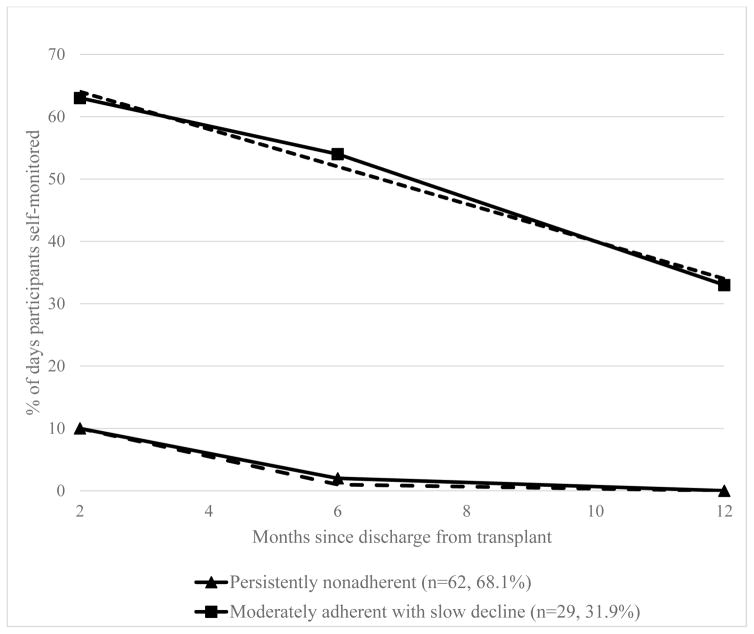
Self-monitoring of lung function, vital signs, and symptoms is crucial for lung transplant recipients (LTRs) to ensure early detection of complications and prompt intervention. This study sought to identify patterns and correlates of adherence to self-monitoring among LTRs over the first 12 months post-discharge from transplant. This study analyzed existing data from the usual care arm participants of a randomized clinical trial who tracked self-monitoring activities using paper-and-pencil logs. Adherence was calculated as the percent of days LTRs recorded any self-monitoring data per interval: hospital discharge-2 months, 3-6 months, and 7-12 months. The sample (N=91) was mostly white (87.9%), male (61.5%), with a mean age of 57.2±13.8 years. Group-based trajectory analyses revealed two groups: (i) moderately adherent with slow decline (n=29, 31.9%) and (ii) persistently nonadherent (n=62, 68.1%). Multivariate binary logistic regression revealed the following baseline factors increased the risk in the persistently nonadherent group: female (P=.035), higher anxiety (P=.008), and weaker sense of personal control over health (P=.005). Poorer physical health over 12 months were associated with increased risk in the persistently nonadherent group (P=.004). This study highlighted several modifiable factors for future interventions to target, including reducing post-transplant anxiety, and strengthening sense of personal control over health in LTRs.
对肺移植受者(LTRs)进行肺功能、生命体征和症状的自我监测,对于确保早期发现并发症并及时干预至关重要。本研究旨在确定移植出院后头12个月内LTRs自我监测依从性的模式及其相关因素。本研究分析了一项随机临床试验常规护理组参与者的现有数据,这些参与者使用纸笔日志记录自我监测活动。依从性计算为LTRs在每个时间段记录任何自我监测数据的天数百分比:出院至2个月、3至6个月以及7至12个月。样本(N = 91)大多为白人(87.9%),男性(61.5%),平均年龄57.2±13.8岁。基于组的轨迹分析显示有两组:(i)中度依从且下降缓慢(n = 29,31.9%)和(ii)持续不依从(n = 62,68.1%)。多变量二元逻辑回归显示,以下基线因素会增加持续不依从组的风险:女性(P = .035)、焦虑程度较高(P = .008)以及对健康的个人控制感较弱(P = .005)。12个月内身体健康状况较差与持续不依从组的风险增加相关(P = .004)。本研究突出了未来干预可针对的几个可改变因素,包括降低移植后焦虑以及增强LTRs对健康的个人控制感。