Key Laboratory of Protein Modification and Degradation, SKLRD, Affiliated Cancer Hospital and School of Basic Medical Sciences, Guangzhou Medical University, Guangzhou, Guangdong 511436, China.
Department of Hematology and Hematopoietic Cell Transplantation, City of Hope, Duarte, CA 91010, USA.
Cell Death Dis. 2017 May 18;8(5):e2803. doi: 10.1038/cddis.2017.210.
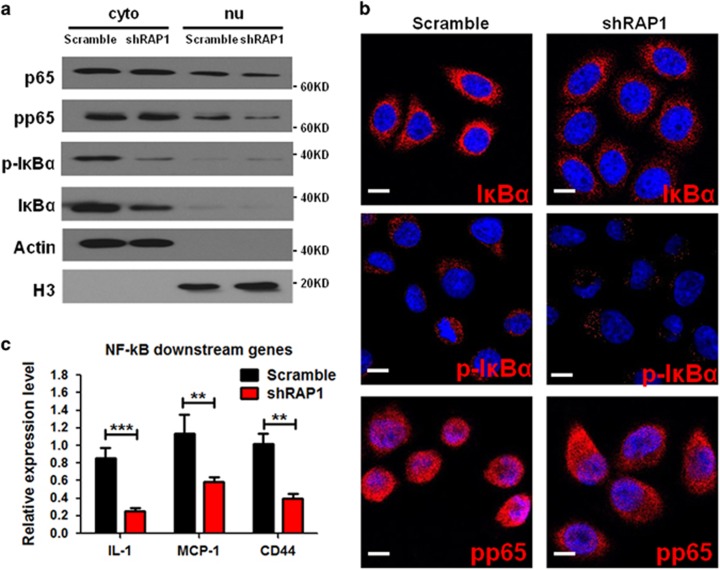
Cytotoxic chemotherapy agents (e.g., cisplatin) are the first-line drugs to treat non-small cell lung cancer (NSCLC) but NSCLC develops resistance to the agent, limiting therapeutic efficacy. Despite many approaches to identifying the underlying mechanism for cisplatin resistance, there remains a lack of effective targets in the population that resist cisplatin treatment. In this study, we sought to investigate the role of cytoplasmic RAP1, a previously identified positive regulator of NF-κB signaling, in the development of cisplatin resistance in NSCLC cells. We found that the expression of cytoplasmic RAP1 was significantly higher in high-grade NSCLC tissues than in low-grade NSCLC; compared with a normal pulmonary epithelial cell line, the A549 NSCLC cells exhibited more cytoplasmic RAP1 expression as well as increased NF-κB activity; cisplatin treatment resulted in a further increase of cytoplasmic RAP1 in A549 cells; overexpression of RAP1 desensitized the A549 cells to cisplatin, and conversely, RAP1 depletion in the NSCLC cells reduced their proliferation and increased their sensitivity to cisplatin, indicating that RAP1 is required for cell growth and has a key mediating role in the development of cisplatin resistance in NSCLC cells. The RAP1-mediated cisplatin resistance was associated with the activation of NF-κB signaling and the upregulation of the antiapoptosis factor BCL-2. Intriguingly, in the small portion of RAP1-depleted cells that survived cisplatin treatment, no induction of NF-κB activity and BCL-2 expression was observed. Furthermore, in established cisplatin-resistant A549 cells, RAP1 depletion caused BCL2 depletion, caspase activation and dramatic lethality to the cells. Hence, our results demonstrate that the cytoplasmic RAP1-NF-κB-BCL2 axis represents a key pathway to cisplatin resistance in NSCLC cells, identifying RAP1 as a marker and a potential therapeutic target for cisplatin resistance of NSCLC.
细胞毒性化疗药物(如顺铂)是治疗非小细胞肺癌(NSCLC)的一线药物,但 NSCLC 对该药物产生耐药性,限制了治疗效果。尽管有许多方法可用于确定顺铂耐药的潜在机制,但在人群中仍然缺乏对顺铂治疗有抵抗作用的有效靶点。在这项研究中,我们试图研究细胞质 RAP1 在 NSCLC 细胞顺铂耐药中的作用,RAP1 是先前鉴定的 NF-κB 信号的正调节剂。我们发现,细胞质 RAP1 在高级别 NSCLC 组织中的表达明显高于低级别 NSCLC 组织;与正常肺上皮细胞系相比,A549 NSCLC 细胞表现出更高的细胞质 RAP1 表达和增加的 NF-κB 活性;顺铂处理导致 A549 细胞中细胞质 RAP1 的进一步增加;RAP1 的过表达使 A549 细胞对顺铂产生耐药性,相反,RAP1 在 NSCLC 细胞中的耗竭降低了其增殖并增加了对顺铂的敏感性,表明 RAP1 是细胞生长所必需的,并且在 NSCLC 细胞中顺铂耐药的发展中具有关键的介导作用。RAP1 介导的顺铂耐药与 NF-κB 信号的激活和抗凋亡因子 BCL-2 的上调有关。有趣的是,在顺铂处理后存活下来的 RAP1 耗竭细胞的一小部分中,没有观察到 NF-κB 活性和 BCL-2 表达的诱导。此外,在已建立的顺铂耐药 A549 细胞中,RAP1 耗竭导致 BCL2 耗竭、半胱天冬酶激活和细胞致命性。因此,我们的结果表明,细胞质 RAP1-NF-κB-BCL2 轴代表 NSCLC 细胞顺铂耐药的关键途径,确定 RAP1 为 NSCLC 顺铂耐药的标志物和潜在治疗靶点。