Wilke Hans-Joachim, Herkommer Andrea, Werner Karin, Liebsch Christian
Institute of Orthopaedic Research and Biomechanics, Trauma Research Centre Ulm, University of Ulm, Ulm, Germany.
PLoS One. 2017 May 16;12(5):e0177823. doi: 10.1371/journal.pone.0177823. eCollection 2017.
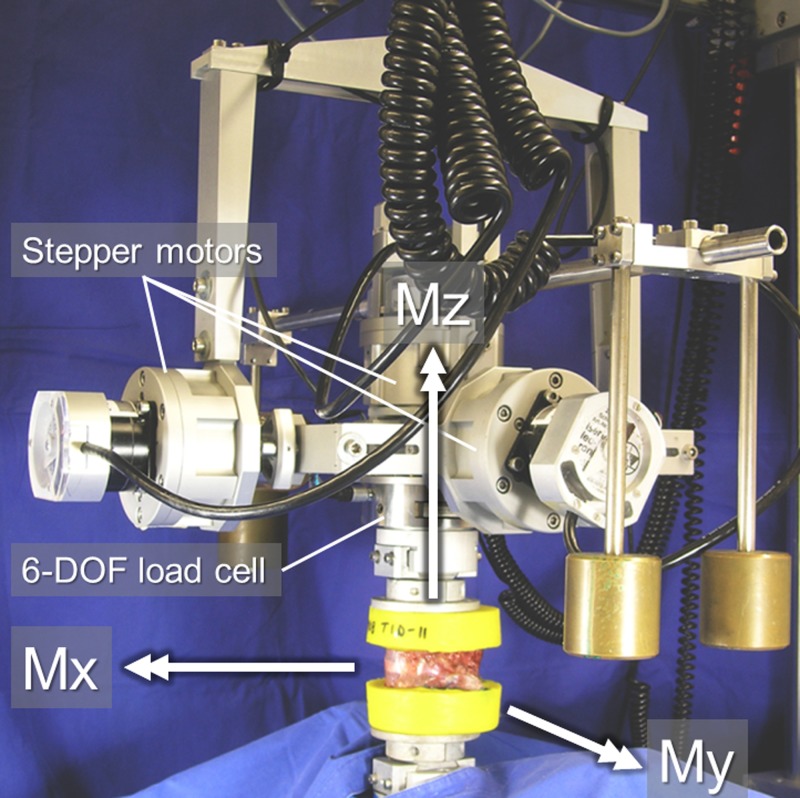
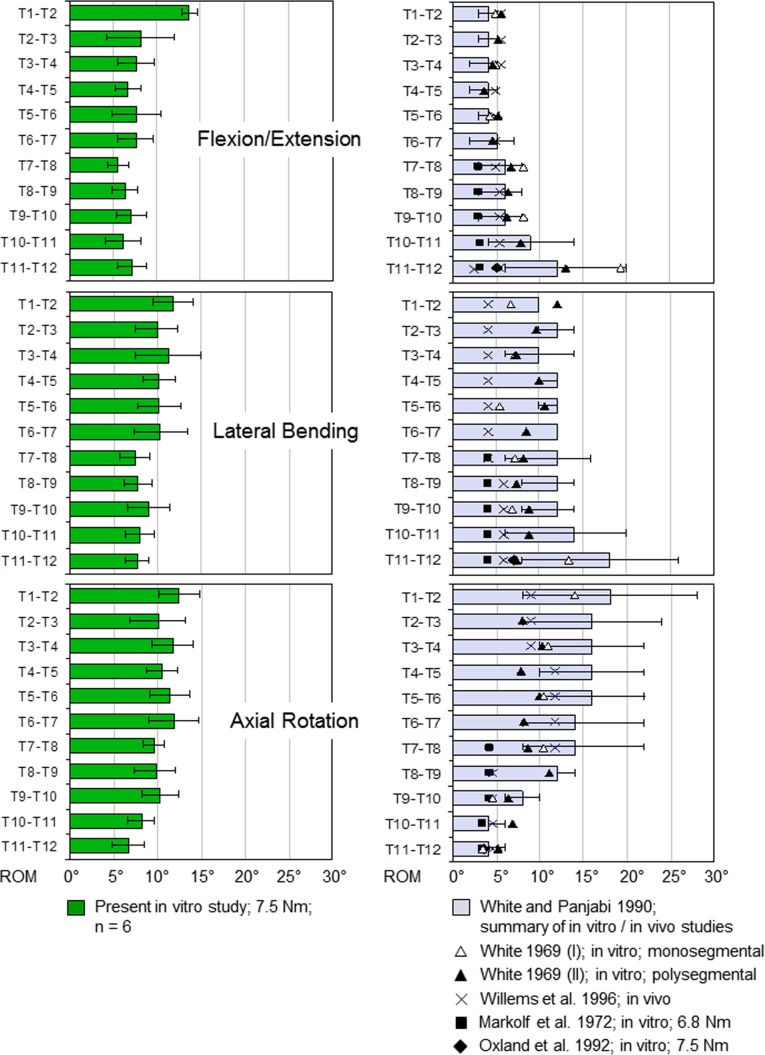
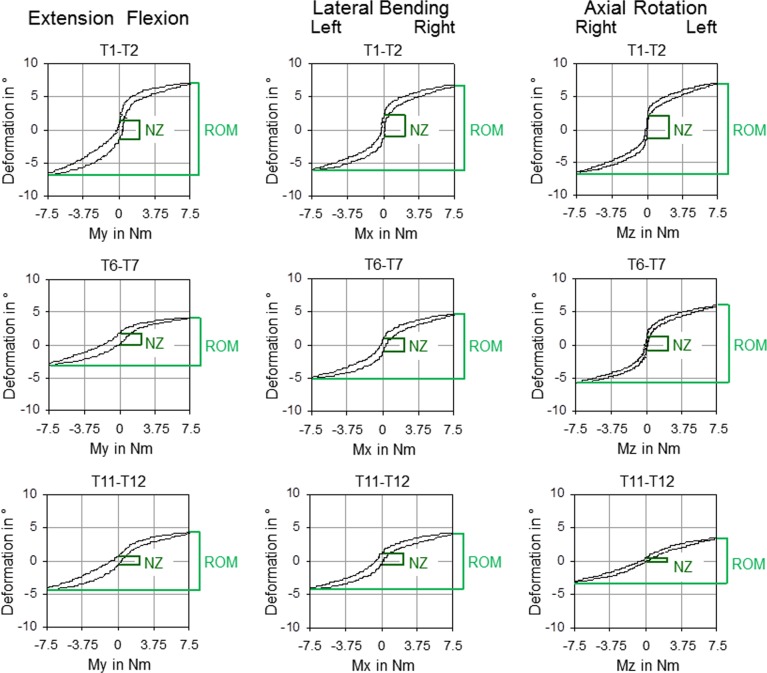
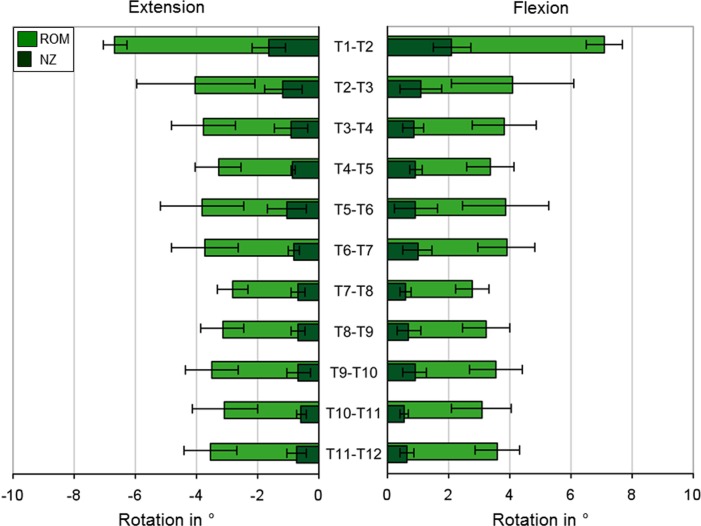
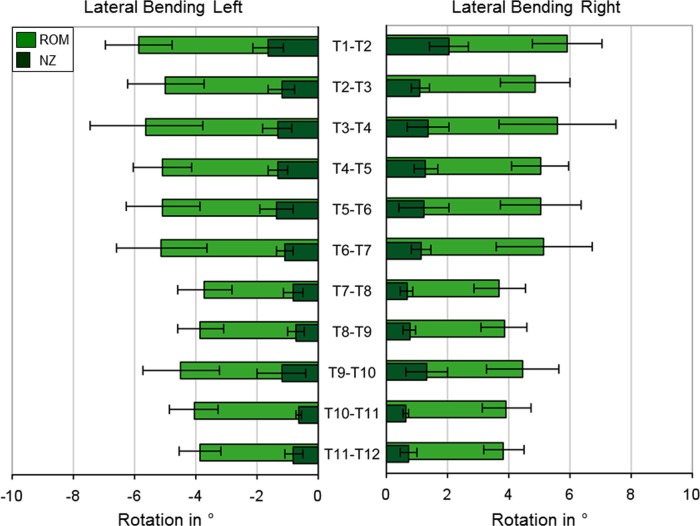
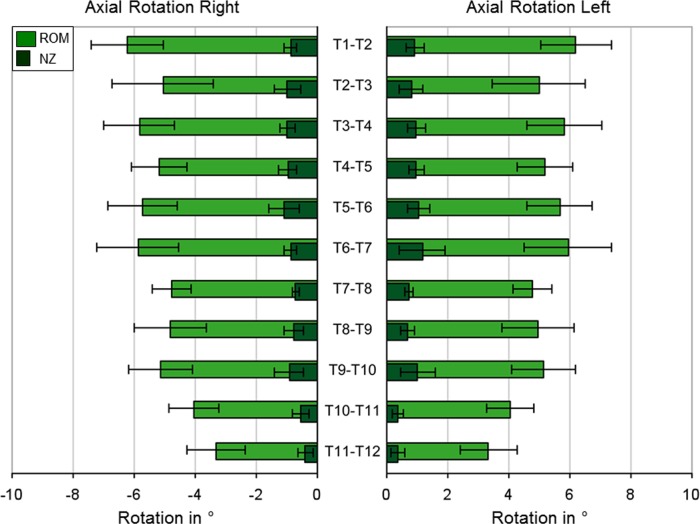
Basic knowledge about the thoracic spinal flexibility is limited and to the authors' knowledge, no in vitro studies have examined the flexibility of every thoracic spinal segment under standardized experimental conditions using pure moments. In our in vitro study, 68 human thoracic functional spinal units including the costovertebral joints (at least n = 6 functional spinal units per segment from T1-T2 to T11-T12) were loaded with pure moments of ±7.5 Nm in flexion/extension, lateral bending, and axial rotation in a custom-built spine tester to analyze range of motion (ROM) and neutral zone (NZ). ROM and NZ showed symmetric motion behavior in all loading planes. In each loading direction, the segment T1-T2 exhibited the highest ROM. In flexion/extension, the whole thoracic region, with exception of T1-T2 (14°), had an average ROM between 6° and 8°. In lateral bending, the upper thoracic region (T1-T7) was, with an average ROM between 10° and 12°, more flexible than the lower thoracic region (T7-T12) with an average ROM between 8° and 9°. In axial rotation, the thoracic region offered the highest overall flexibility with an average ROM between 10° and 12° in the upper and middle thoracic spine (T1-T10) and between 7° and 8° in the lower thoracic spine (T10-T12), while a trend of continuous decrease of ROM could be observed in the lower thoracic region (T7-T12). Comparing these ROM values with those in literature, they agree that ROM is lowest in flexion/extension and highest in axial rotation, as well as decreasing in the lower segments in axial rotation. Differences were found in flexion/extension and lateral bending in the lower segments, where, in contrast to the literature, no increase of the ROM from superior to inferior segments was found. The data of this in vitro study could be used for the validation of numerical models and the design of further in vitro studies of the thoracic spine without the rib cage, the verification of animal models, as well as the interpretation of already published human in vitro data.
关于胸椎灵活性的基础知识有限,据作者所知,尚无体外研究在标准化实验条件下使用纯力矩来检测每个胸段脊柱的灵活性。在我们的体外研究中,68个包含肋椎关节的人体胸段功能性脊柱单元(从T1-T2至T11-T12,每个节段至少n = 6个功能性脊柱单元)在定制的脊柱测试仪中承受±7.5 Nm的纯力矩,进行屈伸、侧弯和轴向旋转,以分析活动范围(ROM)和中性区(NZ)。ROM和NZ在所有加载平面中均表现出对称的运动行为。在每个加载方向上,T1-T2节段的ROM最高。在屈伸运动中,除T1-T2(14°)外,整个胸段的平均ROM在6°至8°之间。在侧弯时,上胸段(T1-T7)平均ROM在10°至12°之间,比下胸段(T7-T12)更灵活,下胸段平均ROM在8°至9°之间。在轴向旋转时,胸段总体灵活性最高,上胸椎和中胸椎(T1-T10)平均ROM在10°至12°之间,下胸椎(T10-T12)在7°至8°之间,而下胸段(T7-T12)的ROM呈持续下降趋势。将这些ROM值与文献中的值进行比较,结果一致表明ROM在屈伸运动中最低,在轴向旋转中最高,并且在轴向旋转时下段ROM减小。在下段的屈伸和侧弯中发现了差异,与文献不同的是,未发现ROM从上段到下段有增加。这项体外研究的数据可用于验证数值模型、设计进一步的无胸廓胸椎体外研究、验证动物模型以及解释已发表的人体体外数据。