Department of Materials Science and Engineering, University of Florida Gainesville, FL 32611- 6400.
Animal Welfare Science and Practice, Tulip House, 70 Borough High Street, London Bridge, London SE1 1XF, United Kingdom.
Poult Sci. 2017 Aug 1;96(8):2528-2539. doi: 10.3382/ps/pex066.
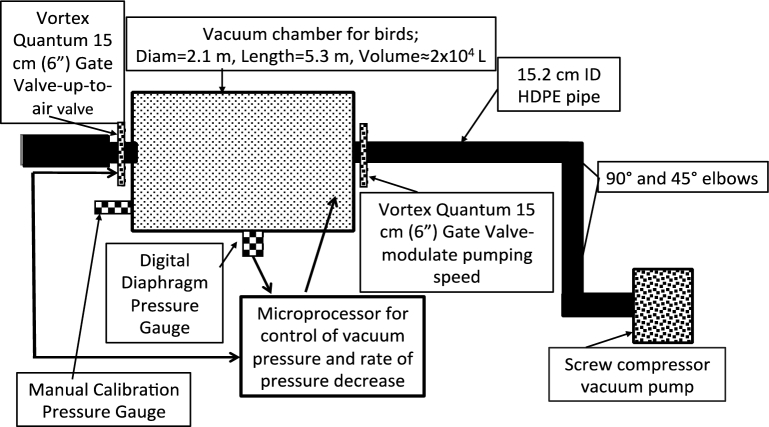
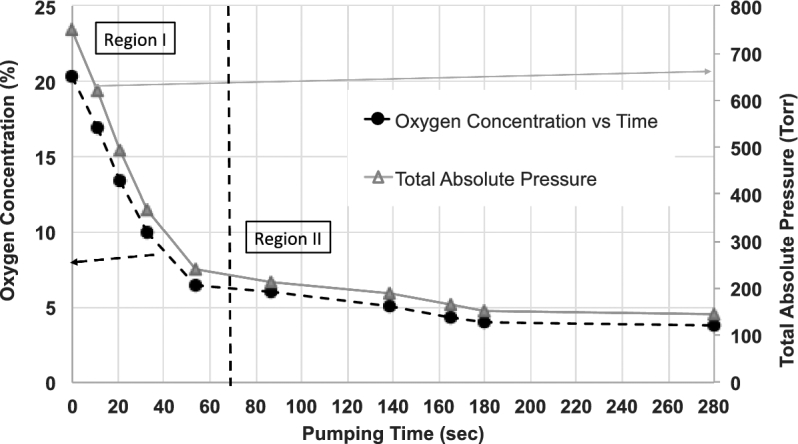
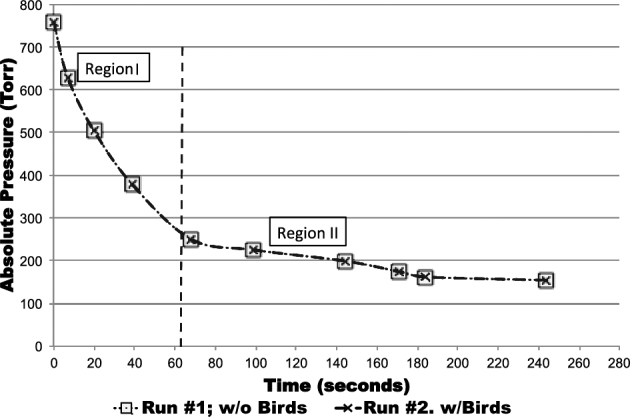
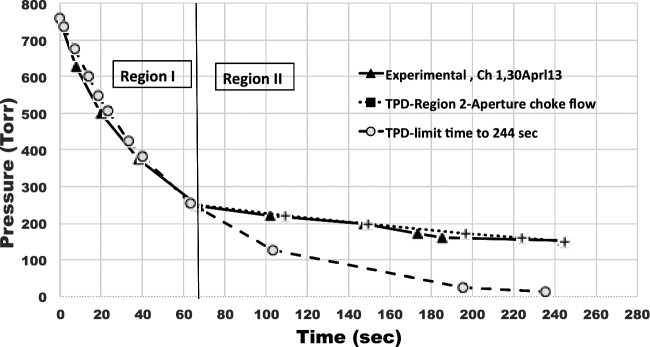
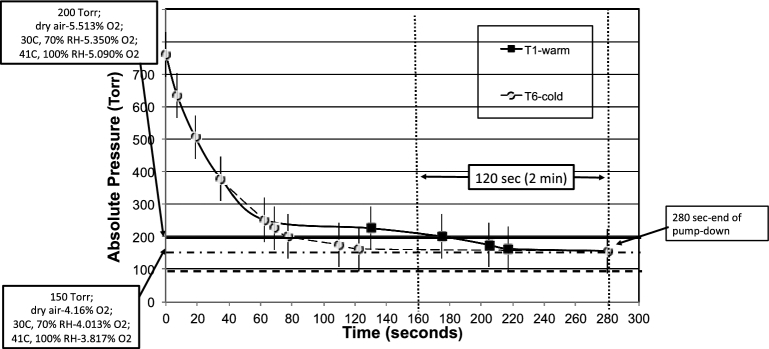
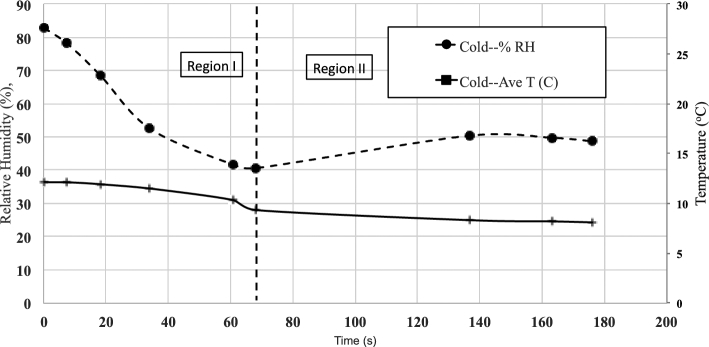
The characteristics of the vacuum used in a low atmospheric pressure stunning system to stun (render unconscious) poultry prior to slaughter are described. A vacuum chamber is pumped by a wet screw compressor. The vacuum pressure is reduced from ambient atmospheric pressure to an absolute vacuum pressure of ∼250 Torr (∼33 kPa) in ∼67 sec with the vacuum gate valve fully open. At ∼250 Torr, the sliding gate valve is partially closed to reduce effective pumping speed, resulting in a slower rate of decreasing pressure. Ambient temperature affects air density and water vapor pressure and thereby oxygen levels and the time at the minimum total pressure of ∼160 Torr (∼21 kPa) is varied from ∼120 to ∼220 sec to ensure an effective stun within the 280 seconds of each cycle. The reduction in total pressure results in a gradual reduction of oxygen partial pressure that was measured by a solid-state electrochemical oxygen sensor. The reduced oxygen pressure leads to hypoxia, which is recognized as a humane method of stunning poultry. The system maintains an oxygen concentration of <5% for at least 2 minutes, which ensures that birds are irreversibly stunned. Calculated pump down (pressure versus time) data match experimental data very closely because the programmable logic controller and the human machine interface enable precise and accurate control. The vacuum system operates in the turbulent viscous flow regime, and is best characterized by absolute vacuum pressure rather than gauge pressure. Neither the presence of broiler chickens nor different fore-line pipe designs of four parallel commercial systems affected the pressure-time data. Water in wet air always reduces the oxygen concentrations to a value lower than in dry air. The partial pressure of water and oxygen were found to depend on the pump down parameters due to the formation of fog in the chamber and desorption of water from the birds and the walls of the vacuum chamber.
本文介绍了用于在屠宰前使家禽昏迷(失去知觉)的低气压致昏系统中所使用的真空的特性。一个真空室由一个湿式螺杆压缩机进行抽气。在真空门完全打开的情况下,真空压力从环境大气压降至约 250 托(约 33 kPa)的绝对真空压力,这一过程大约需要 67 秒。在约 250 托时,滑动门阀部分关闭以降低有效抽气速度,从而导致压力下降速度减慢。环境温度会影响空气密度和水蒸气压力,从而影响氧气水平,在最小总压力约 160 托(约 21 kPa)下的时间从约 120 秒到约 220 秒不等,以确保在每个循环的 280 秒内有效地致昏。总压力的降低导致氧气分压逐渐降低,这是通过固态电化学氧气传感器测量的。氧气压力的降低导致缺氧,这被认为是一种人道的家禽致昏方法。该系统在至少 2 分钟内保持氧气浓度 <5%,这确保了鸟类无法恢复意识。计算出的减压(压力与时间)数据与实验数据非常吻合,因为可编程逻辑控制器和人机界面可以实现精确和准确的控制。真空系统在湍流粘性流区中运行,最好用绝对真空压力而不是表压来描述。肉鸡的存在或四个商业系统的不同前级管道设计都不会影响压力-时间数据。湿空气中的水总是会将氧气浓度降低到低于干空气的水平。由于在腔室中形成雾以及水从禽鸟和真空腔室壁上解吸,发现水和氧气的分压取决于减压参数。