Chao Lemeng, Liu Jianfeng, Zhao Dewei
Graduate College, Southern Medical University, Guangzhou, Guangdong 510515, P.R. China.
Department of Orthopaedics, Inner Mongolia People's Hospital, Hohhot, Inner Mongolia Autonomous Region 010017, P.R. China.
Oncol Lett. 2017 May;13(5):2891-2896. doi: 10.3892/ol.2017.5803. Epub 2017 Mar 6.
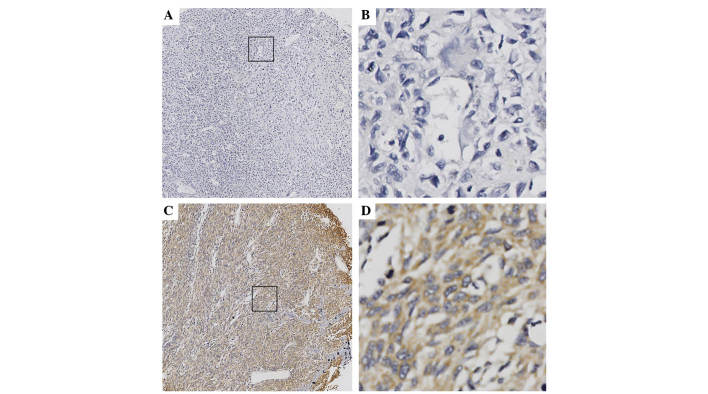
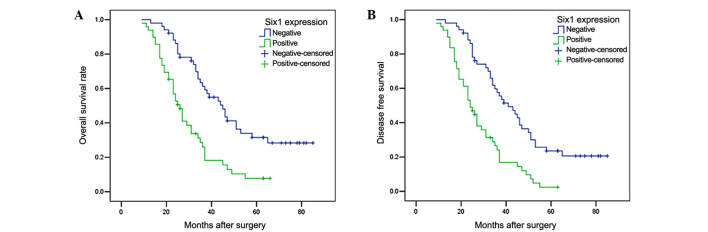
Sine oculis homeobox homolog 1 (Six1) is an evolutionarily conserved transcription factor that acts as master regulator of development and is frequently dysregulated in various types of cancer. Six1 has been demonstrated to be upregulated in human osteosarcoma cell lines compared with osteoblastic cell lines. However, the association of Six1 expression with the progression and prognosis of osteosarcoma patients remains unclear. The purpose of the present study was to investigate the association between Six1 expression and the clinicopathological characteristics and prognosis of osteosarcoma. Six1 protein was detected by immunohistochemistry in a series of 100 osteosarcoma patients, and Kaplan-Meier survival analysis was performed to assess prognosis. The results revealed that increased Six1 protein expression was prevalent in osteosarcoma and was significantly associated with Enneking stage (P=0.002) and tumor size (P=0.010). Additionally, according to the log-rank test and Cox regression model, expression of Six1 is indicated to be an independent prognostic factor in osteosarcoma patients. In summary, positive expression of Six1 protein is closely associated with the tumor progression and poor survival of osteosarcoma patients. The results suggest that Six1 is a overexpressed in individuals with poor prognosis, and may thus be used as a prognostic biomarker in patients with osteosarcoma.
眼无同源盒蛋白1(Six1)是一种在进化上保守的转录因子,它作为发育的主要调节因子,在各种类型的癌症中经常失调。与成骨细胞系相比,Six1已被证明在人骨肉瘤细胞系中上调。然而,Six1表达与骨肉瘤患者的进展和预后之间的关联仍不清楚。本研究的目的是探讨Six1表达与骨肉瘤的临床病理特征及预后之间的关系。通过免疫组织化学检测了100例骨肉瘤患者的Six1蛋白,并进行Kaplan-Meier生存分析以评估预后。结果显示,Six1蛋白表达增加在骨肉瘤中普遍存在,并且与Enneking分期(P=0.002)和肿瘤大小(P=0.010)显著相关。此外,根据对数秩检验和Cox回归模型,Six1的表达被认为是骨肉瘤患者的独立预后因素。总之,Six1蛋白的阳性表达与骨肉瘤患者的肿瘤进展和不良生存密切相关。结果表明,Six1在预后不良的个体中过度表达,因此可能用作骨肉瘤患者的预后生物标志物。