Jin Hongwei, Welzig Charles M, Aronovitz Mark, Noubary Farzad, Blanton Robert, Wang Bo, Rajab Mohammad, Albano Alfred, Link Mark S, Noujaim Sami F, Park Ho-Jin, Galper Jonas B
Tufts Medical Center, Tufts University School of Medicine, Boston, Massachusetts; Molecular Cardiology Research Institute, Tufts Medical Center, Boston, Massachusetts.
Tufts Medical Center, Tufts University School of Medicine, Boston, Massachusetts; Departments of Neurology, Physiology and Biomedical Engineering, Medical College of Wisconsin, Milwaukee, Wisconsin.
Heart Rhythm. 2017 Sep;14(9):1406-1416. doi: 10.1016/j.hrthm.2017.05.026. Epub 2017 May 15.
The incidence of sudden arrhythmic death is markedly increased in diabetics.
The purpose of this study was to develop a mouse model for postmyocardial infarction (post-MI) ventricular tachycardia (VT) in the diabetic heart and determine the mechanism of an antiarrhythmic effect of statins.
ECG transmitters were implanted in wild-type (WT), placebo, and pravastatin-treated type I diabetic Akita mice. MIs were induced by coronary ligation, and Ca transients were studied by optical mapping, and Ca transients and sparks in left ventricular myocytes (VM) by the Ionoptix system and confocal microscopy.
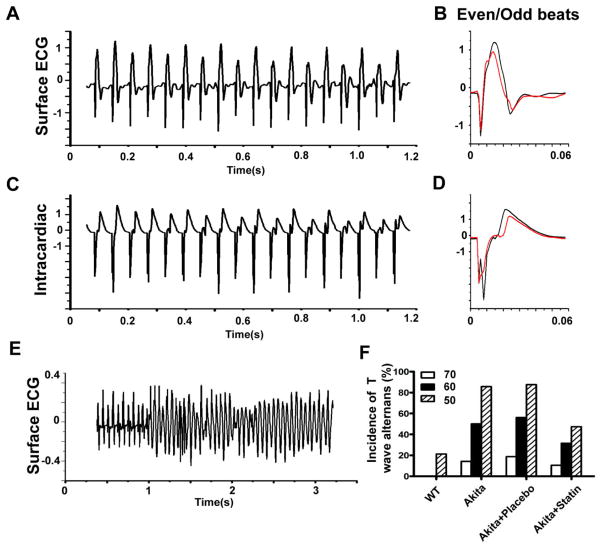
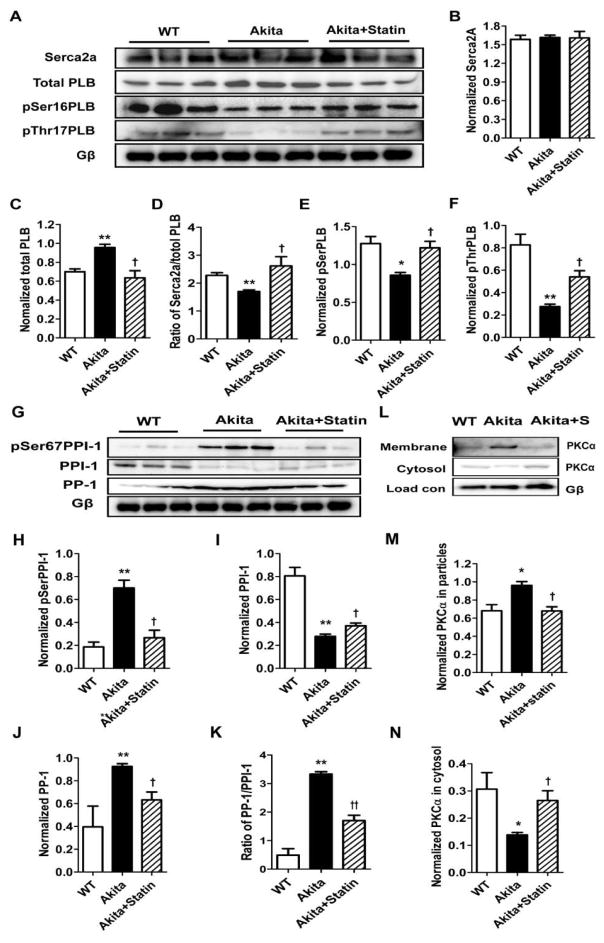
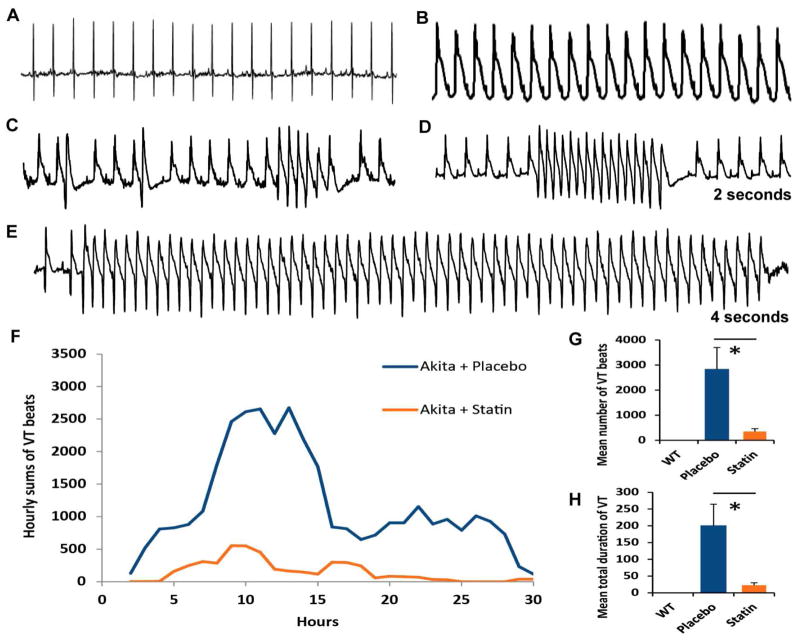
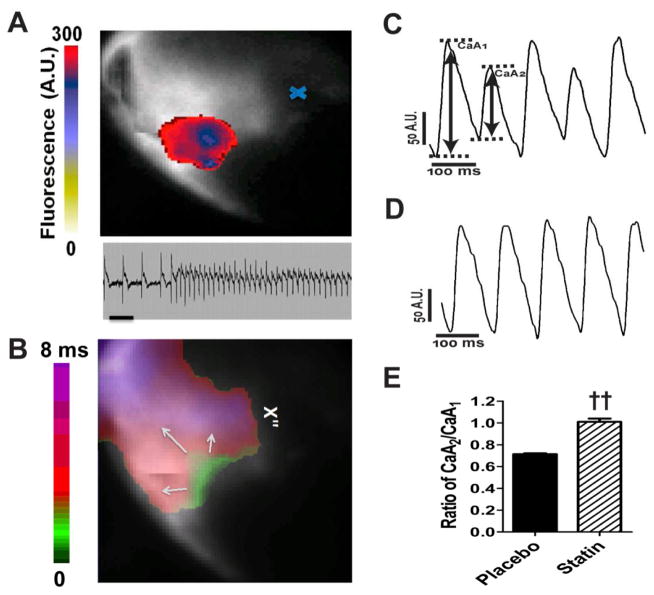
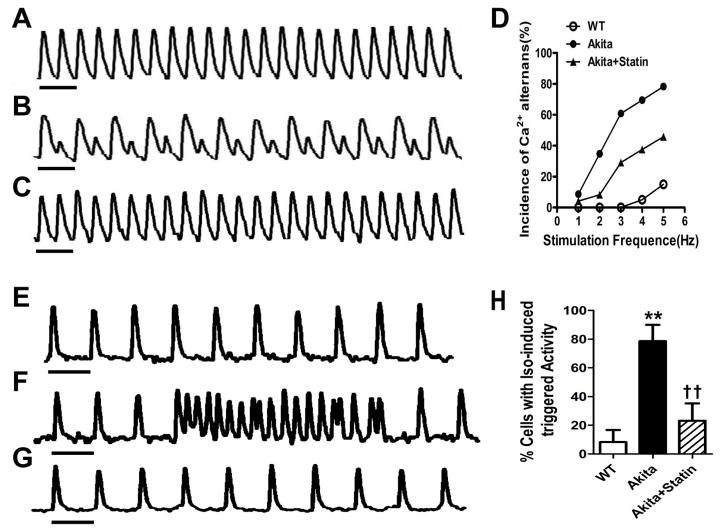
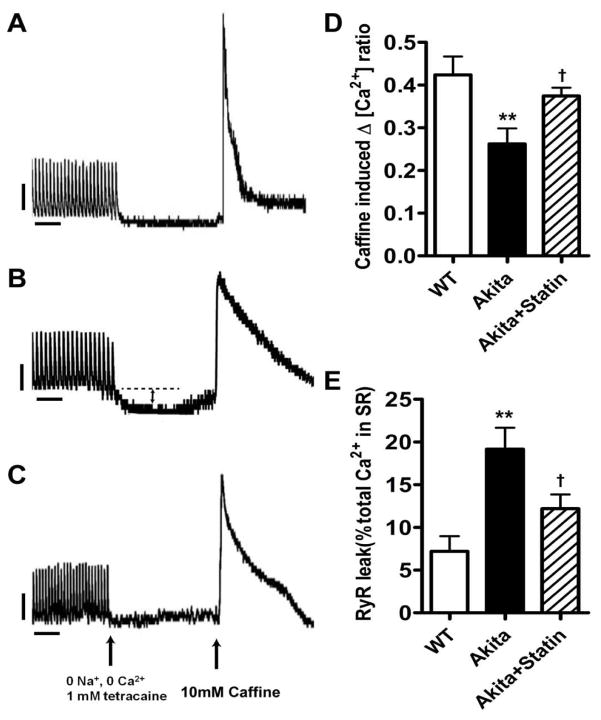
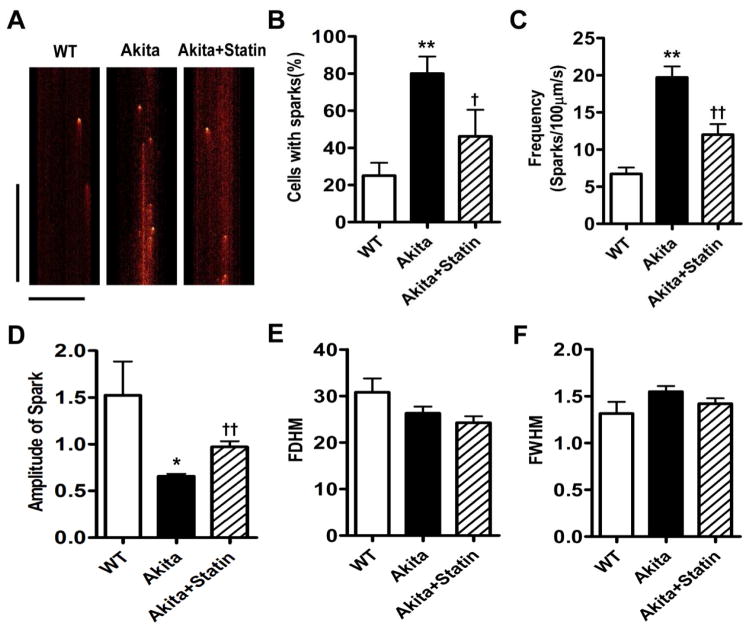
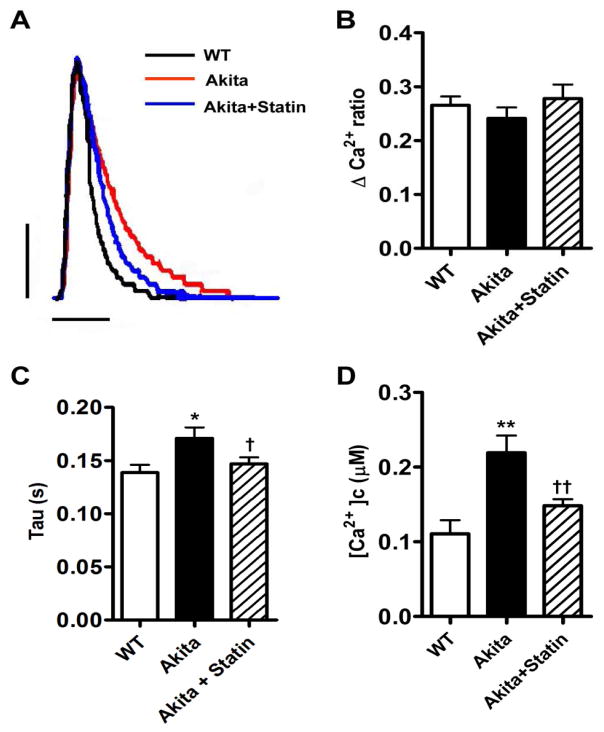
Burst pacing of Akita mouse hearts resulted in rate-related QRS/T-wave alternans, which was attenuated in pravastatin-treated mice. Post-MI Akita mice developed QRS/T-wave alternans and VT at 2820 ± 879 beats per mouse, which decreased to 343 ± 115 in pravastatin-treated mice (n = 13, P <.05). Optical mapping demonstrated pacing-induced VT originating in the peri-infarction zone and Ca alternans, both attenuated in hearts of statin-treated mice. Akita VM displayed Ca alternans, and triggered activity as well as increased Ca transient decay time (Tau), Ca sparks, and cytosolic Ca and decreased SR Ca stores all of which were in part reversed in cells from statin treated mice. Homogenates of Akita ventricles demonstrated decreased SERCA2a/PLB ratio and increased ratio of protein phosphatase (PP-1) to the PP-1 inhibitor PPI-1 which were reversed in homogenates of pravastatin-treated Akita mice.
Pravastatin decreased the incidence of post-MI VT and Ca alternans in Akita mouse hearts in part by revering abnormalities of Ca handling via the PP-1/PPI-1 pathway.
糖尿病患者心律失常性猝死的发生率显著增加。
本研究旨在建立糖尿病心脏心肌梗死后(post-MI)室性心动过速(VT)的小鼠模型,并确定他汀类药物抗心律失常作用的机制。
将心电图发射器植入野生型(WT)、安慰剂及普伐他汀治疗的I型糖尿病阿基塔小鼠体内。通过冠状动脉结扎诱导心肌梗死,利用光学标测研究钙瞬变,并通过Ionoptix系统和共聚焦显微镜研究左心室心肌细胞(VM)中的钙瞬变和钙火花。
阿基塔小鼠心脏的猝发起搏导致与心率相关的QRS/T波交替,在普伐他汀治疗组小鼠中这种交替减弱。心肌梗死后的阿基塔小鼠在每分钟2820±879次搏动时出现QRS/T波交替和室性心动过速,在普伐他汀治疗组小鼠中降至343±115次(n = 13,P <.05)。光学标测显示,起搏诱导的室性心动过速起源于梗死周边区以及钙交替,在他汀治疗组小鼠心脏中均减弱。阿基塔心肌细胞显示出钙交替、触发活动以及钙瞬变衰减时间(Tau)增加、钙火花、胞质钙增加和肌浆网钙储存减少,所有这些在他汀治疗组小鼠的细胞中部分得到逆转。阿基塔心室匀浆显示肌浆网钙ATP酶2a/受磷蛋白(SERCA2a/PLB)比值降低,蛋白磷酸酶(PP-1)与PP-1抑制剂PPI-1的比值增加,在普伐他汀治疗的阿基塔小鼠匀浆中这些情况得到逆转。
普伐他汀部分通过逆转PP-1/PPI-1途径的钙处理异常,降低了阿基塔小鼠心脏心肌梗死后室性心动过速和钙交替的发生率。