Kozlovskaia Maria, Vlahovich Nicole, Ashton Kevin J, Hughes David C
Faculty of Health Sciences and Medicine, Bond University, 14 University Drive, Robina, QLD, 4226, Australia.
Department of Sports Medicine, Australian Institute of Sport, 1 Leverrier Street, Bruce, ACT, 2617, Australia.
Sports Med Open. 2017 Dec;3(1):20. doi: 10.1186/s40798-017-0087-y. Epub 2017 May 18.
Achilles tendinopathy is the most prevalent tendon disorder in people engaged in running and jumping sports. Aetiology of Achilles tendinopathy is complex and requires comprehensive research of contributing risk factors. There is relatively little research focussing on potential biomedical risk factors for Achilles tendinopathy. The purpose of this systematic review is to identify studies and summarise current knowledge of biomedical risk factors of Achilles tendinopathy in physically active people.
Research databases were searched for relevant articles followed by assessment in accordance with PRISMA statement and standards of Cochrane collaboration. Levels of evidence and quality assessment designation were implemented in accordance with OCEBM levels of evidence and Newcastle-Ottawa Quality Assessment Scale, respectively.
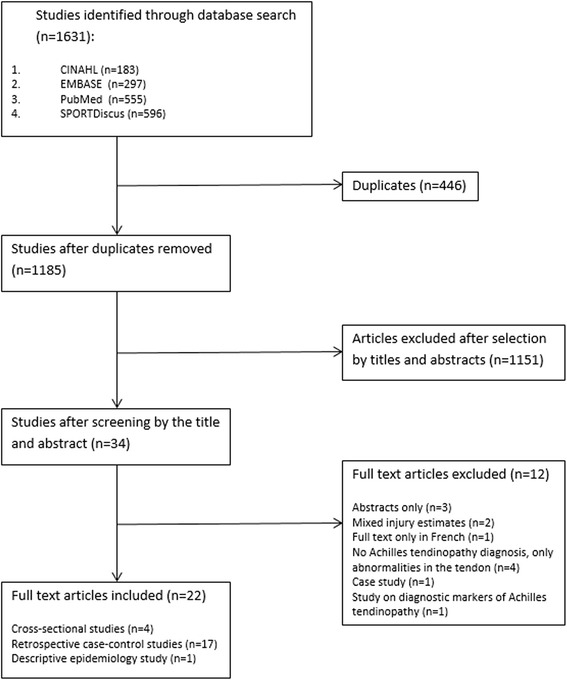
A systematic review of the literature identified 22 suitable articles. All included studies had moderate level of evidence (2b) with the Newcastle-Ottawa score varying between 6 and 9. The majority (17) investigated genetic polymorphisms involved in tendon structure and homeostasis and apoptosis and inflammation pathways. Overweight as a risk factor of Achilles tendinopathy was described in five included studies that investigated non-genetic factors. COL5A1 genetic variants were the most extensively studied, particularly in association with genetic variants in the genes involved in regulation of cell-matrix interaction in tendon and matrix homeostasis. It is important to investigate connections and pathways whose interactions might be disrupted and therefore alter collagen structure and lead to the development of pathology. Polymorphisms in genes involved in apoptosis and inflammation, and Achilles tendinopathy did not show strong association and, however, should be considered for further investigation.
This systematic review suggests that biomedical risk factors are an important consideration in the future study of propensity to the development of Achilles tendinopathy. The presence of certain medical comorbidities and genetic markers should be considered when contemplating the aetiology of Achilles tendinopathy. Further elucidation of biomedical risk factors will aid in the understanding of tendon pathology and patient risk, thereby informing prevention and management strategies for Achilles tendinopathy.
PROSPERO CRD42016036558.
跟腱病是从事跑跳运动人群中最常见的肌腱疾病。跟腱病的病因复杂,需要对相关危险因素进行全面研究。针对跟腱病潜在生物医学危险因素的研究相对较少。本系统评价的目的是识别相关研究,并总结身体活跃人群中跟腱病生物医学危险因素的现有知识。
检索研究数据库以查找相关文章,随后根据PRISMA声明和Cochrane协作网标准进行评估。证据水平和质量评估分别按照OCEBM证据水平和纽卡斯尔-渥太华质量评估量表执行。
对文献的系统评价确定了22篇合适的文章。所有纳入研究的证据水平均为中等(2b级),纽卡斯尔-渥太华评分在6至9分之间。大多数研究(17项)调查了参与肌腱结构、内稳态以及细胞凋亡和炎症途径的基因多态性。五项纳入研究在调查非遗传因素时描述了超重是跟腱病的一个危险因素。COL5A1基因变异是研究最为广泛的,尤其是与参与肌腱细胞-基质相互作用调节和基质内稳态的基因中的基因变异相关。研究那些相互作用可能被破坏从而改变胶原蛋白结构并导致病理发展的联系和途径很重要。参与细胞凋亡和炎症的基因多态性与跟腱病并未显示出强关联,不过仍应考虑进一步研究。
本系统评价表明,生物医学危险因素是未来跟腱病发病倾向研究中的一个重要考量因素。在考虑跟腱病的病因时,应考虑某些合并症和遗传标志物的存在。进一步阐明生物医学危险因素将有助于理解肌腱病理和患者风险,从而为跟腱病的预防和管理策略提供依据。
PROSPERO CRD42016036558