Scarfone Richard, Murray Ashlee, Gala Payal, Balamuth Fran
Division of Emergency Medicine, The Children's Hospital of Philadelphia, Philadelphia, PA; Department of Pediatrics, University of Pennsylvania School of Medicine, Philadelphia, PA.
Division of Emergency Medicine, The Children's Hospital of Philadelphia, Philadelphia, PA; Department of Pediatrics, University of Pennsylvania School of Medicine, Philadelphia, PA.
J Pediatr. 2017 Aug;187:200-205.e1. doi: 10.1016/j.jpeds.2017.04.003. Epub 2017 May 16.
To determine the incidence of bacterial meningitis (BM) among all febrile infants 29-56 days old undergoing a lumbar puncture (LP) in the emergency department of a tertiary care children's hospital and the number of low-risk febrile infants with BM to reassess the need for routine LP in these infants.
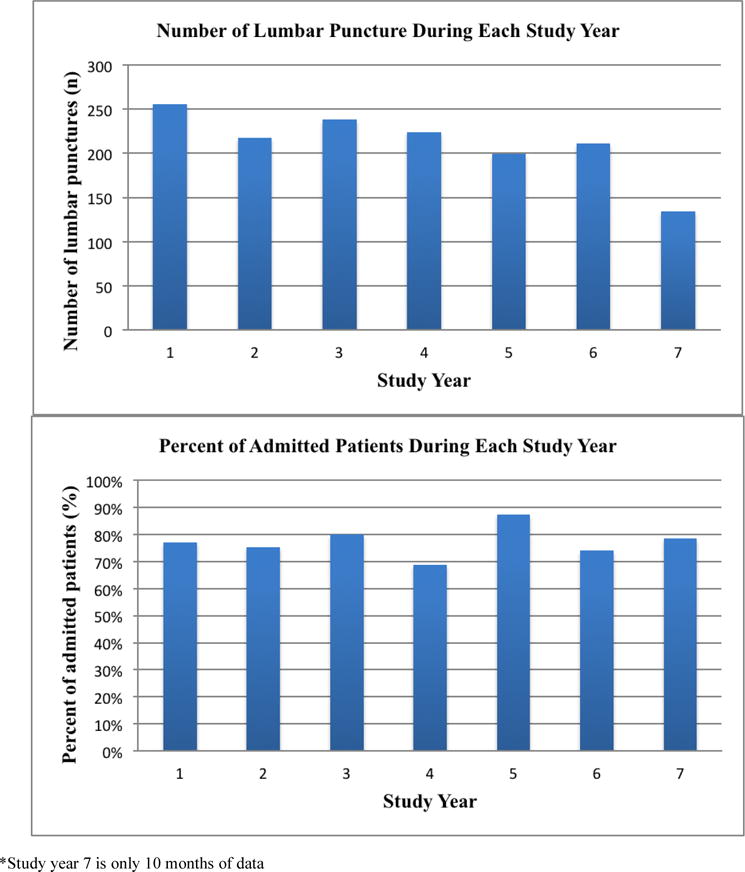
Retrospective cohort study using a quality improvement registry from July 2007-April 2014. Infants included were 29-56 days old with fever and who had an LP in the emergency department. Low-risk criteria were adapted from the Philadelphia criteria. BM was defined as having a bacterial pathogen isolated from the cerebrospinal fluid. A medical record review of one-third of randomly selected patients in the cohort determined the proportion who met low-risk criteria.
One of 1188 febrile infants (0.08%) had BM; this patient did not meet low-risk criteria. An additional 40 (3.4%) had positive cerebrospinal fluid cultures; all were contaminants. Subanalysis of one-third of the study population revealed that 45.6% met low-risk criteria; the most common reasons for failing low-risk classification included abnormal white blood cell count or urinalysis.
In a cohort of febrile infants, BM is uncommon and no cases of BM would have been missed had LPs not been performed in those meeting low-risk criteria.
确定在一家三级儿童专科医院急诊科接受腰椎穿刺(LP)的29至56日龄发热婴儿中细菌性脑膜炎(BM)的发病率,以及患有BM的低风险发热婴儿数量,以重新评估这些婴儿进行常规LP的必要性。
采用2007年7月至2014年4月质量改进登记册进行回顾性队列研究。纳入的婴儿为29至56日龄发热且在急诊科接受LP的婴儿。低风险标准采用费城标准。BM定义为脑脊液中分离出细菌病原体。对队列中三分之一随机选择的患者进行病历审查,以确定符合低风险标准的比例。
1188名发热婴儿中有1名(0.08%)患有BM;该患者不符合低风险标准。另外40名(3.4%)脑脊液培养呈阳性;均为污染物。对三分之一研究人群的亚分析显示,45.6%符合低风险标准;低风险分类未通过的最常见原因包括白细胞计数或尿液分析异常。
在发热婴儿队列中,BM并不常见,并且如果对符合低风险标准的婴儿不进行LP,不会漏诊任何BM病例。